The best children’s museum in Seoul costs nothing to enter. That is the good news. The complication is that you cannot simply turn up — there is no ticket desk, no queue you can join, and if you arrive without a booking on your phone you will be turned away at the door with your children watching. Here is how the system actually works, and where it catches people out.
We went with a five-year-old and a 21-month-old, which turns out to be almost the perfect test case for this place.
So why can’t you just walk in?
Because the Children’s Museum (어린이박물관) runs on timed sessions rather than open admission. Each session lasts 80 minutes, and there are five a day: 9:30–10:50, 11:00–12:20, 13:00–14:20, 14:30–15:50 and 16:00–17:20. Every session holds up to 320 people, which sounds enormous until you see the space and realise how much of it is designed to be climbed on.
Admission is free. Reservations are made online only — telephone booking is not accepted, and on-site ticketing does not exist. One more rule that catches families out: adults cannot enter without a child, and children cannot enter without an adult guardian. This is not a place you can leave the kids for an hour.
One warning before you plan around those times. The session timetable changed on 18 August 2026, and the museum extends its hours during the summer school holidays. The session we booked in mid-August started at 09:10, which no longer exists. Check the current timetable on the day you book rather than trusting a blog post — including this one.
How do you actually book it?
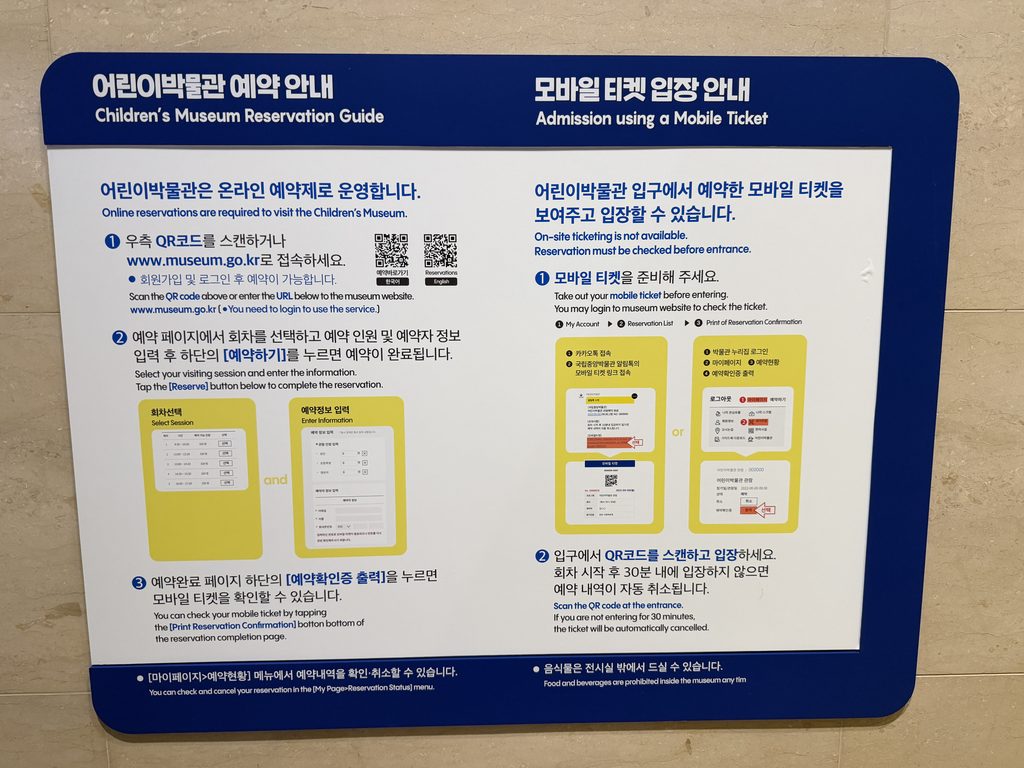
Reservations open at 00:00, exactly 14 days before your visit date, at museum.go.kr. You need an account and you need to be logged in first, which is the step most visitors underestimate — do it the night before you plan to book, not while you are staring at a countdown.
You choose a session, enter the number of visitors, and confirm. Up to five people per booking, one booking per day per account. Once it goes through you save the mobile ticket, and that is what gets scanned at the door.
There is also a useful back door. Bookings for a session stay open until 50 minutes after that session has already started, so a last-minute cancellation can put a slot back on the site while people are inside. If you are nearby and flexible, it is worth refreshing rather than giving up.
Two details that catch families out. First, children under 36 months also need their own reservation — they are not free-entry infants in the booking system. Second, the group system is completely different: groups of ten or more book from 90 days out and confirm 15 days ahead. If you find a Korean blog post talking about 90-day windows, that rule is not for you.
We did the midnight run. The date we wanted was a Saturday in mid-August that also happened to be a public holiday, so we opened the booking page exactly 14 days out and reserved the moment the clock turned. It took about a minute and there was no drama at all — we got the first session of the day, four tickets, first choice. The lesson is not that it’s easy; it’s that the two-week mark is the whole game. Book at 00:00 on the day it opens and you can pick your session. Try three days beforehand for a weekend and you’ll be taking whatever’s left.
The no-show rule: the one thing that can actually cost you
Everything about this museum is free and forgiving, except this.
The rule arrives on your phone the moment you book, so there is no pretending you didn’t read it. Three lines, and they are worth reading twice:
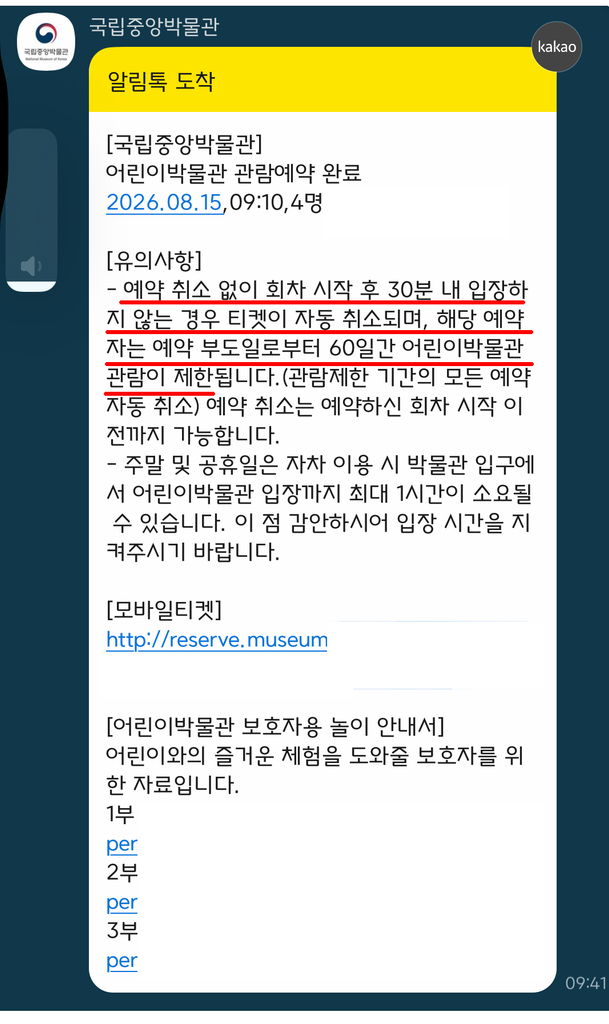
If you do not enter within 30 minutes of your session’s start time without cancelling, the ticket is cancelled automatically. That counts as a no-show, and a no-show blocks you from visiting the Children’s Museum for 60 days. Every reservation you already hold inside those 60 days is cancelled too.
Read that last part again, because it is the expensive one. If you have booked the Children’s Museum for a birthday next month and you miss a session tomorrow, the birthday booking disappears with it. Nobody phones to tell you.
The escape hatch is simple and free: cancel. You can cancel right up until the moment your session starts. It costs nothing, it carries no penalty, and the released slot goes straight back into the pool for someone else. The museum is not trying to punish you for having a bad morning with a toddler — it is trying to stop 320 people’s worth of free tickets from sitting empty.
So the practical rule for families is this: the second you know you’re not going to make it, cancel from your phone. Do it in the taxi. Do it while you’re still arguing about shoes.
If you’re driving, take the first session or don’t drive at all
The booking confirmation carries a warning that appears nowhere on the website, and it is blunt: on weekends and public holidays, allow up to one hour from the moment your car reaches the museum entrance to the moment you walk into the Children’s Museum.
An hour. Between the car park queue, the walk across the plaza, the lockers and the stroller, a family that left home “with plenty of time” can burn through the 30-minute grace period entirely — and then lose sixty days of booking rights along with it.
Here is the workaround, and it is the single most useful thing we learned all day. We drove on a Saturday that was also a national holiday, which should have been the worst possible combination, and the car park was close to empty. Because we had the first session of the morning. We were parked and walking before the crowds arrived.
By late morning that car park is full. Not busy — full. If your session is anything other than the first of the day, assume you will not find a space, and take the subway or a bus instead. The museum is not going to conjure parking for you, and the no-show clock does not care that you spent forty minutes circling.
So: first session, drive if you like. Any other session, don’t.
Is your child actually the right age for it?
This is the question I would want answered before booking, and the museum is unusually honest about it. The main exhibition hall is designed for ages five to nine. Below five you are welcome, but the official guidance asks for close adult supervision — which in practice means one adult per small child, not one adult per group.
There is, however, a separate room for the very youngest: Degul Degul Playground (데굴데굴놀이터), a sensory space reserved for children 36 months and under. Staff do check. We arrived with exactly that split — one child at five, right at the bottom edge of the main hall’s target range, and one at 21 months, comfortably inside the toddler room’s limit. So we did the thing the museum quietly assumes you will do: two adults, two children, and we separated for most of the session. One parent in the main hall keeping up with a five-year-old who wanted to touch everything, one parent on the floor of the toddler room. We swapped once, near the end.
If that sounds like less of a family outing than you had in mind, it is worth knowing in advance. It also worked far better than trying to keep both children in the same room, which we attempted for the first ten minutes and abandoned.
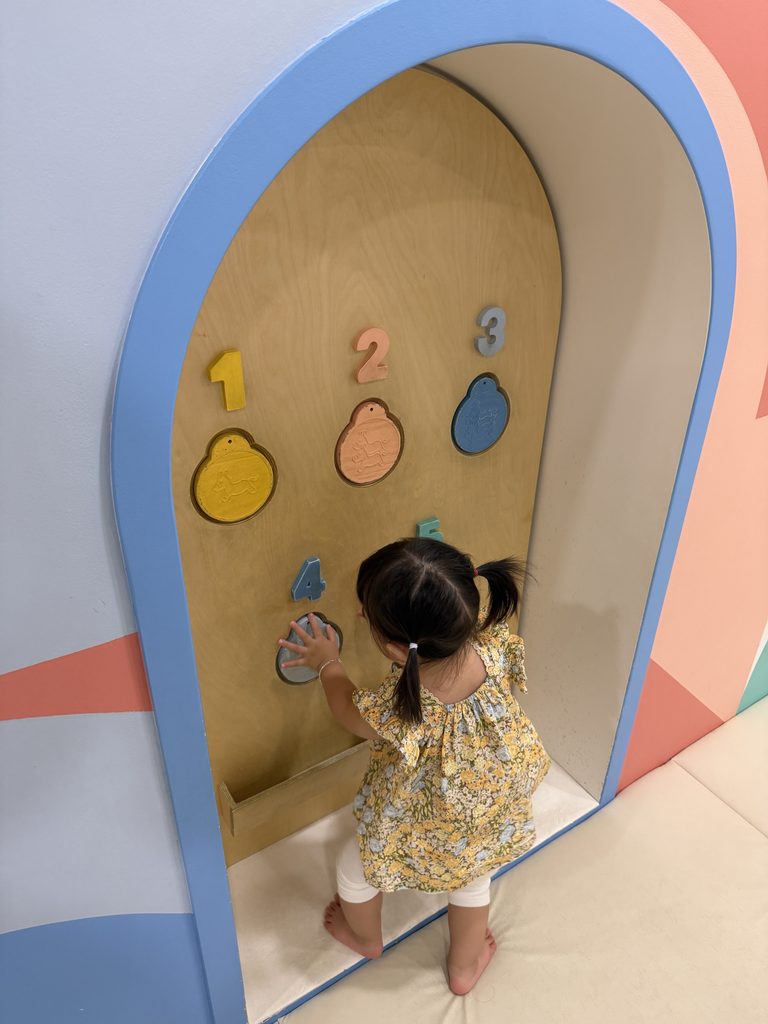
What is actually inside?
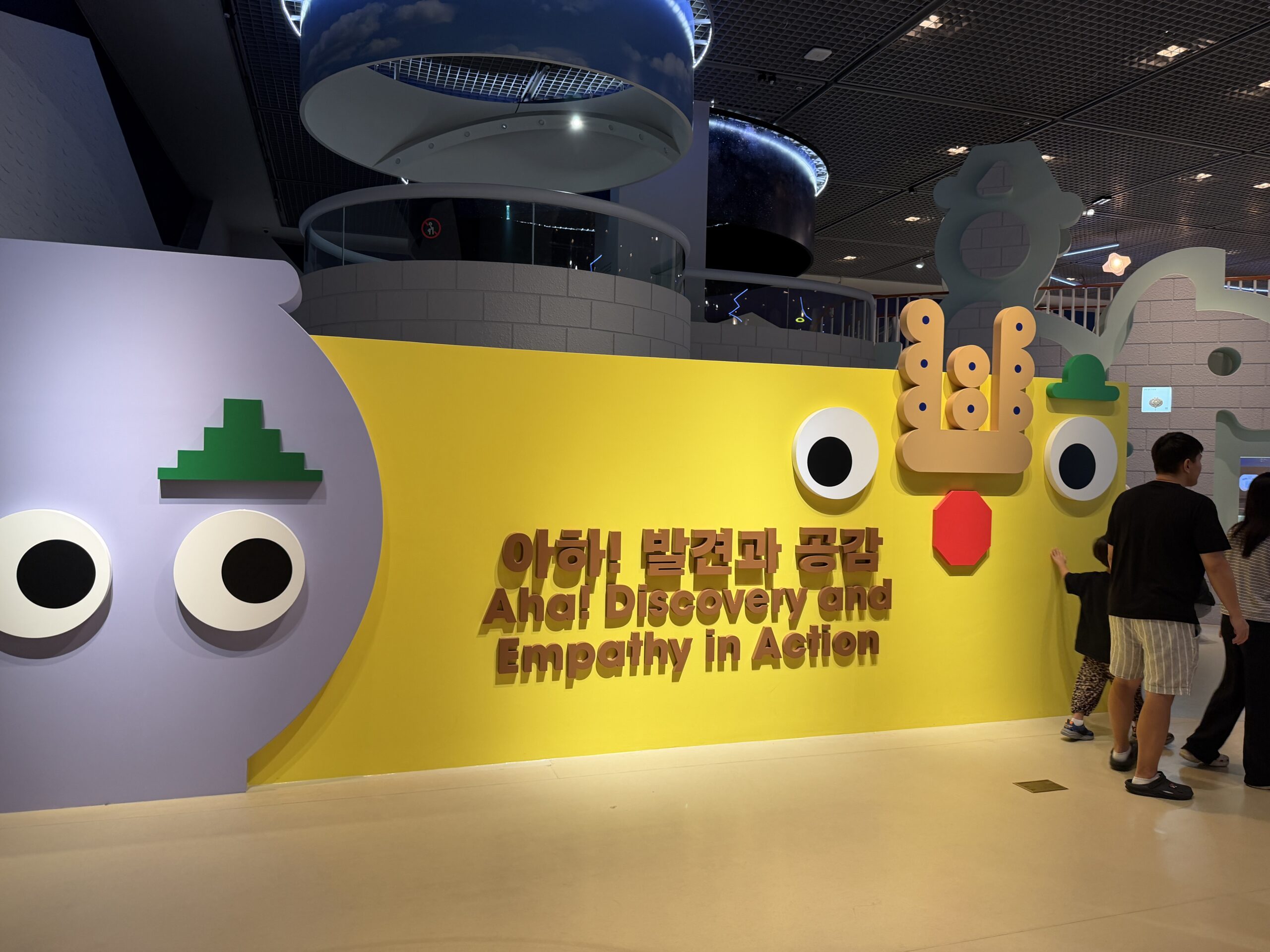
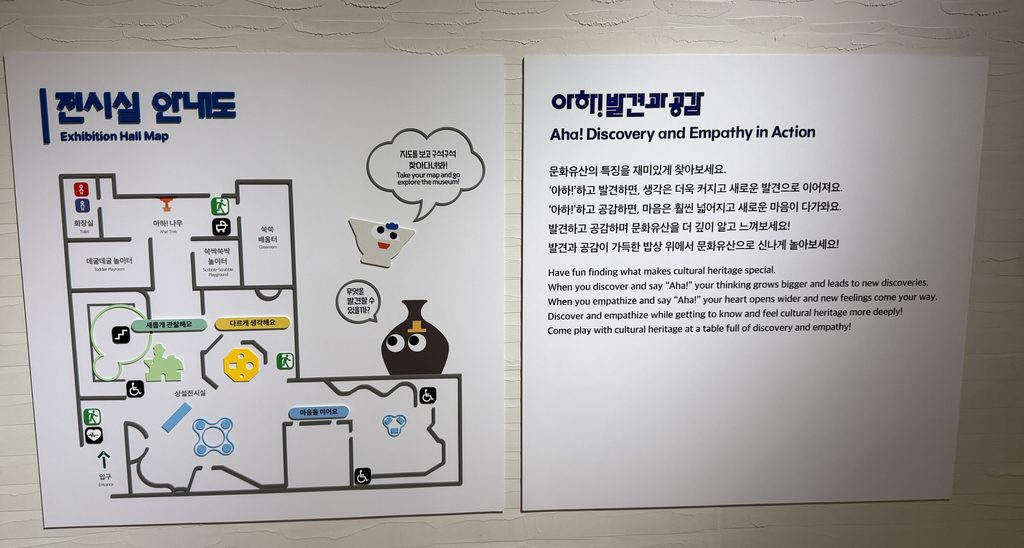
The permanent exhibition is called Aha! Discovery and Empathy in Action (아하! 발견과 공감), and it is built around three ideas rather than three collections: observing things freshly, thinking about them differently, and connecting what you feel to what you see. In practice your child will not notice the structure at all. They will notice that almost everything can be touched.
There is a map on the wall as you go in, and it is worth thirty seconds of your time before you release the children into the room.
What did the kids refuse to leave?
Here is the honest ranking, which had almost nothing to do with what I expected.
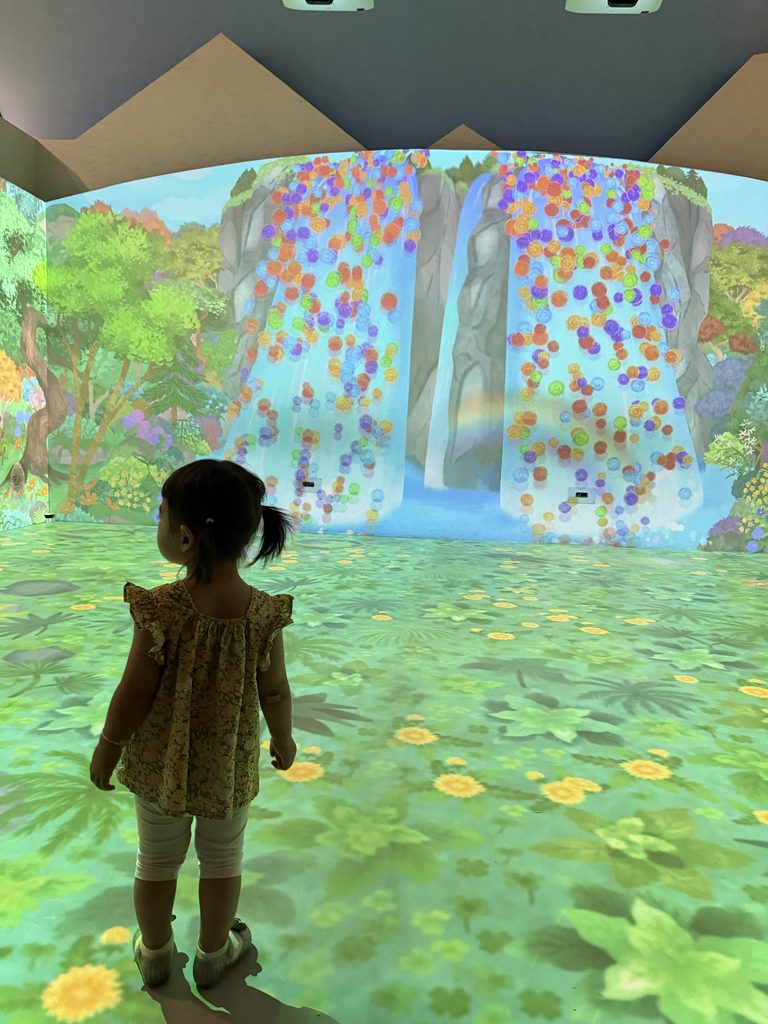
The projection room won outright. One wall becomes a waterfall, the floor becomes a meadow, and the flowers scatter when you walk through them. Our 21-month-old planted herself in the middle of it and just watched, not touching anything, for longer than she has ever watched anything at home — which, if you have a child that age, you will recognise as an extraordinary event.
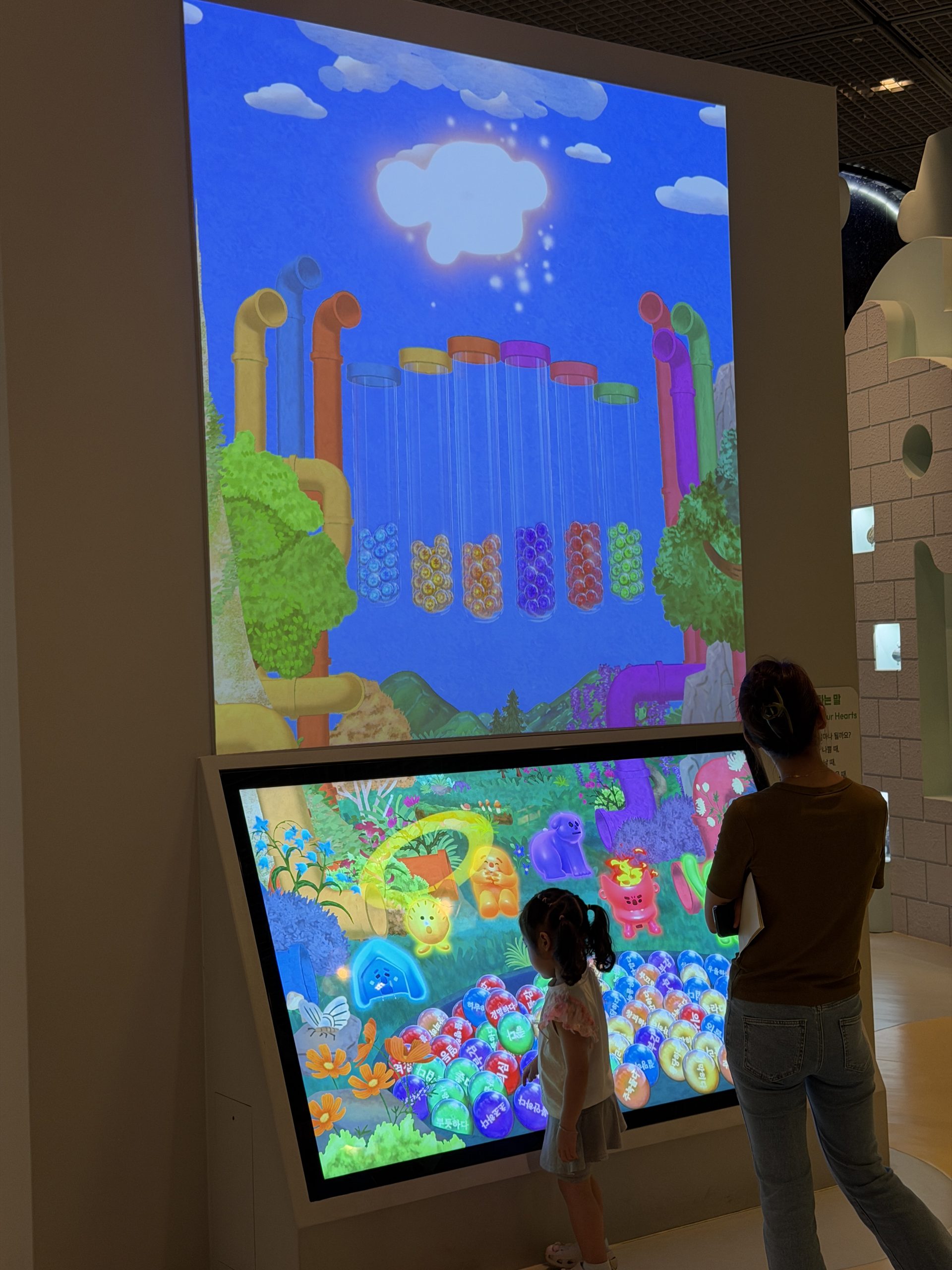
Second was the big touchscreen wall, the one where you drag things around and they respond. There is a small queue for it during busy sessions, and the museum has done the sensible thing of setting the screen low enough that a three-year-old can reach the interesting parts.
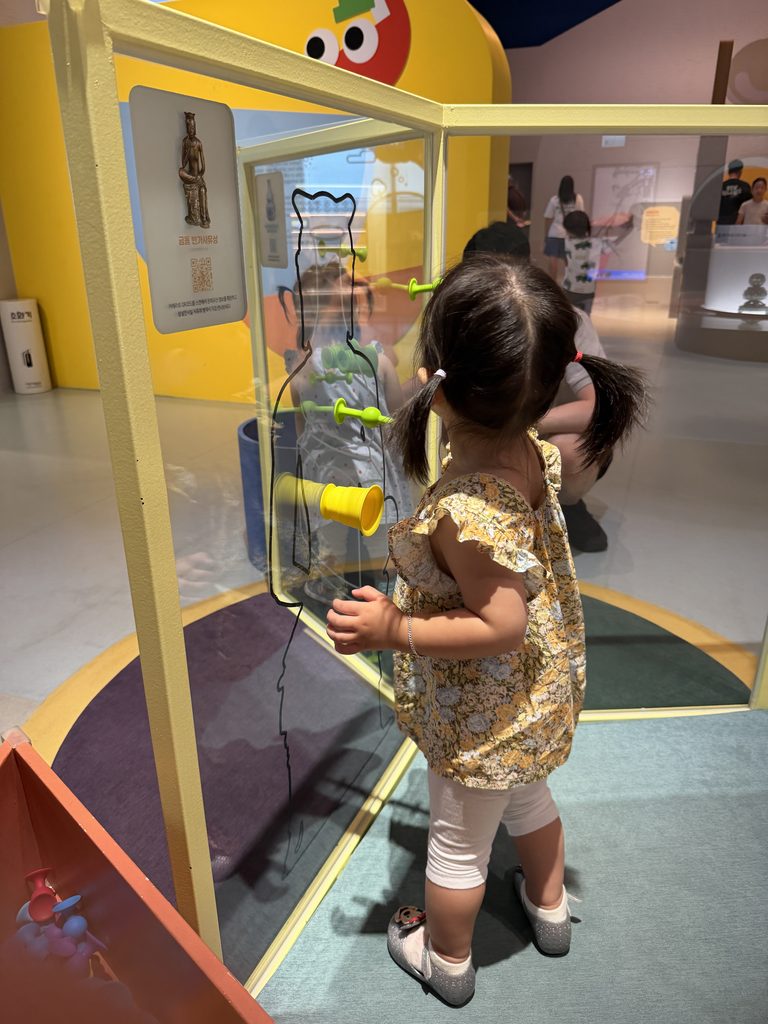
Third — and this surprised me — was a plain transparent panel with suction pieces you move around, sitting inside a glass case beside a photo of a Buddhist figurine. No screen, no sound, no lights.
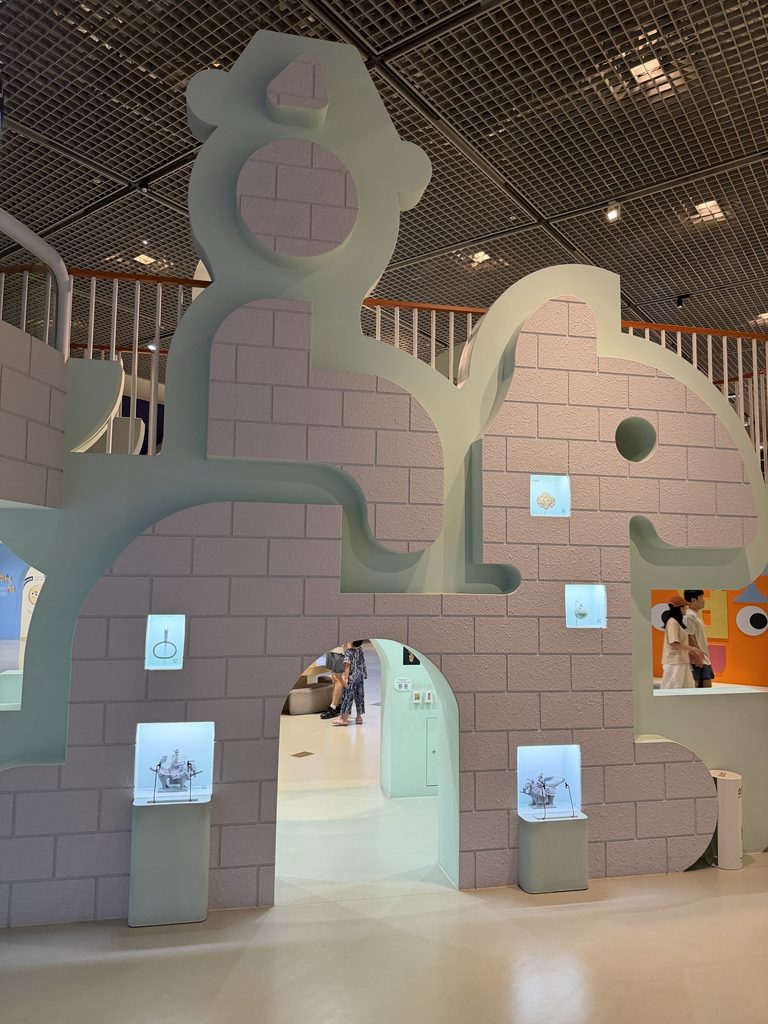
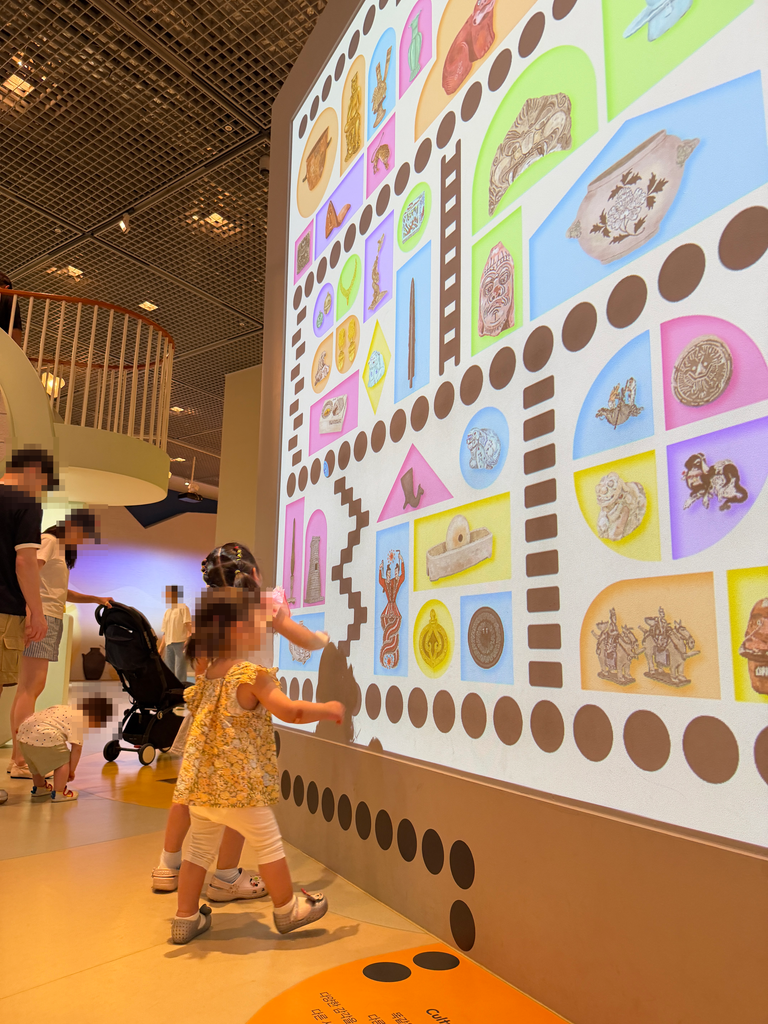
And the artefact wall is the one photograph everybody takes. It looks like a printed mural until you get close and realise the whole surface is a projection — a giant illustrated catalogue of the collection, thrown onto the wall in blocks of colour, reacting when small hands reach for it. Crowns, celadon, roof tiles, coins, gilt-bronze figures. This is also the only place where the museum quietly admits what it is doing: teaching children the shapes of the collection they will meet properly upstairs.
Strollers, lockers, and the bag problem
You will arrive with more equipment than you intend to carry, so deal with it before you go in.
There is stroller parking in the waiting area outside the exhibition hall, but you can also take the stroller inside with you — the floor is flat and there is more room in there than the entrance suggests. With a baby who might nap, that matters. Take the rain cover and anything valuable with you either way.
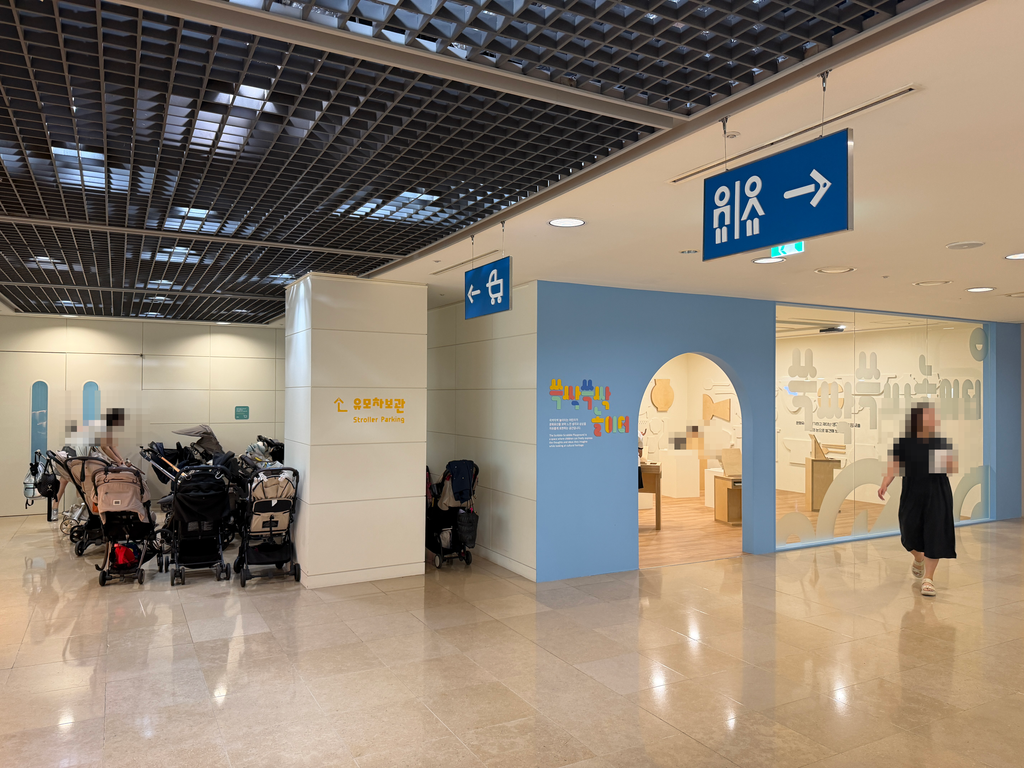
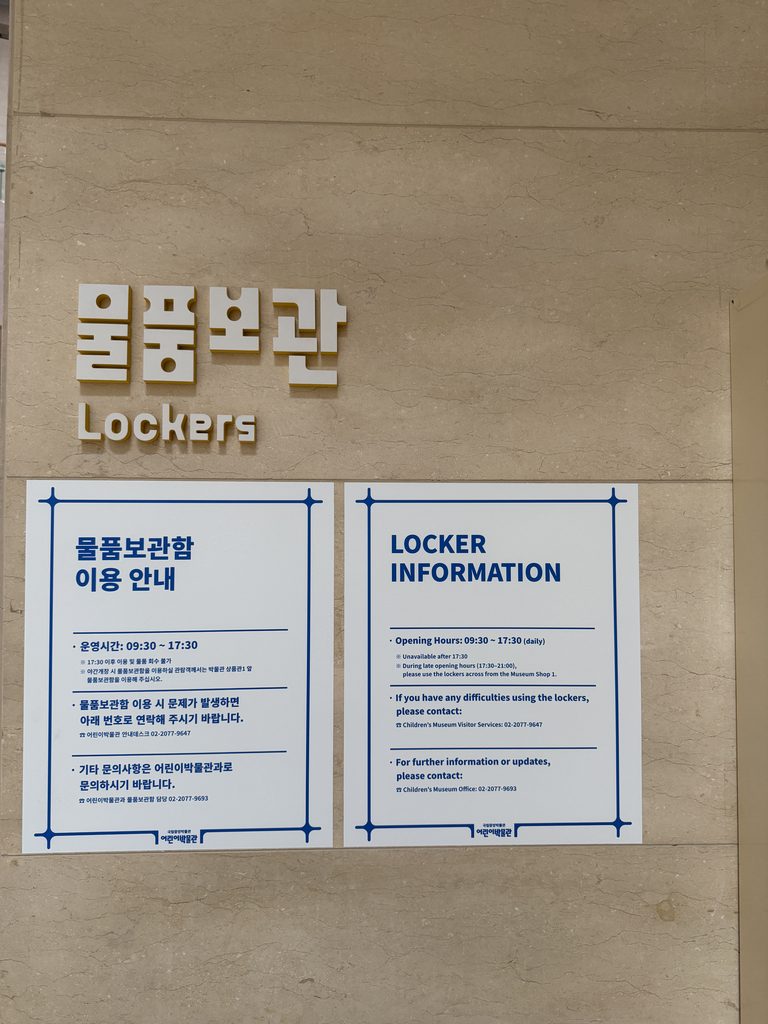
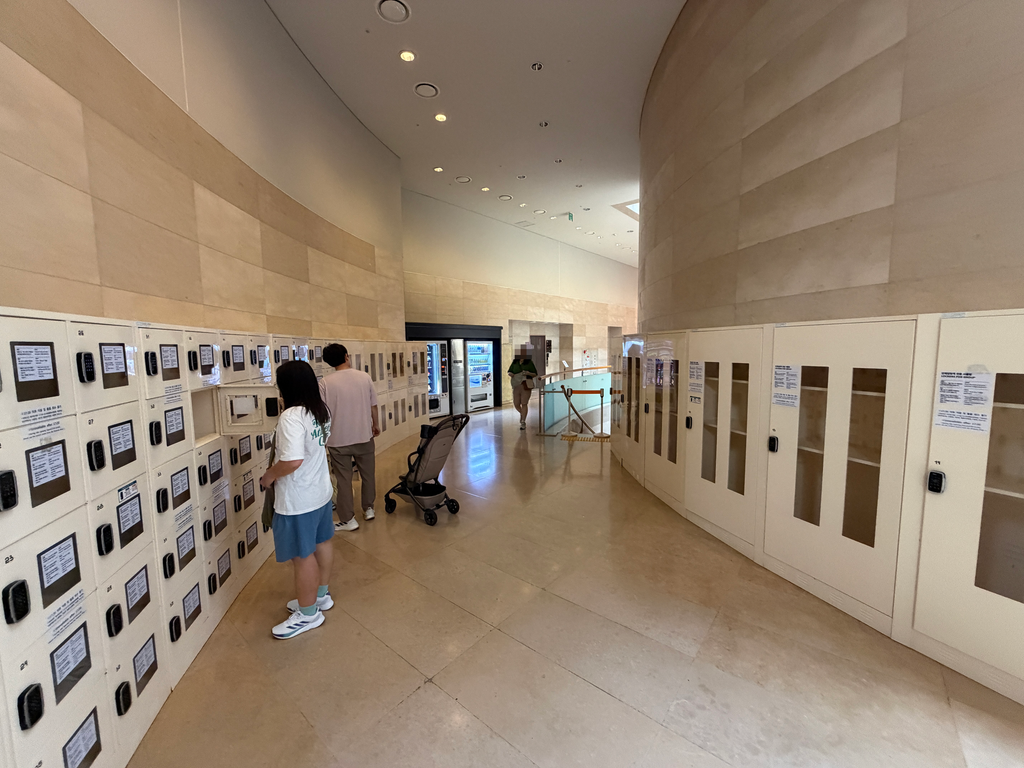
Lockers are in the same waiting area and are free, with two conditions: they operate from 09:30 to 17:30, and only for the duration of your own 80-minute session. If you are heading up to the main museum afterwards, empty the locker first. After 17:30 you use the lockers opposite Museum Shop 1 instead.
No food or drink inside the exhibition hall, at any time. Feed everyone beforehand. Eighty minutes is short enough to survive, and long enough that a hungry four-year-old will make it feel otherwise.
Photography is allowed inside, which is not true of every children’s museum in Seoul. Tripods, flash and commercial shoots are not.
Is 80 minutes enough?
It depends entirely on which of your children you ask.
Our 21-month-old was slowing down at around the hour mark and was done well before staff started clearing the room. For a toddler, 80 minutes is generous.
Our five-year-old was not finished. At five you are at the very bottom of the target range, which turns out to be the sweet spot — old enough to read the pictures and follow the prompts, young enough to be delighted by all of it. She would have stayed another hour. We skipped roughly a third of the hall.
Since it’s free, a second visit is a reasonable answer. Just remember the one-booking-per-day rule, and that same-day re-entry is not how the system works.
What do you do when your session ends?
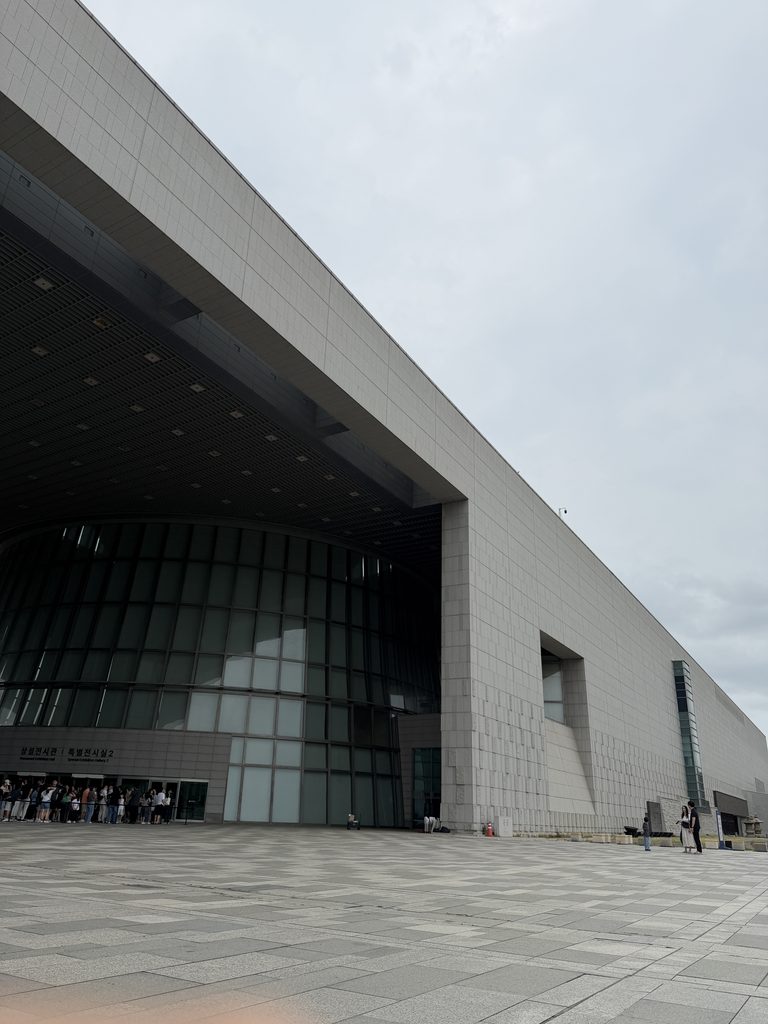
Walk upstairs. This is the point most visitors miss: the Children’s Museum sits inside the National Museum of Korea, and the main permanent galleries are also free. Three floors, everything from Goguryeo tomb paintings to celadon, in the same building your child just spent an hour looking at cartoon versions of.
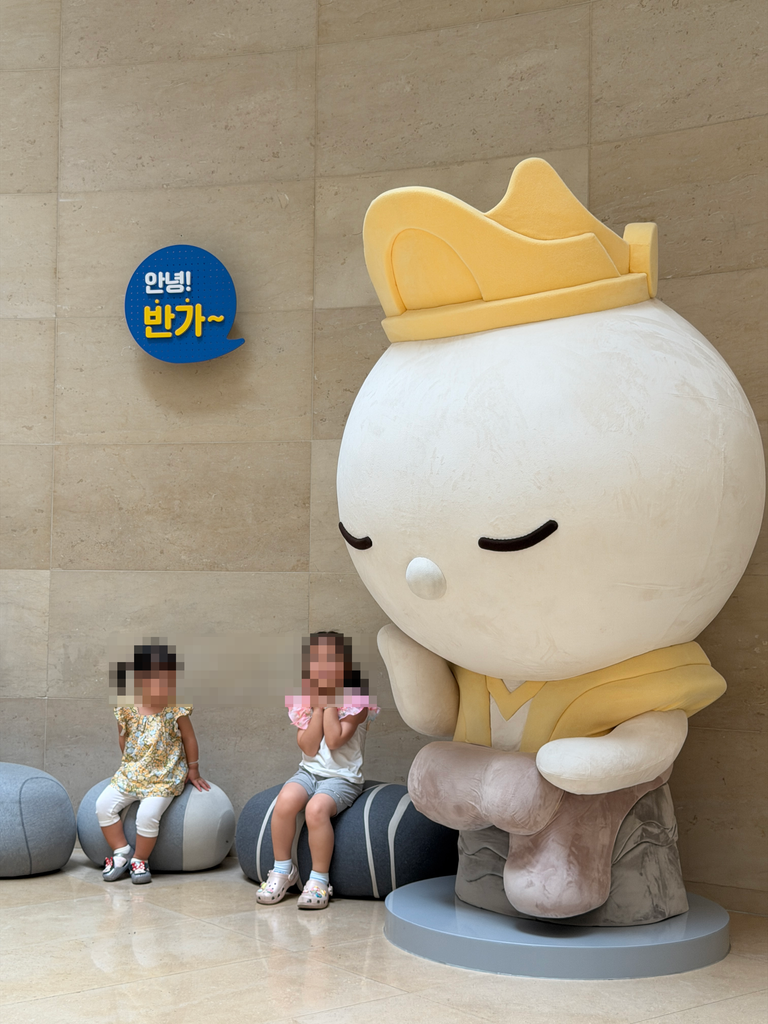
You will also meet the museum’s mascot, a soft, enormous version of the Pensive Bodhisattva that sits in the lobby and is, for reasons I cannot explain, more popular with children than anything on display.
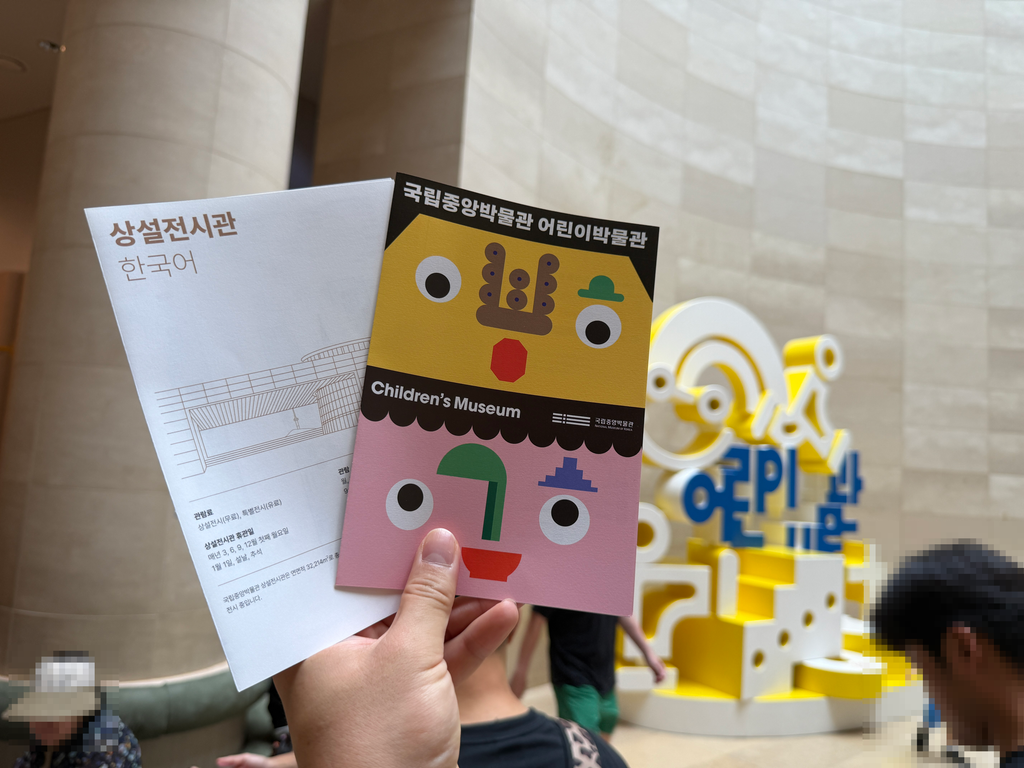
Pick up the leaflets on your way in. There is a guide to the permanent galleries and a separate Children’s Museum leaflet, and the second one has a floor plan that survives being folded into a pocket.
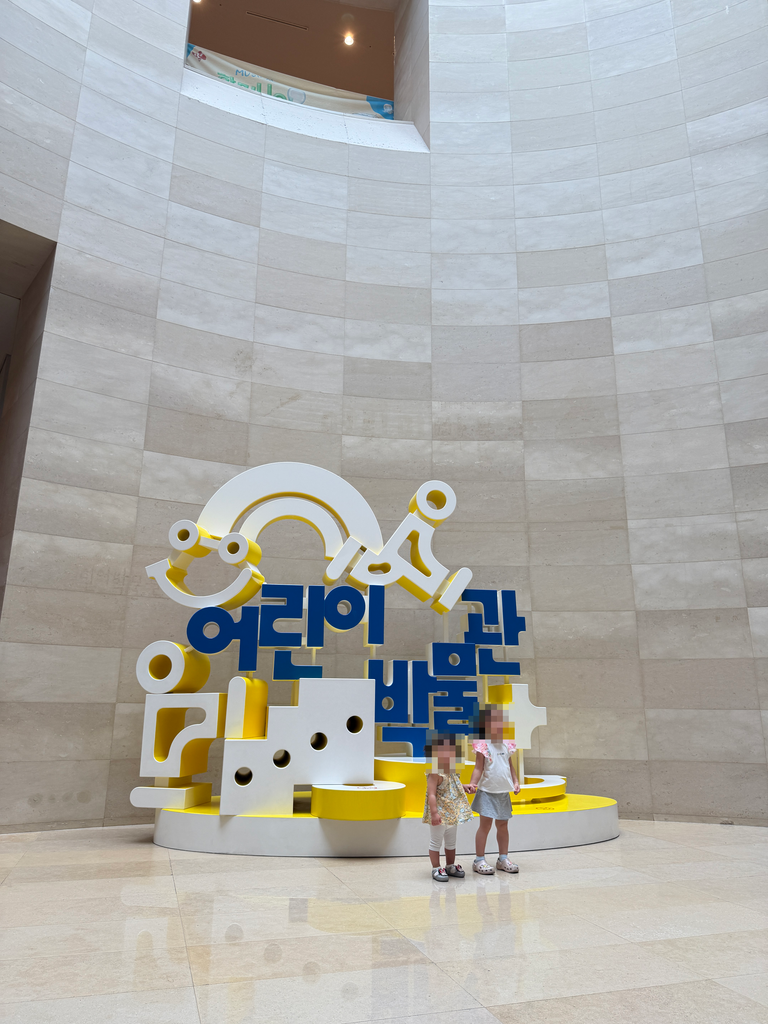
Getting there without carrying a stroller up stairs
Unless you have the first session, this is the way in. Take Line 4 or the Gyeongui-Jungang Line to Ichon Station (이촌역). Do not go up to street level. Head for the Exit 2 side and follow the underground passage marked Museum Nadeulgil (박물관 나들길) — signed for the National Museum of Korea, Theater Yong and the National Hangeul Museum, step-free, with moving walkways. It comes out at the museum plaza.
If you exit at street level instead you will still get there, but you will do it in the sun with a stroller and a set of steps.
Practical notes
Admission to both the Children’s Museum and the main permanent galleries is free; only special exhibitions are ticketed. The Children’s Museum runs 09:30–17:20, session-based, Monday to Sunday.
The main museum opens 09:30–17:30 on Monday, Tuesday, Thursday, Friday and Sunday, and 09:30–21:00 on Wednesday and Saturday. The Children’s Museum does not follow the extended evening hours — its last session still ends at 17:20, so a Wednesday evening at the museum is an adults-and-older-children plan.
Closed in 2026 on 1 January, Lunar New Year (17 February) and Chuseok (25 September). The Children’s Museum has extra closure days on 1 June, 7 September and 7 December, all Mondays. The main permanent galleries close on the first Monday of March, June, September and December, so a first-Monday visit is the one to avoid entirely.
For anything time-sensitive — session changes, temporary closures, holiday hours — the official Children’s Museum page is the only source I would trust, and it exists in English: National Museum of Korea Children’s Museum. Enquiries: 02-2077-9647.
Looking for something free and outdoors instead? The Gyeongchun Line Forest Trail needs no booking at all. And if you want the opposite end of the scale, we’ve also written about Lotte World with kids, which costs real money and involves no reservation system whatsoever.
FAQ
Is the National Museum of Korea Children’s Museum free?
Yes, entirely. But it is reservation-only and there is no on-site ticketing, so free does not mean walk-in.
How far in advance should I book?
Bookings open at 00:00, exactly 14 days before your visit date, and for a weekend or holiday session that midnight window is genuinely the difference between choosing your time and taking leftovers. We booked a Saturday public-holiday session the minute it opened and got first choice in under a minute. Slots also stay bookable until 50 minutes after a session has started, so last-minute cancellations do reappear if you’re flexible.
What age is it for?
The main hall is designed for ages five to nine. Younger children are welcome with close supervision, and there is a separate sensory playground for children 36 months and under. Children under 36 months still need their own reservation.
Can I go without a child?
No. Adults unaccompanied by a child are not admitted, and children must be with an adult guardian.
What if we’re running late?
You have a 30-minute grace period from the session start time. Miss it without cancelling and your ticket is voided automatically — and the museum blocks your account from booking for 60 days, cancelling any future reservations you already hold. Cancelling is free right up to the start time, so cancel rather than gamble.
Can we drive there?
Only if you have the first session of the day. We parked easily at 9am on a Saturday that was also a national holiday — but by late morning the car park is full, and the booking confirmation itself warns that on weekends and holidays it can take up to an hour from the car park to the museum entrance. Given the 30-minute no-show cutoff, any session after the first one is a subway trip.
Can I take photos inside?
Yes. Tripods, flash and commercial photography are not permitted.
How long should we allow in total?
The session is 80 minutes. Add 30 minutes for lockers, strollers and the walk from Ichon Station, and at least another hour if you’re going up into the main museum afterwards — which you should.
1 thought on “National Museum of Korea Children’s Museum: Free, But You Can’t Just Walk In”