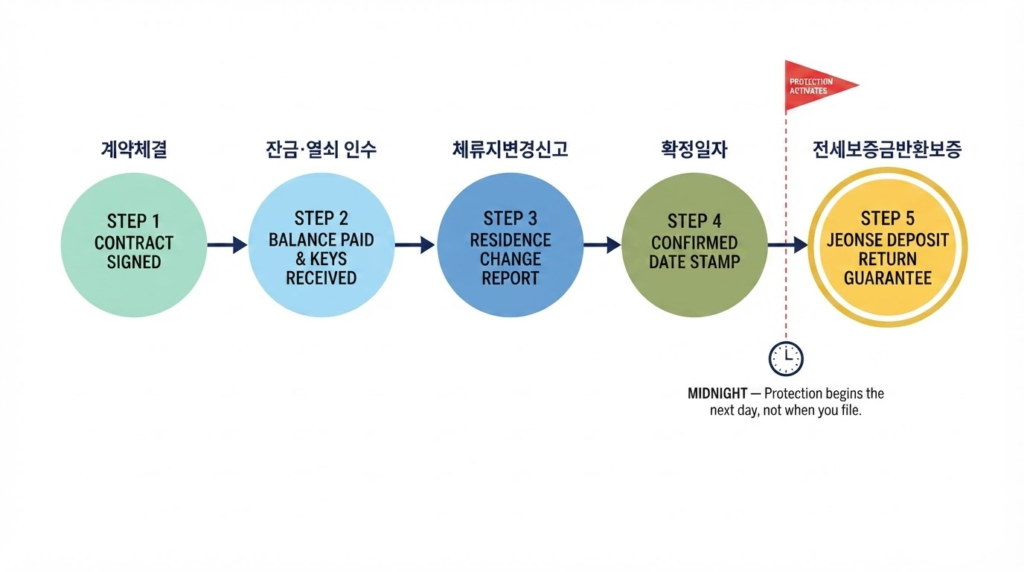
Jeonse deposit protection in Korea does not begin when you sign the lease, and it does not begin when you hand over the money. It begins at midnight after you have done two specific things, in a specific order. Miss the order and your deposit — often 300 million won or more for jeonse, 10 to 20 million won for a wolse contract — sits behind whoever registered a claim on that property first.
Here is the whole thing in one table.
| What you do | When | What it gives you |
|---|---|---|
| Take possession + file your residence change report | Move-in day, within 15 days | 대항력 (right to stay) — from 00:00 the next day |
| Get a confirmed date stamped on your lease | Same visit, if possible | 우선변제권 (priority repayment) |
| Apply for a deposit-return guarantee | Before half the lease term elapses | Contractual payout if the landlord defaults |
The two rights behind jeonse deposit protection
Korean law gives a residential tenant two separate protections, and most foreign tenants only ever hear about one of them.
대항력 (daehangryeok), the right to stay. Under Article 3(1) of the Housing Lease Protection Act, once you have actually taken possession of the home and completed your residence registration, your lease becomes effective against third parties from 00:00 on the following day. If the property is sold, the buyer steps into the landlord’s shoes and inherits the obligation to return your deposit. Without 대항력, a new owner can simply tell you to leave.
우선변제권 (useon byeonjaegwon), priority repayment. Article 3-2 of the same Act. If the property goes to auction, you can be paid out of the proceeds ahead of later-registered claims — but only if your lease carries a 확정일자 (confirmed date). The confirmed date is what fixes your place in the queue. Possession and registration alone do not create it.
You need both. 대항력 lets you stay; 우선변제권 gets your money back if the building is sold at auction. One without the other is half a defence.
How jeonse deposit protection works for foreign nationals
You cannot file a Korean resident registration (주민등록). That does not exclude you.
Article 88-2(2) of the Immigration Act provides that a foreign national’s alien registration and report of change of residence has the same effect as resident registration. The Supreme Court settled the point in case 2015Da14136 (13 October 2016): an alien registration or residence-change report satisfies the residence-registration requirement in Article 3(1) of the Housing Lease Protection Act, so a foreign tenant acquires 대항력 on exactly the same terms as a Korean tenant.
The same decision added something practically useful. The registration does not have to be in the tenant’s own name — a filing by the tenant’s spouse or children who live in the home also satisfies the requirement. If your own alien registration is delayed by a visa process, a family member’s filing can carry the date.
If you hold an F-4 (Overseas Korean) visa, you are a foreign national of Korean descent, and the instrument you file is the domestic residence report (국내거소신고) rather than an alien registration. The 2016 decision above covers you directly — it addressed foreign nationals and foreign-national Koreans together. Watch the deadline, though: a change of domestic residence must be reported within 14 days under Article 6(2) of the Overseas Koreans Act, whereas an alien registration holder has 15 days under Article 36(1) of the Immigration Act. It is a one-day difference that is easy to miss.
A separate line of cases covers overseas Koreans who kept their Korean nationality (재외국민) — people holding foreign permanent residency but still Korean citizens. They fall outside the Immigration Act, and until 2015 they could not register at all. In 2015Da254507 (11 April 2019) the Supreme Court applied Article 88-2(2) by analogy so that their domestic residence report also establishes 대항력.
Filing the residence change report
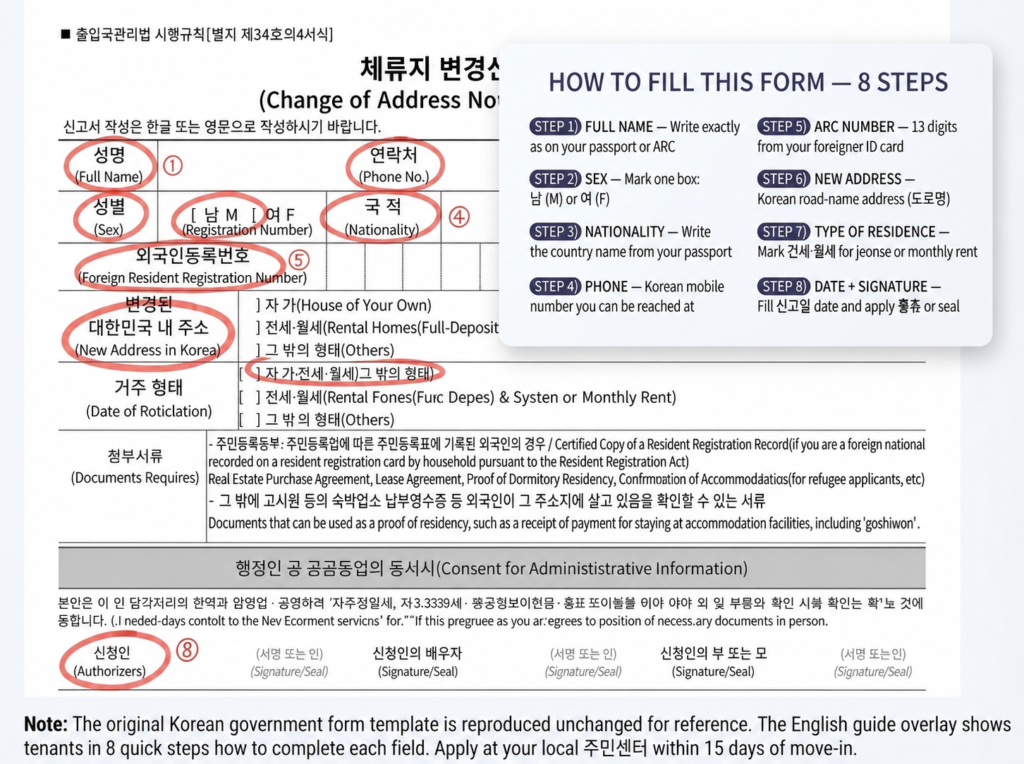
This is the step that actually creates your protection, so treat it as part of the move, not paperwork for later.
Deadline: 15 days from the day you move in (Immigration Act Article 36(1)). Filing on the day you receive the keys is better — every day you wait is a day someone else can register a mortgage ahead of you.
Where: an immigration office, your city or district office, or your local community centre (주민센터). There is no fee.
What to bring: your passport or alien registration card, and proof of your new address — the lease agreement, an accommodation confirmation, a utility bill, or a dormitory receipt. The application form (별지 제34호) is filled in at the counter; you do not need to prepare it in advance.
Online: you can file through HiKorea (hikorea.go.kr), with processing of roughly three working days. Two limits matter. First, the online route closes once the 15-day window has passed — after that you must appear in person. Second, only the registrant can file online for themselves; a representative cannot, with one exception: a head of household on an F-3 can file for themselves and their dependents together.
If you are late: the Immigration Act’s penalty provisions allow a fine of up to 1,000,000 won, and the amount scales with the length of the delay.
The midnight gap
Your ‘대항력’ takes effect at 00:00 on the day after you file. Not at the moment of filing.
So there is a window — the afternoon you pay the balance and file, up to midnight — in which a mortgage registered on the property still outranks you. This is not a theoretical loophole; it is how a recognisable pattern of deposit fraud works.
Two things reduce the exposure. Ask for a special clause in the lease stating that the landlord will not create any new mortgage, lien or other encumbrance on the property between the balance payment and the day after your filing, and that breach entitles you to terminate and recover the deposit. Then pull the property register again the morning after you pay, and read it.
Reading the property register before you pay
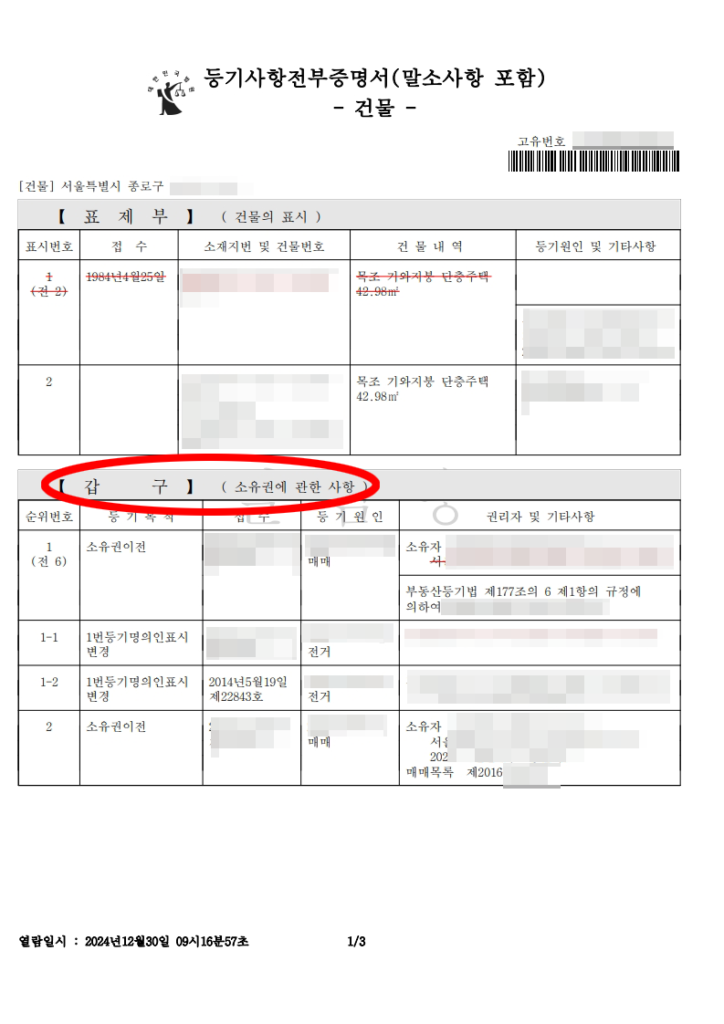
Get the ‘등기부등본’ yourself rather than accepting a copy from anyone else, and read three things.
In the ‘갑구’ (section on ownership), confirm the registered owner is the person signing your lease, and look for a trust registration (신탁등기). If the property is held in trust, the trustee — not the person on the lease — controls it, and a lease signed without the trustee’s consent may not bind anyone.
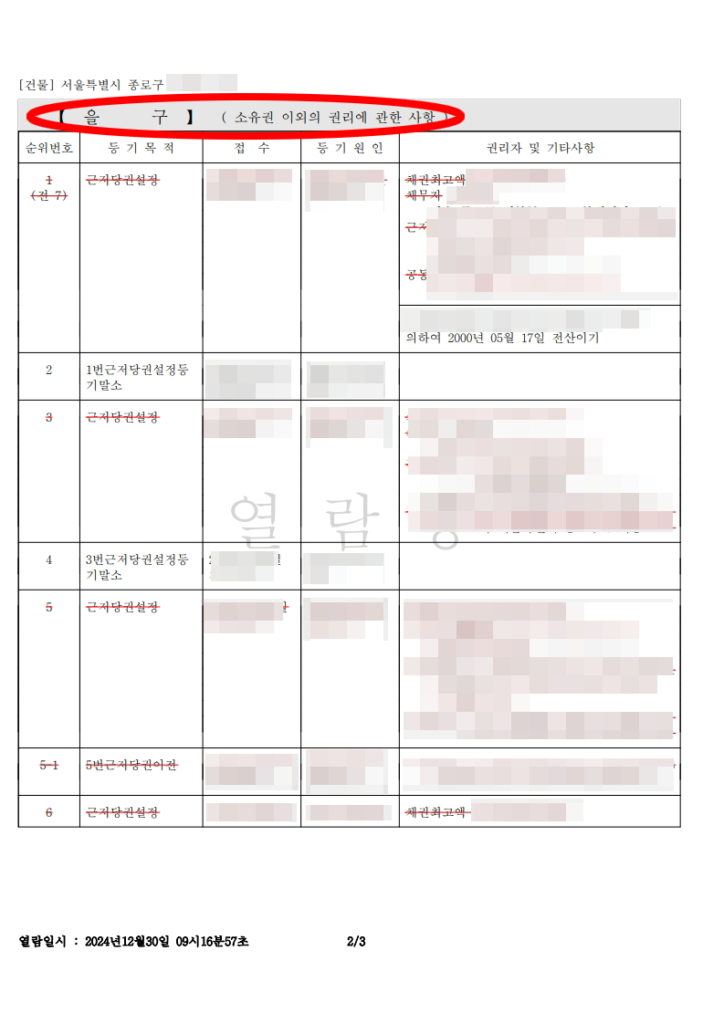
In the ‘을구’ (section on other rights), list every mortgage, note the maximum claim amount (채권최고액, not the loan balance — the maximum is what ranks ahead of you), and note the date each mortgage was created. That date matters for reasons explained in the next section but one.
Then ask about tenants you cannot see on the register. Existing leases with 대항력 do not appear there.
What your landlord must show you
Since 18 April 2023, the Housing Lease Protection Act obliges a landlord to provide, at the point of contract, information on existing senior leases on the property and a certificate of tax payment. A tenant may also inspect the landlord’s unpaid national taxes within the prescribed window.
Use it. Unpaid national taxes can rank ahead of your deposit, and they do not appear on the property register at all. A landlord who resists this request has told you something.
The statutory floor for smaller deposits
Article 8 of the Act guarantees a minimum recovery for tenants with smaller deposits, paid ahead of mortgage holders. Under the Enforcement Decree as amended 21 February 2023:
| Region | Deposit up to | Minimum recoverable |
|---|---|---|
| Seoul | 165,000,000 won | 55,000,000 won |
| Overconcentration control zone, Sejong, Yongin, Hwaseong, Gimpo | 145,000,000 won | 48,000,000 won |
| Metropolitan cities, Ansan, Gwangju, Paju, Icheon, Pyeongtaek | 85,000,000 won | 28,000,000 won |
| Elsewhere | 75,000,000 won | 25,000,000 won |
Two things people get wrong. The applicable version of this table is the one in force when the mortgage on the property was created, not the one in force when you sign — which is why the mortgage date in the 을구 matters. And the total paid to all small-deposit tenants cannot exceed half the auction proceeds; where several tenants qualify, it is divided proportionally.
Confirm the current figures at the Korea Law Information Center before relying on them.
Deposit-return guarantees
Statutory rights get you in the queue. A guarantee product pays you. Three providers offer deposit-return guarantees — HUG, HF and SGI — and foreign nationals are explicitly eligible for the HUG product. Its main conditions:
The lease must have been concluded through a licensed real-estate agent; private deals are not eligible. Deposits are covered up to 700 million won in the capital region and 500 million won elsewhere. You must apply before half the lease term has elapsed, counted from the later of the balance payment date or your residence report date — note that this is after those events, not before them. Underwriting looks at the property: your deposit plus senior claims must not exceed 90% of assessed value (80% for multi-household buildings), and senior claims alone must not exceed 60%. The building must be free of code violations, liens and seizures. Premiums run roughly 0.097% to 0.211% per year depending on deposit size, property type and debt ratio.
Applications go through HUG branches, partner banks, Naver Pay, KakaoPay, Toss, or HUG’s app. Check your own eligibility with HUG’s online checker rather than guessing from a blog — including this one.
The order of operations
- Pull the property register. Check owner, trust registration, mortgages with maximum claim amounts and creation dates.
- Ask the landlord for senior-lease information and the tax payment certificate.
- Sign through a licensed agent, with the no-new-encumbrance special clause.
- Pay the balance, take possession, get the keys.
- Within 15 days of moving in — ideally the same day — file your residence change report.
- Get the confirmed date stamped on the lease at the same visit.
- The next morning, pull the register again and confirm nothing new was registered.
- Apply for a deposit-return guarantee before half the lease term has elapsed.
FAQ
Do foreigners get the same jeonse deposit protection as Korean nationals?
Yes, provided you make the filings. An alien registration or residence-change report has the same effect as resident registration (Immigration Act Art. 88-2(2); Supreme Court 2015Da14136), and a filing by a resident spouse or child also counts.
How long do I have to report a change of address as a foreign resident?
15 days from moving in, under Article 36(1) of the Immigration Act. Overseas Koreans filing a change of domestic residence have 14 days. Late filing carries a fine of up to 1,000,000 won, rising with the delay.
When does jeonse deposit protection actually start?
At 00:00 on the day after you have both taken possession and filed your residence report. Not at signing, and not at payment.
Can foreigners buy jeonse deposit insurance?
Yes. HUG’s deposit-return guarantee is open to foreign nationals, provided the lease was concluded through a licensed agent, you apply before half the lease term has elapsed, and the property meets the underwriting limits.
What happens if my landlord sells the apartment?
If you have 대항력, the buyer inherits the lease and the obligation to return your deposit. If you do not, you have no defence against the new owner.
This guide was written by a Seoul-based parent who works in architecture and real-estate development, based on the statutes, Supreme Court decisions and official product terms cited below. I am not a lawyer, and this is general information rather than advice on any particular contract. For a specific lease, consult a licensed professional — the Korea Legal Aid Corporation and the Seoul Global Center both offer free consultations, including in English.
Sources: Housing Lease Protection Act, Arts. 3, 3-2, 3-6, 3-7, 8 (English) · Enforcement Decree of the Housing Lease Protection Act, Arts. 10–11 (Presidential Decree No. 33254, 21 Feb 2023) · Immigration Act, Arts. 36(1), 88-2(2) and penalty provisions (English) · Act on the Immigration and Legal Status of Overseas Koreans (English) · Supreme Court 2015Da14136(13 October 2016) · Supreme Court 2015Da254507(11 April 2019). · HUG Jeonse Deposit Return Guarantee terms · Government24 residence change report service · Korea Law Information Center
Last reviewed : 18 August 2026
This guide explains how Korean tenancy law and the official deposit-guarantee products work in general terms. It is not legal advice on your contract, and I cannot review individual leases or answer questions about a specific property. Thresholds, guarantee limits and premium rates are current as of the review date above and change periodically — verify them at the official sources linked at the end before you sign anything or transfer money. English translations of Korean statutes are unofficial reference translations; the Korean text governs.