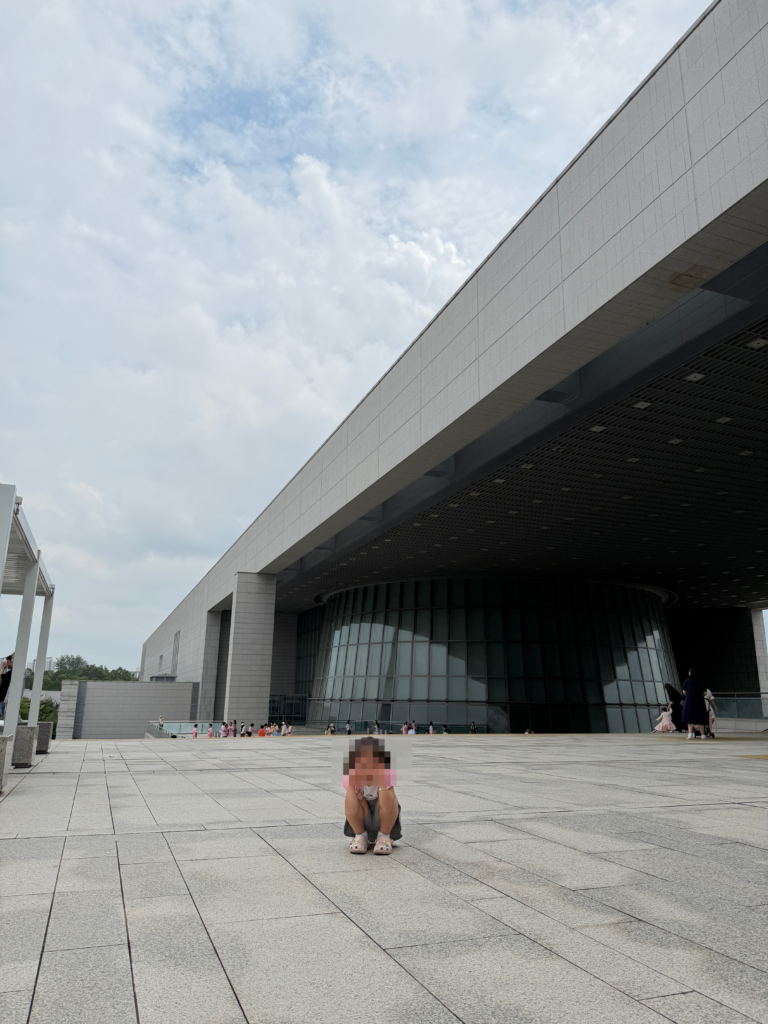
There is a theatre inside the National Museum of Korea, and almost nobody who visits the museum knows it is there.
We found it the way most families do — by accident. We had a morning session booked at the Children’s Museum, and while walking back across the plaza we passed a building on the eastern side of the complex with THEATER YONG on it. Not a lecture hall. Not a screening room. An 805-seat auditorium running family musicals on a professional production schedule, with tickets that cost more than a day at Lotte World.
What Theater Yong actually is
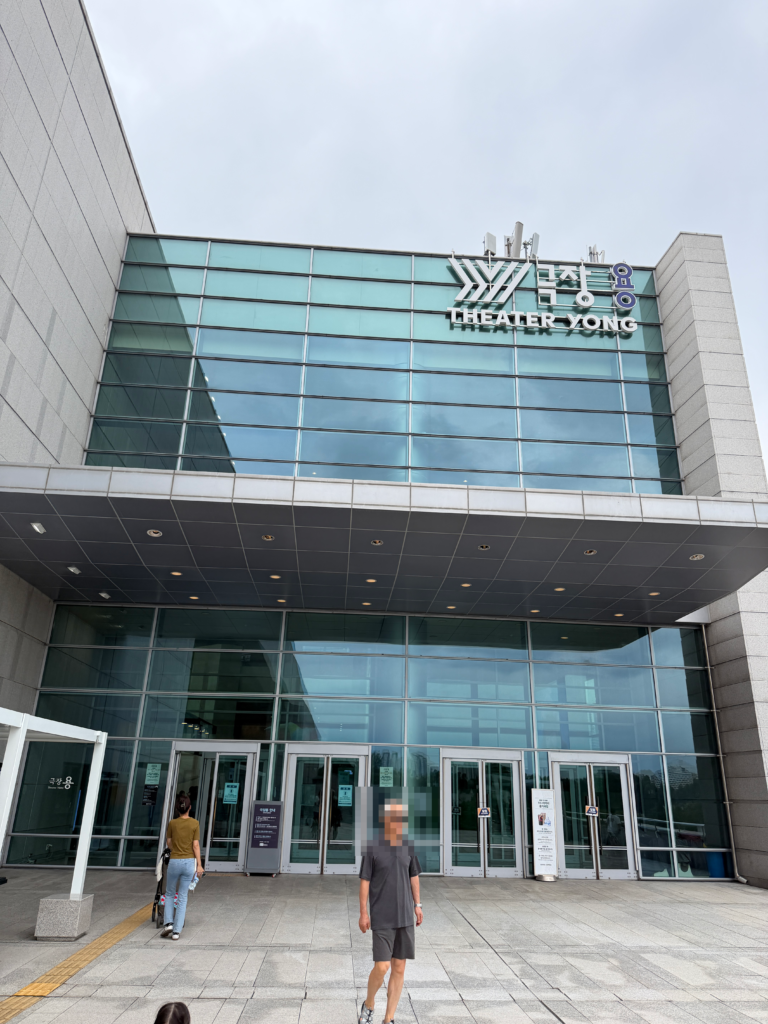
Theater Yong opened in 2005 and is operated by the National Museum Foundation of Korea. It sits physically inside the museum complex — same site, same car park, same subway exit. 538 seats downstairs, 267 upstairs, 805 in total. This is not a black-box space with fifty folding chairs.
The programming is almost entirely family musicals, produced in-house or co-produced with commercial theatre companies, running in seasons of six to eight weeks. In 2026 alone the theatre has staged a taekwondo musical, a summer show set underwater, and a spy adventure — one after another, all year.
The important thing to understand is that this is a paid, commercial theatre attached to a free museum. The Children’s Museum downstairs costs nothing. A VIP seat here costs 77,000 won. People conflate the two and get a shock at the box office.
The show we saw
We went to Grandma’s Summer Holiday, which ran from 4 July to 30 August 2026. It has now closed, so treat what follows as a description of what this theatre does rather than a recommendation you can act on.
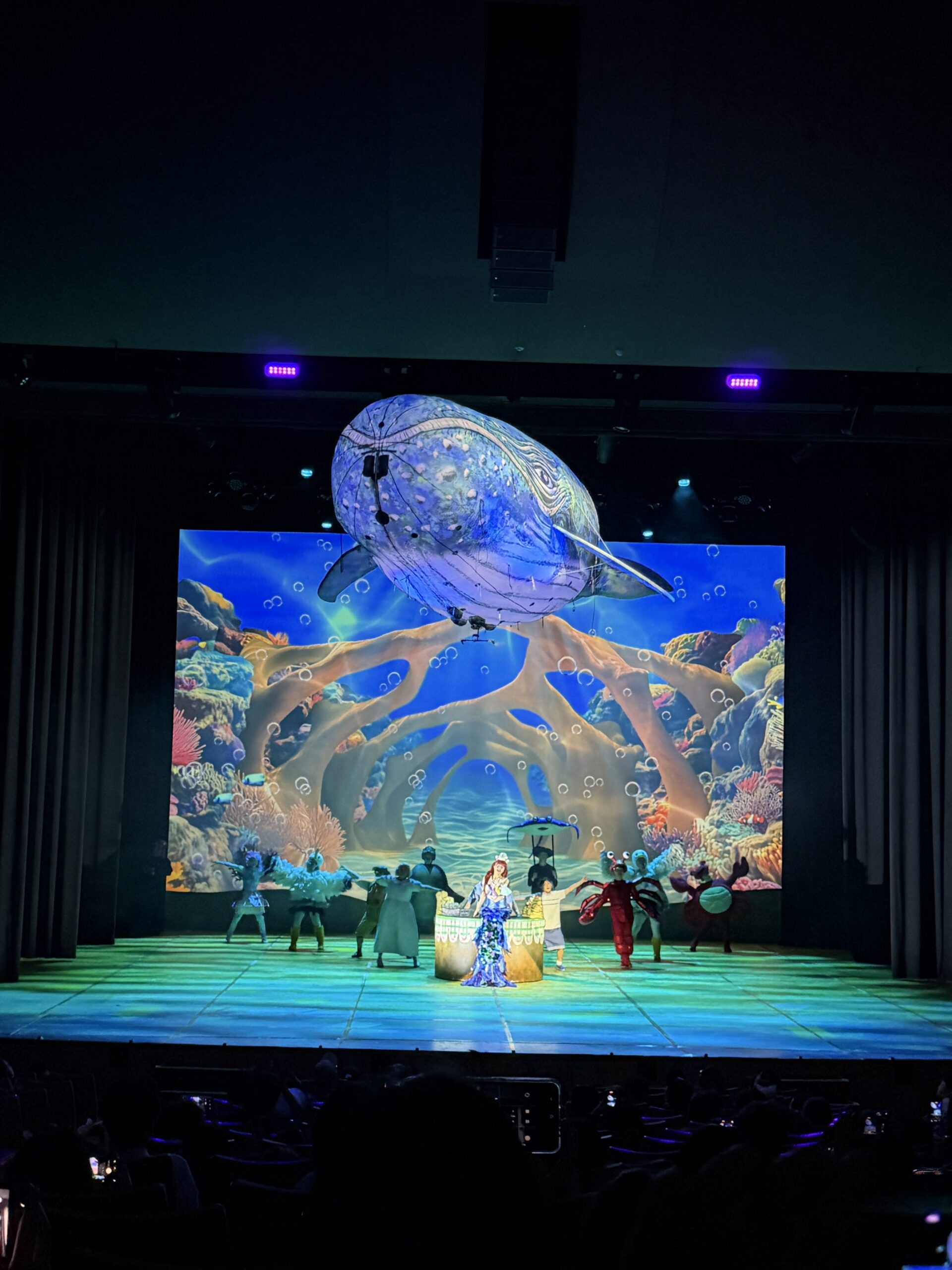
Seventy-five minutes, no interval. A grandmother and her grandson fall through a conch shell into an underwater world, and the production commits to that premise completely — including a six-metre whale that swims out over the audience.
I had planned this badly, or so I thought.
Our 21-month-old had no ticket and no seat, so I took her on my lap on the aisle — row I, level one, ninth row back, on the edge of the centre block with a clear route out — and I spent the first five minutes waiting for the moment I would have to carry her out. Seventy-five minutes with no interval and a toddler who has never sat through anything is not a promising equation.
She did not move.
She watched the whole thing — and what she worked out, somewhere in the first fifteen minutes, was the blackouts. The show is built in scenes: a song finishes, the stage drops to black for two or three seconds, the lights come up somewhere else entirely. Every single time that happened, she clapped. Not copying us a beat late. On the cue, with the rest of the room, because she had understood that the darkness meant something had ended.
I have no idea what that says about child development and I am not going to pretend otherwise. But whatever this production was doing with light and pacing and volume, it was legible to someone who cannot yet form a sentence.
A five-year-old could actually see the stage
This is the part I did not expect to be writing about, and it is the reason I would come back.
Our five-year-old sat on a booster cushion — stacked at the entrance to each aisle, free, take one on your way in — and had a clear view of the stage for the entire show, with a grown adult sitting directly in front of her. No craning. No lifting her onto a knee halfway through. She simply watched it.
I do not know exactly what the auditorium is doing to achieve that. The seating is laid out as a broad, shallow fan rather than straight ranks, the rake climbs steadily towards the back, and the rows have real depth between them. Whatever the combination is, it works: we were in row I of the centre block, nine rows back, and the sightline went between the heads in front rather than into one of them.
I have sat behind tall men in theatres that cost twice as much and seen a third of the show. Here, a theatre built specifically for children has been built so that children can see, and the cushions are where you actually need them rather than at a desk you have to ask at. It is a small thing done properly, which in my experience is rarer than a big thing done well.
One practical note if you are booking with a baby on your lap. We took three tickets for four people and sat in row I, seats 10 to 12 — the aisle edge of the centre block, nine rows back. It was the right call: close enough that the whale passing overhead was genuinely startling, and one step from a clear route out. If you want an actual end-of-row seat instead, the side doors on level one sit between rows B/C and rows K/L at the outer edges. Two other things from the official seating plan: row U is the wheelchair row, and row T has the sound console directly behind seats 10 to 18.
One more thing worth knowing before the lights go down. Photography is prohibited during the performance, along with phone use and outside food, and the ushers do enforce it. The curtain call is the exception: when the cast come out to bow, an announcement invites the audience to photograph it, and the entire room does. That is where the picture at the top of this article comes from. Keep the phone in your bag until the bows.
Late arrivals are handled sensibly — latecomers are seated during scene changes rather than being locked out — but do not build a plan around it. Seventy-five minutes with no interval means there is no natural break, so the toilet trip happens before, not during.
What’s on now: Codename X
The current production is Codename X, running 12 September to 18 October 2026.
It is a time-slip spy adventure adapted from a bestselling Korean children’s book series — a child agent partnered with a mysterious operative called Violet, chasing suspects through the past to uncover a secret about his mother. Seventy minutes, no interval.
We have not seen it, so this is not a review. But the theatre’s track record this year is good enough that we have it in the diary.
Tickets: VIP 77,000 won / R 66,000 won / S 44,000 won.
The age rule, and why you must check it per show
This is the most useful thing in this article, and it is more nuanced than the internet will tell you.
Both of this year’s productions are billed as 24 months and over. But the wording differs between them in a way that matters enormously if you have a baby.
Grandma’s Summer Holiday was listed as “viewable by ages 24 months and over.” In practice, our 21-month-old was admitted — no ticket, no seat, on a parent’s lap, at no charge.
Codename X, the current production, is listed differently. The museum states that children under 24 months will not be admitted even when accompanied by a parent. Not discouraged. Refused. And promotional bookings for these shows have required documentary proof of date of birth — an insurance card, a passport, a family register extract — for children near the cutoff.
Same theatre, same producing foundation, two different rules in the same calendar year.
Do not assume the lap-seat option exists. Phone 1544-5955 and ask about the specific production before you buy. If the answer is no, one adult sits it out and takes the baby to the plaza, where there is a free outdoor programme running until the end of October.
Where to book
Three official ticketing agents, all listed by the museum: Ticketlink (ticketlink.co.kr), NOL Ticket, formerly Interpark (tickets.interpark.com), and Naver Booking (booking.naver.com).
All three are Korean-language-first. Interpark has historically had the most workable foreign-card checkout, but expect to need a Korean phone number for identity verification on at least one of them. If it fails, the theatre’s phone line is 1544-5955.
Prices have been identical across the last several productions — 77,000 / 66,000 / 44,000 — so you can budget before the next season is announced.
Strollers do not go in
You cannot take a stroller into the auditorium, and there is nowhere to park one at the door.
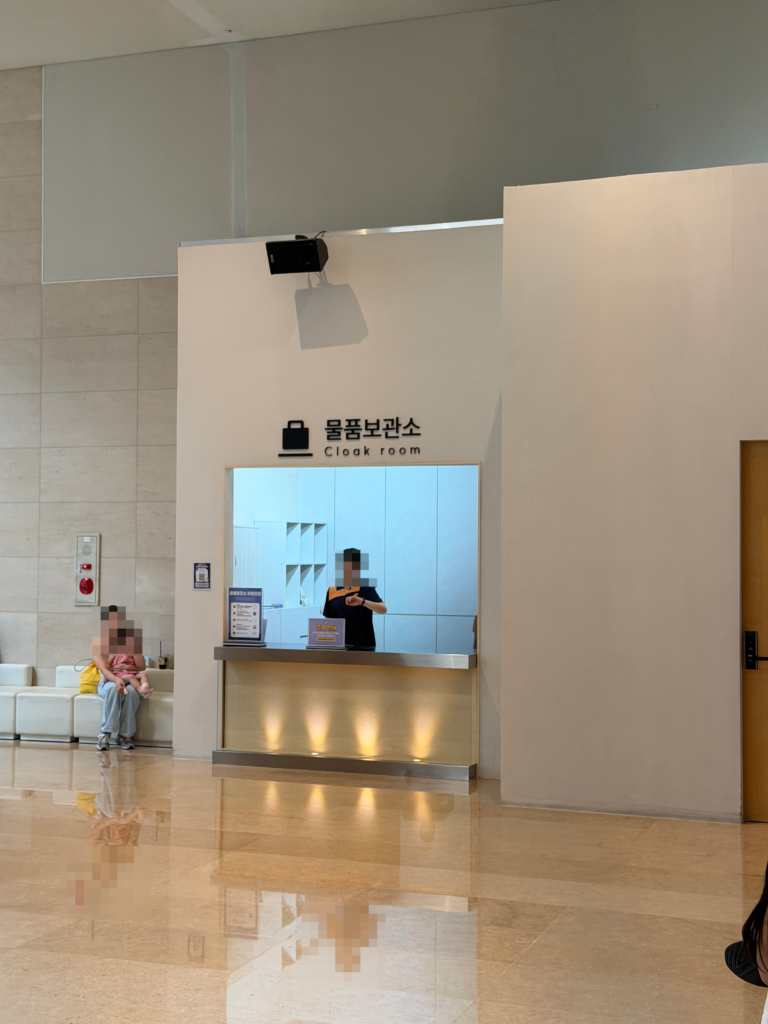
Use the Cloak Room in the main museum’s Great Hall. It is staffed, it takes strollers and bags, and it is on your way if you are coming from the Children’s Museum anyway.
How to build the day around it
This is where the site starts to make sense as a whole. The complex holds a free children’s museum, a free national museum, an 805-seat paid theatre and an outdoor performance stage, all within a five-minute walk of each other.
Our order was: Children’s Museum morning session → main museum → the show → and then, we assumed, lunch. Reverse those last two and you have a better day than we had.
If you are doing the same, the one thing to get right is the Children’s Museum booking, which opens at midnight exactly fourteen days ahead and is genuinely competitive for weekend slots. We covered that in detail here: National Museum of Korea Children’s Museum: how to book.
Eat before the show, not after
We got the order of the day wrong, and this is the one mistake worth passing on.
The museum has a food court, and we walked to it straight after the show with two hungry children and no plan beyond “there is food in that direction.” What we found was a queue that had already absorbed several school groups and showed no sign of moving. Standing in it with a 21-month-old who had just sat still for seventy-five minutes was not a serious option.
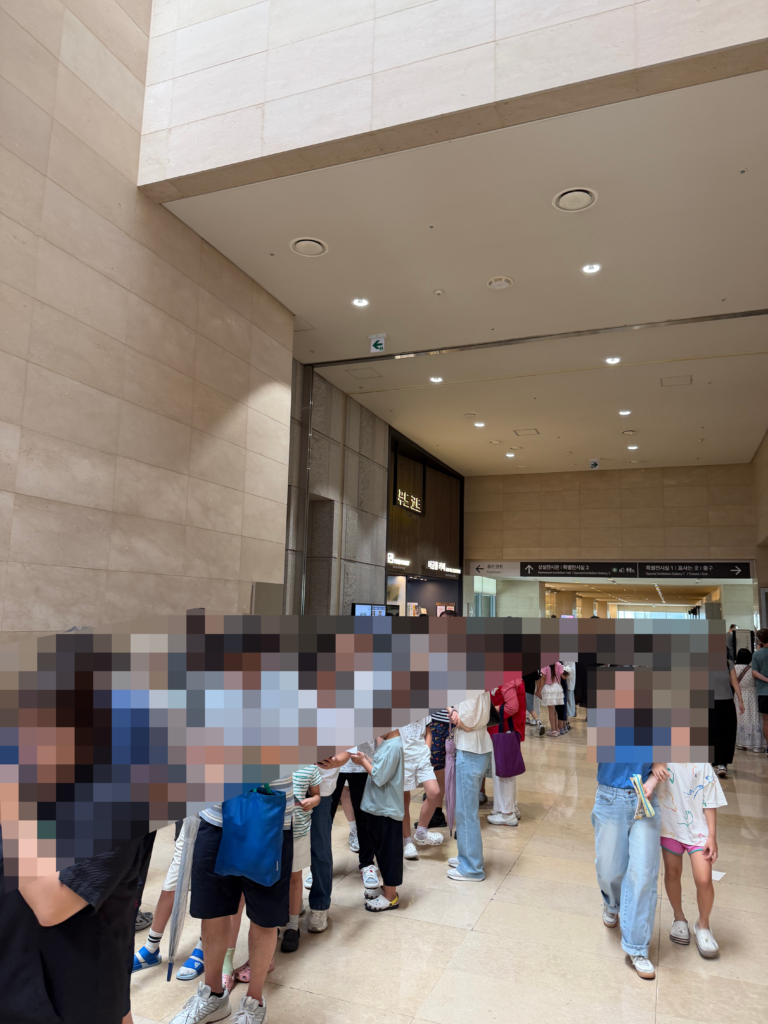
The logic is obvious in hindsight. Everybody in an 805-seat auditorium comes out at the same moment, walks into the same building, and wants the same lunch. Add the ordinary museum crowd and a couple of school parties and the food court cannot absorb it. If your show finishes anywhere near a mealtime, eat beforehand, or accept that you are eating somewhere else entirely.
The free performances nobody mentions
One more thing, and it is free.
The museum’s open plaza hosts a season-long outdoor performance programme called Museum Culture Festival, running 18 April to 31 October 2026, admission free. The line-up is not filler — it includes performances by Korea’s national companies.
So if the musical tickets are outside your budget, or your baby is under two and the current show will not admit her, there is a version of this day that costs nothing at all.
Getting there
Line 4 or the Gyeongui-Jungang Line to Ichon Station. Take Exit 2 and stay underground — follow Museum Nadeulgil, the signed step-free passage with moving walkways, marked for the National Museum of Korea, Theater Yong and the National Hangeul Museum. It comes out at the plaza.
If you are driving, the same warning from Part 1 applies and it applies harder for a matinee: on weekends and holidays the car park is full by late morning. A 2pm show means arriving into the worst of it.
Practical notes
- Theater Yong: inside the National Museum of Korea complex, 137 Seobinggo-ro, Yongsan-gu, Seoul
- Opened: 2005. 805 seats — 538 on level one, 267 on level two
- Enquiries: 1544-5955
- Now playing: Codename X, 12 Sep – 18 Oct 2026, 70 minutes, no interval
- Ages: 24 months and over. Under-24-months not admitted to Codename X, even with a parent. Check per production.
- Tickets: VIP 77,000 / R 66,000 / S 44,000 won
- Booking: Ticketlink, NOL Ticket, Naver Booking
- Inside the auditorium: no photography during the performance, no phone use, no outside food. Photography is permitted at the curtain call.
- Official listing: National Museum of Korea – performances
FAQ
Is Theater Yong part of the museum? Physically yes, financially no. It sits inside the museum complex and is run by the National Museum Foundation of Korea, but it is a paid commercial theatre. The museum and the Children’s Museum are free; theatre tickets are 44,000 ~ 77,000 won.
Can I bring a baby? Check the specific production, because the rule changes. Both 2026 shows are billed 24 months and over, but Grandma’s Summer Holiday admitted our 21-month-old free on a parent’s lap with no seat, whereas Codename X states that under-24-months are not admitted even with an adult. Phone 1544-5955 before booking. Proof of date of birth may be requested for children near the cutoff.
Will a toddler actually sit through it? Ours did — 75 minutes, no interval, on my lap in row I. She spent it working out the scene changes: song ends, stage goes black, and she applauded every blackout on cue. That is one child and not a guarantee. Take an aisle seat so that leaving early is easy and undramatic, and go in expecting to use it.
Can a small child see over the person in front? In our experience yes, and it was the theatre’s best surprise. Free booster cushions are stacked at the entrance to each aisle — take one on the way in. Our five-year-old had a clear view of the whole show on a cushion in row I with an adult directly in front of her.
Where are the best seats for a family? We were happy with row I of the centre block, nine rows back — close enough for the big staging moments to land, far enough that a five-year-old is not craning upwards. Note that row T has the sound console behind seats 10 to 18, and row U is the wheelchair row.
Are the shows in Korean? Yes, and there is no surtitling. That said, these are visually-driven family productions, and a non-Korean-speaking child would follow most of it. An adult expecting dialogue comedy would not.
How long are the shows? Recent productions have run 70–75 minutes with no interval. Do the toilet trip beforehand.
Can I take photographs? Not during the performance photography, phone use and outside food are all prohibited while the show is running. The curtain call is the exception: an announcement invites the audience to take photographs as the cast bow, and that is when the shot at the top of this article was taken. The lobby and the plaza are fine throughout.
Where should we eat? Not immediately after the show. The food court queue absorbs an entire emptying auditorium plus the ordinary museum crowd. Eat before, or eat elsewhere.
Can we combine it with the Children’s Museum? Yes, and it is the best use of the site. Book the Children’s Museum first — it opens fourteen days ahead at midnight and weekend slots go quickly. Full booking guide here.
Is there anything free to see? The Museum Culture Festival runs free outdoor performances on the plaza from April to October.
One last thing
We came out of the theatre, failed to get lunch, and started walking back towards the station across the open plaza in front of the main museum.
Our five-year-old stopped, looked up at the building, and told us it was beautiful. Then she asked to have her photograph taken in front of it.
I have no way of measuring what a day like this does to a child. But somewhere between a free children’s museum, a paid musical with a whale in it, and a very long lunch queue, she had decided that a national museum was a place worth being photographed at. That seems like a reasonable return on a Saturday.