Is the National Museum of Korean Contemporary History free?
Yes — the permanent exhibitions, the children’s museum, and the 8th-floor rooftop garden are all free, and no reservation is needed. It stays open until 9 PM on Wednesdays and Saturdays.
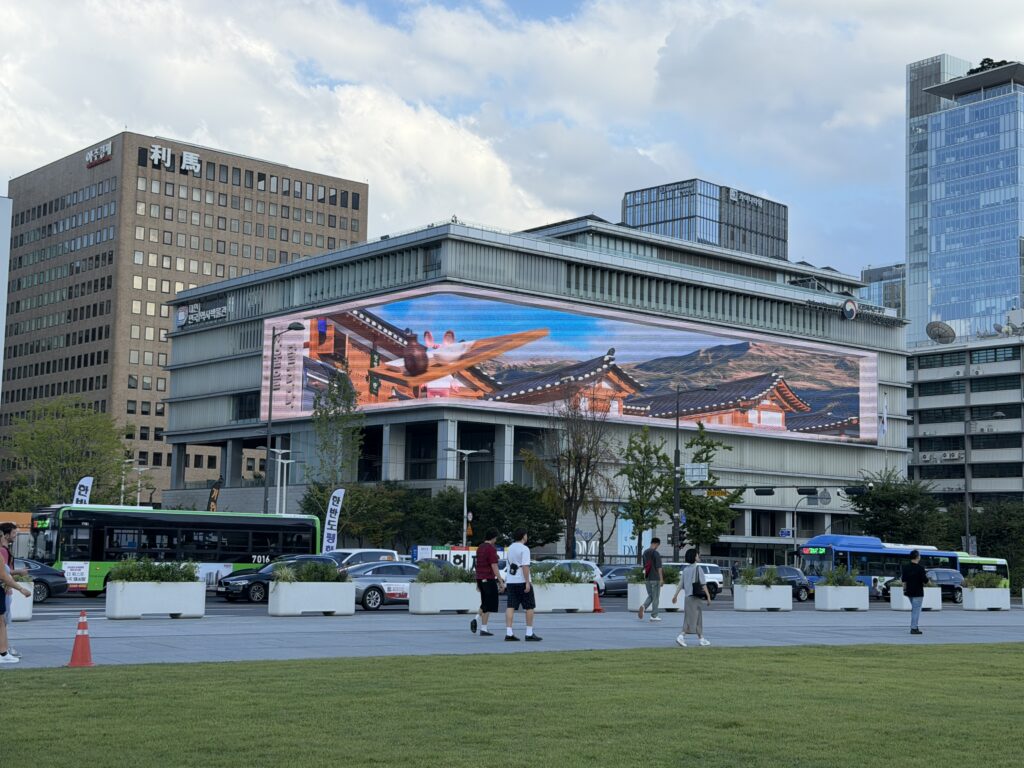
Most people walk straight past this building. It sits on Sejong-daero, two minutes from Gwanghwamun Square, and from the outside it looks like exactly what it used to be: a government office block.
That is not a coincidence. This was the main building of the Ministry of Culture, Sports and Tourism, and in 2012 it was converted into a museum rather than demolished. I work in architecture and real estate development, so this is the kind of thing I notice — a mid-century ministry building given a second life as a public museum is genuinely unusual adaptive reuse, and the ministry logo is still mounted on the roofline. If you are standing outside wondering whether you have the right place, look just below the logo. The English name is there: National Museum of Korean Contemporary History.
Quick Info
| What it is | National museum of Korea’s modern and contemporary history |
| Address | 198 Sejong-daero, Jongno-gu, Seoul |
| Admission | Free — permanent exhibitions, children’s museum, rooftop garden |
| Hours | 10:00 – 18:00 |
| Night opening | Wednesdays and Saturdays, 10:00 – 21:00 |
| Last entry | 30 minutes before closing |
| Closed | 1 January, Seollal (Lunar New Year) day, Chuseok day |
| Reservation | Not required, including the children’s museum |
| Age limit | None |
| Nearest station | Gwanghwamun Station (Line 5) |
| Phone | +82-2-3703-9200 |
Last checked: October 2026.
Start at the Lobby Timeline
Walk in and the first thing you meet is a set of pillars running a timeline down the lobby — 1919, 1920, 1926, 1945, 1980 — with the Korean text mirrored in English underneath each date.
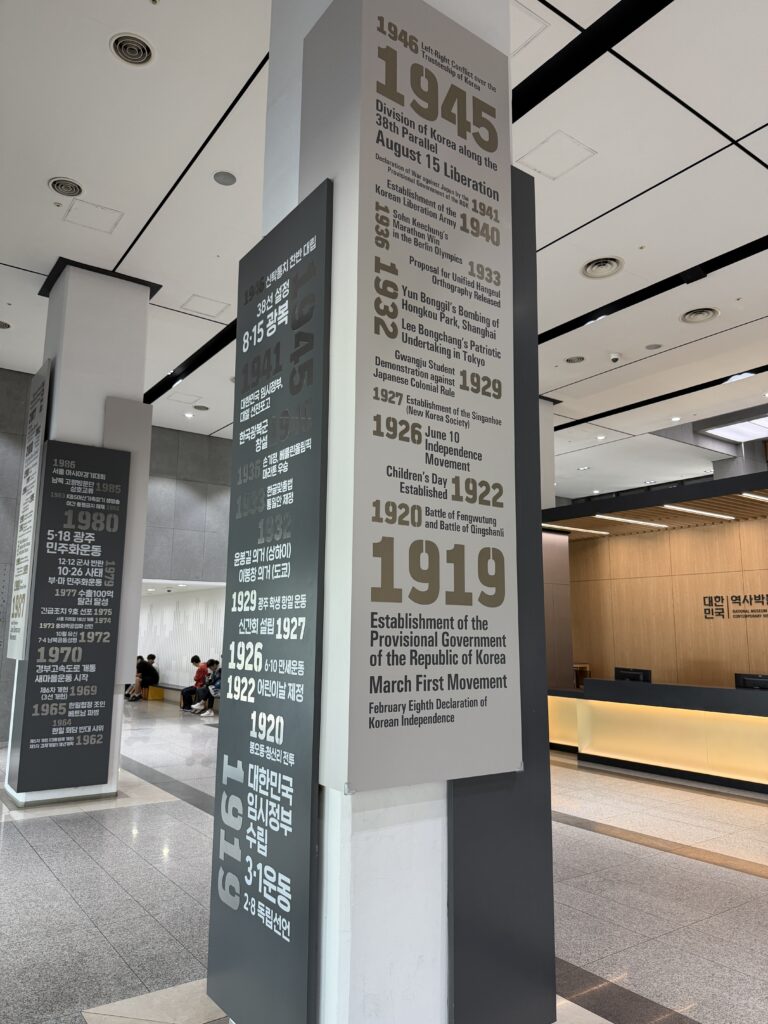
I would not skip this. Korean modern history moves fast and assumes a lot, and the permanent galleries upstairs do not always stop to explain the basics. Thirty seconds at these pillars — provisional government 1919, division along the 38th parallel 1945, Gwangju 1980 — gives you the spine of everything you are about to see.
What’s Upstairs
The permanent exhibition runs from the late nineteenth century to the present, and the objects that land hardest are the ordinary ones.
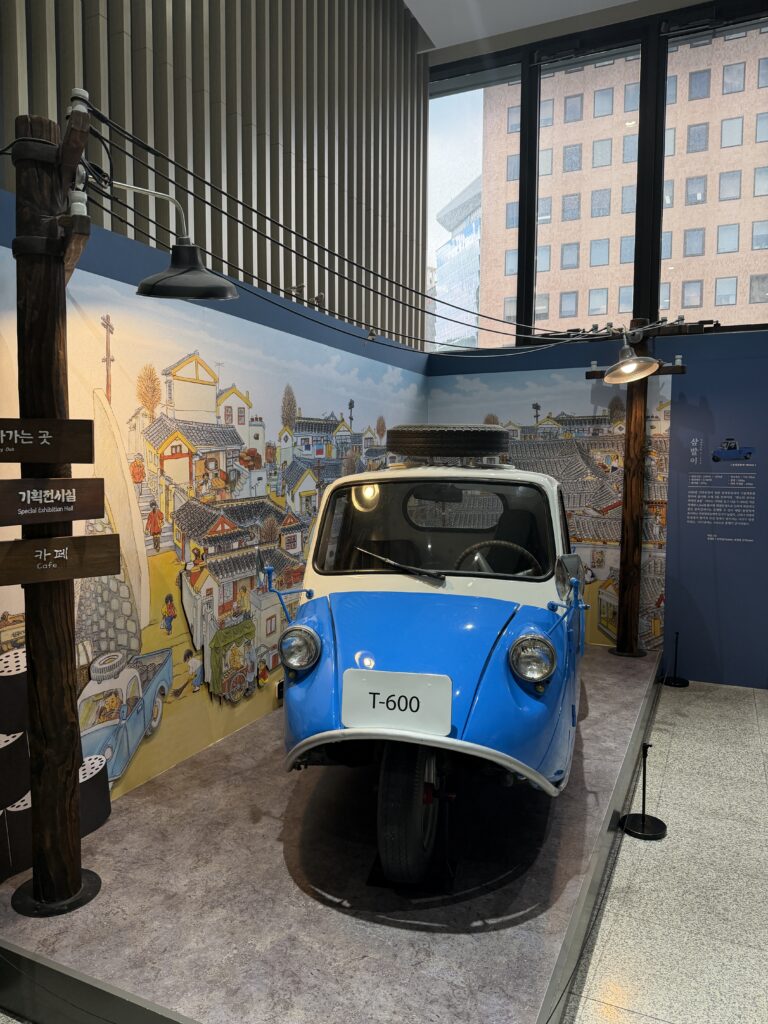
This little blue three-wheeler did more for Korea’s post-war economy than most of the monuments outside. The mural behind it shows the kind of dense hillside neighbourhood it would have climbed every morning. My kids liked it because it looks like a cartoon; I liked it because I have spent fifteen years working on what replaced those neighbourhoods.
There is also a special exhibition hall on the 3rd floor that changes a few times a year. When we visited in September, it was a DMZ photography show.
The Children’s Museum Is the Real Surprise
Here is the part almost no English guide mentions. There is a children’s museum on the 1st floor, it is free, there is no age limit, and you do not need to book.
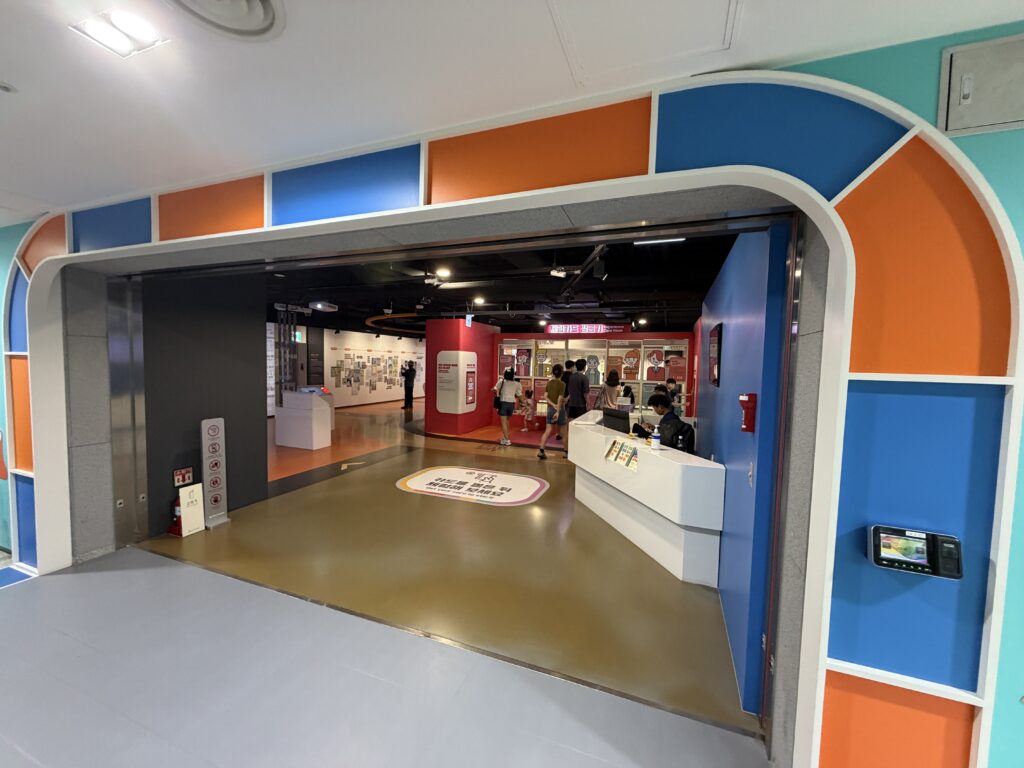
The centrepiece is a build-your-own-character system that runs across the whole room, and it is worth understanding before you walk in, because the kids will work it out faster than you will.
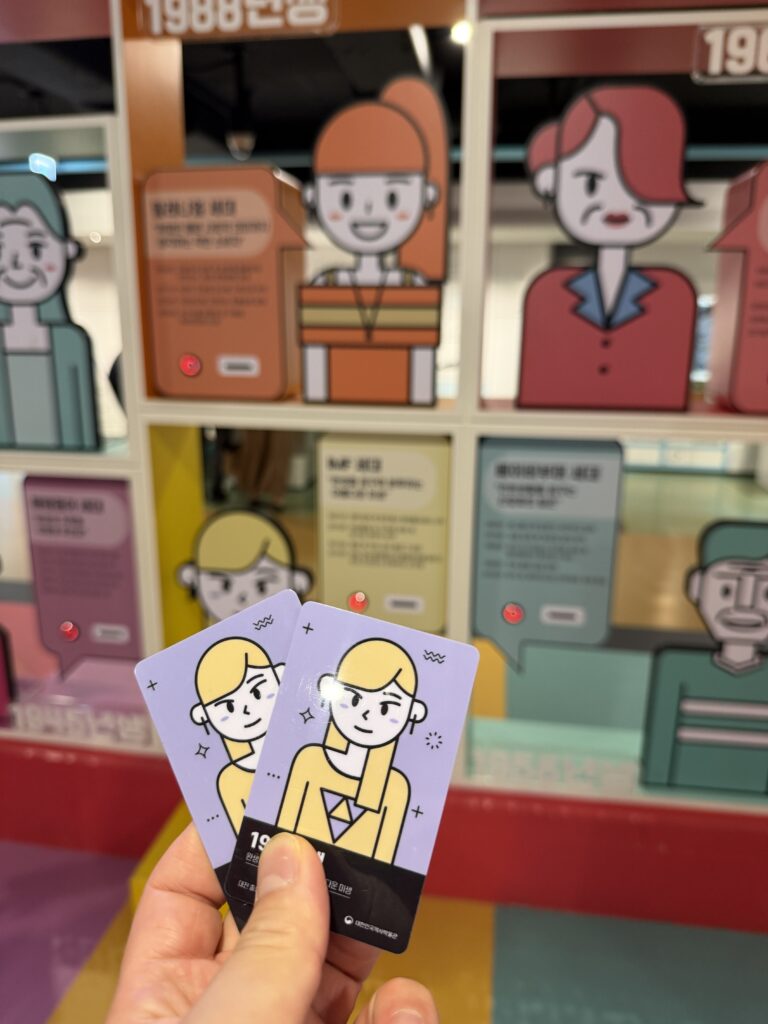
You start with an experience card from the desk. Each card has a barcode on the back.
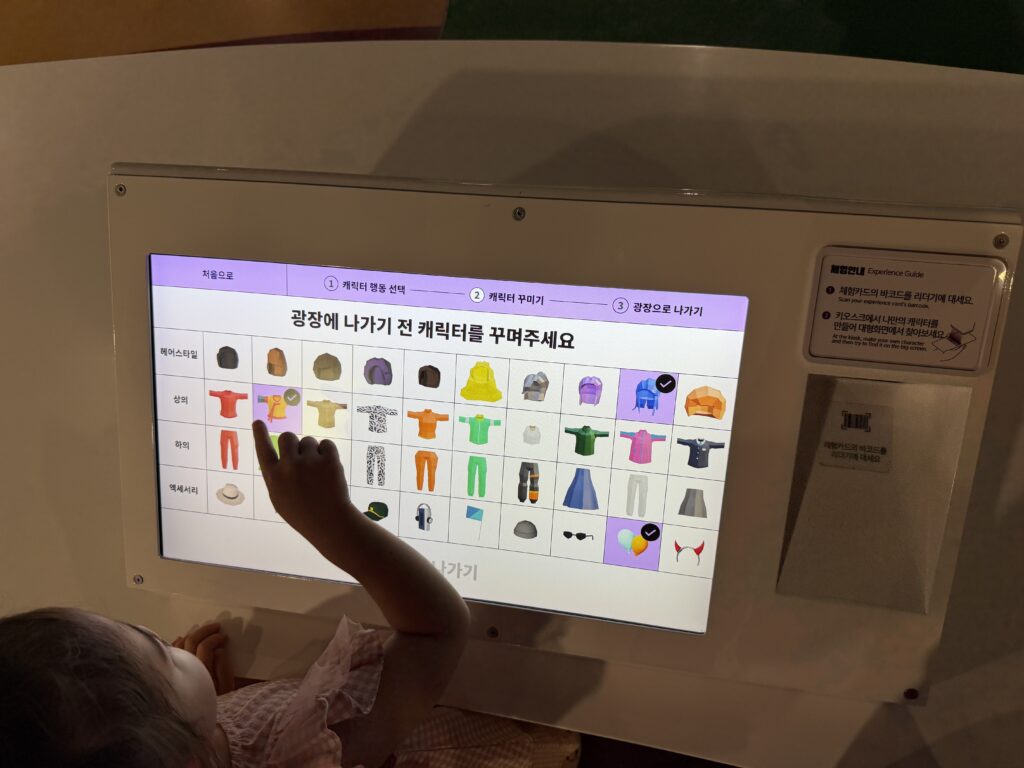
Take the card to one of the kiosks and hold the barcode against the reader mounted below the guide panel, just to the right of the touchscreen. Your character loads, and then you dress it: hairstyle, top, bottom, accessory. My daughter went through every single option twice before committing.
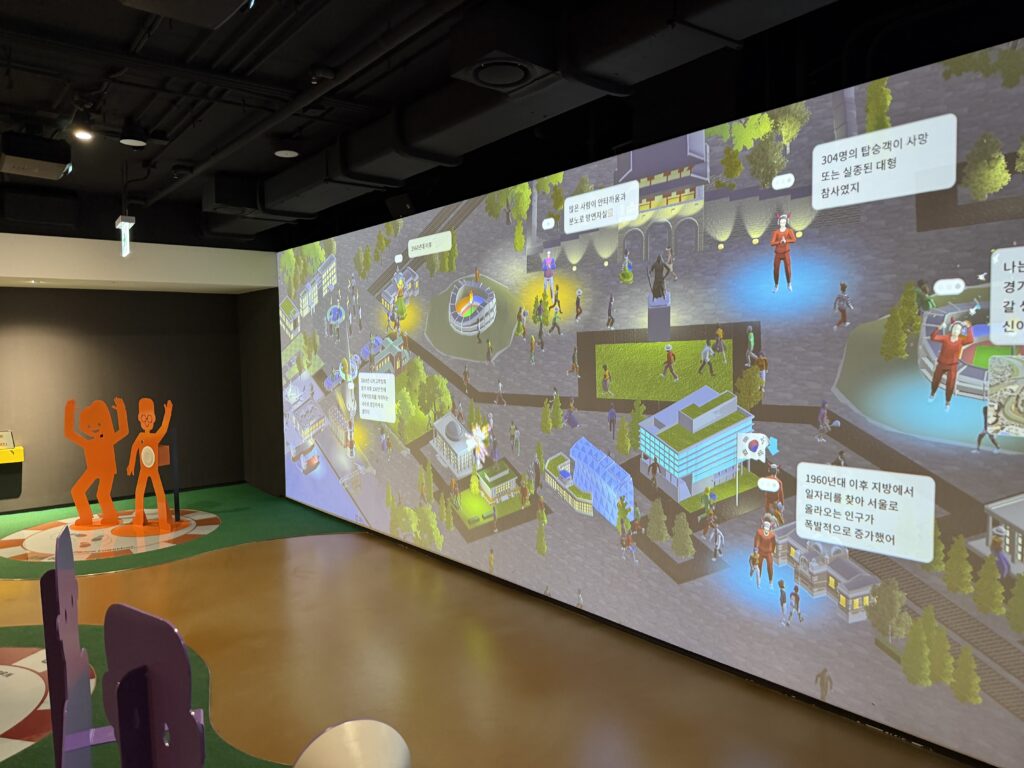
Then you walk over to the big projection wall and your character is summoned into it — wandering around a shared animated square with every other child’s creation. That is the payoff, and the reaction when they spot their own is the reason to come.
The wall is also doing quiet work in the background. The speech bubbles narrate what was happening in Korea in each era: rural families moving to Seoul for work after the 1960s, the stadium built for the 1988 Olympics, and some genuinely heavy moments from recent history. None of it is forced on anyone, but if your child asks, the answer is right there on the wall.
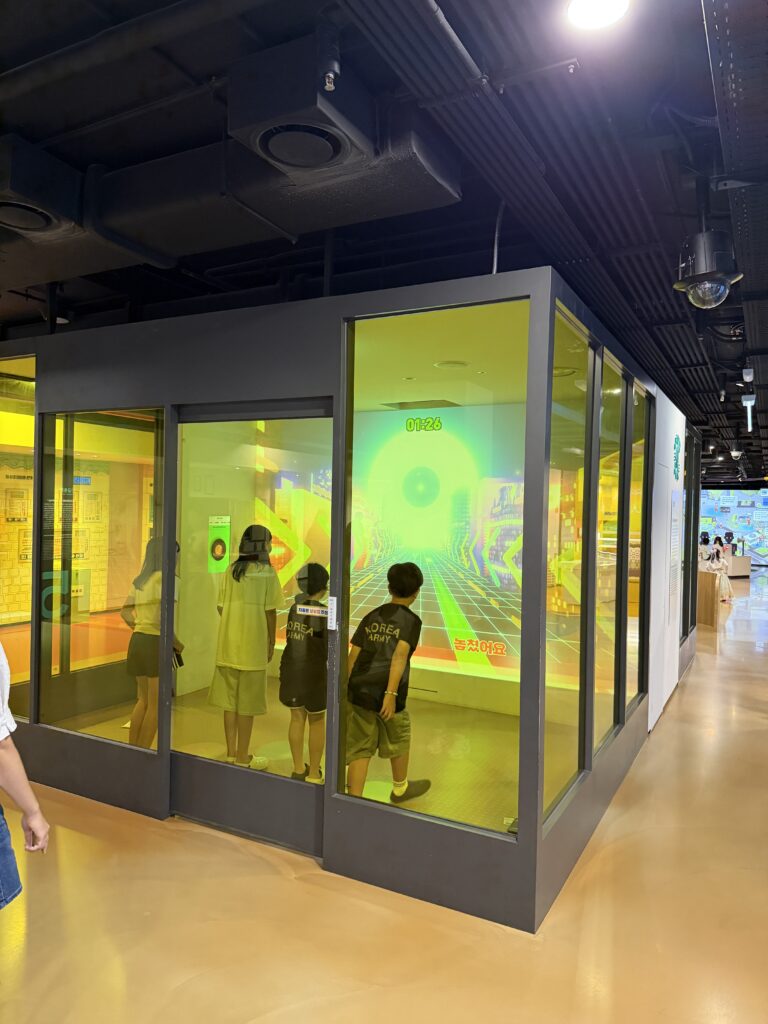
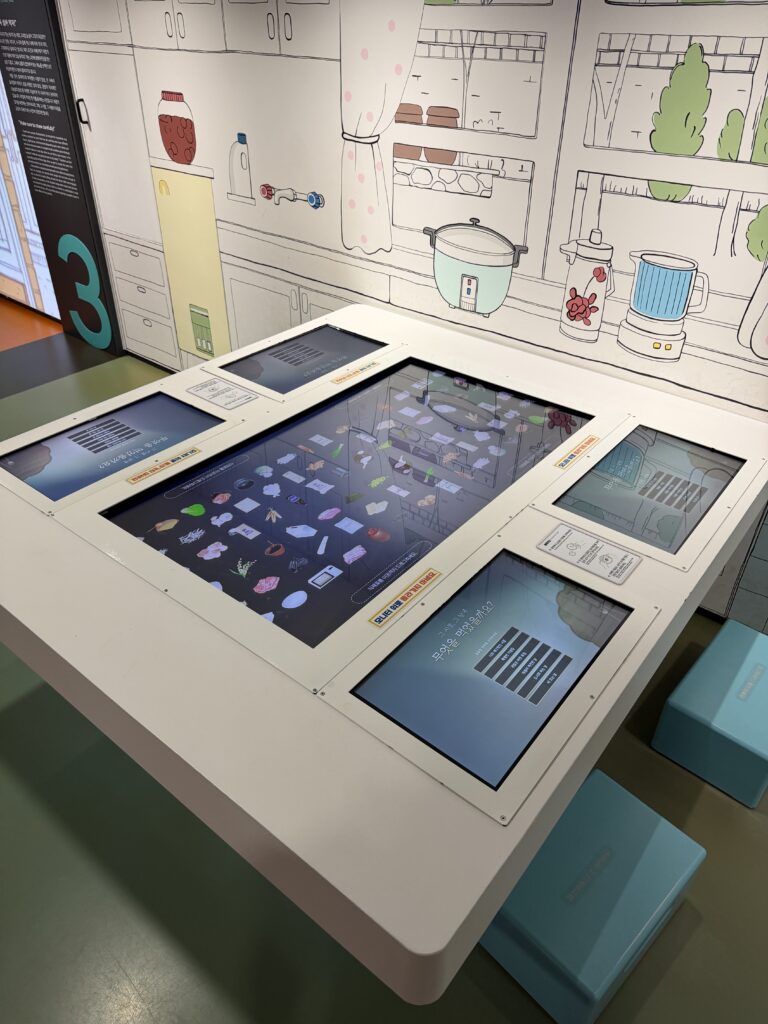
What makes the whole floor work is that the history is embedded rather than explained. The kids were choosing clothes and objects from different decades without being told they were learning about the 1960s or the 1988 Olympics. Mine spent close to an hour here and had to be extracted.
One honest note on language: each kiosk has an English panel beside it with the two steps spelled out — “Scan your experience card’s barcode” and “At the kiosk, make your own character and then try to find it on the big screen” — so the mechanics are followable without any Korean at all. The narration on the projection wall and most of the signage, though, is Korean only. The activities are visual enough that it does not stop anyone from enjoying it, but if you want the history itself in English, that is upstairs in the permanent exhibition, not down here.
The Rooftop Garden — the Best Free View of Gyeongbokgung in Seoul
The rooftop garden on the eighth floor of the National Museum of Korean Contemporary History is why you came.
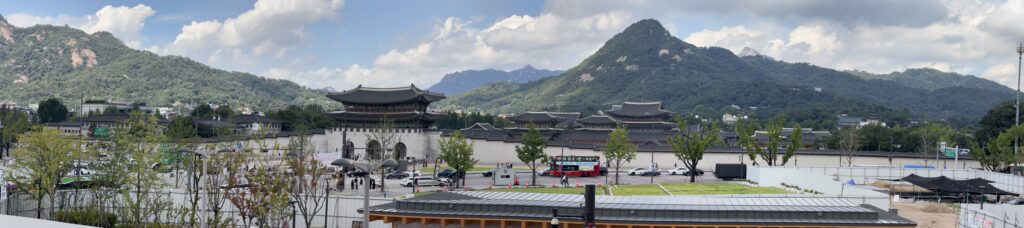
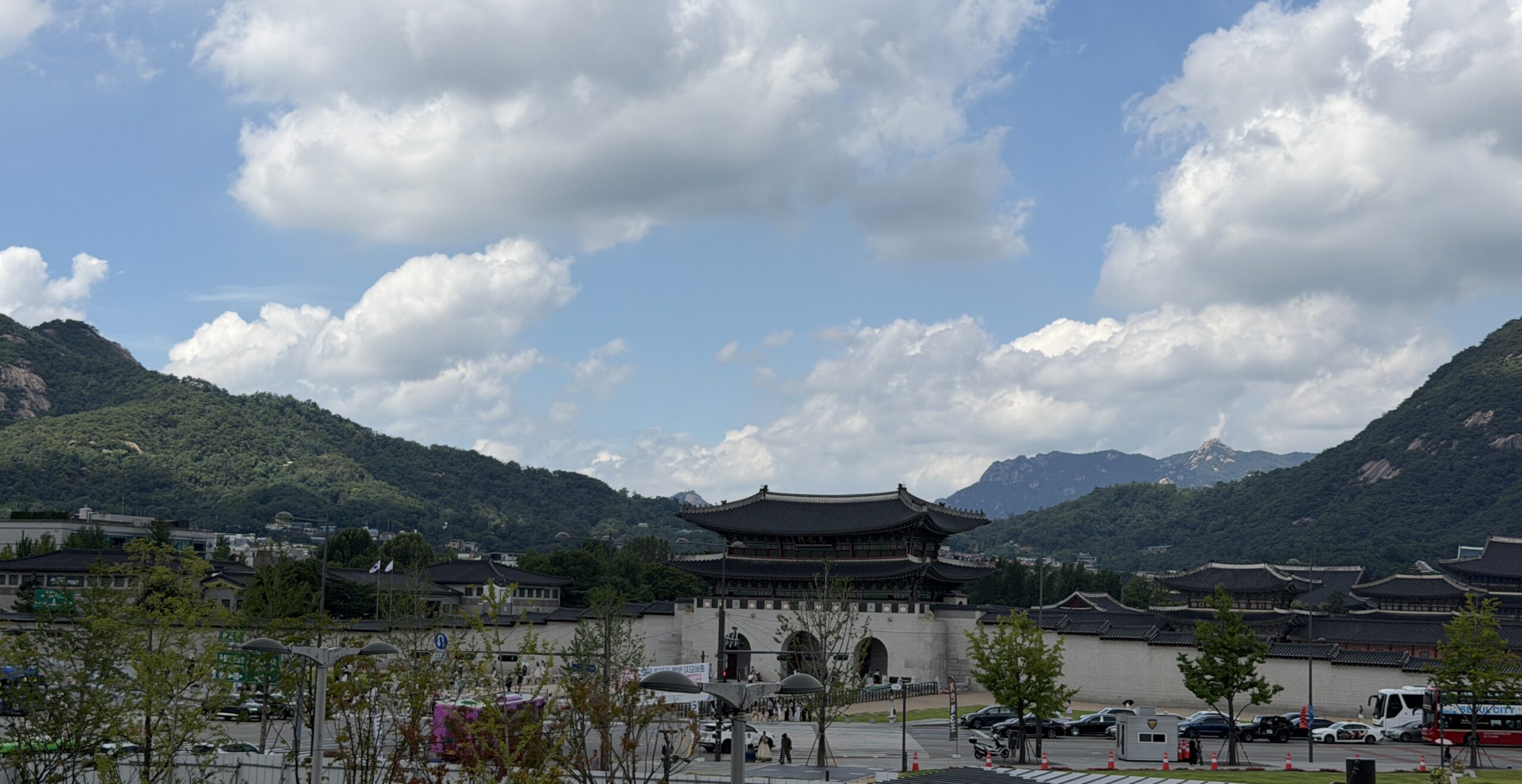
Gwanghwamun gate, the full palace compound, and Bugaksan behind it, laid out in one frame from above. People pay for far worse views in this city. The rooftop is a working rest area with benches, open the same hours as the museum, and it is free.
Local tip: On Wednesdays and Saturdays the museum stays open until 9 PM, and the rooftop garden stays open with it. In December, sunset in Seoul is around 5:15 PM, which means on those two nights you can stand up here and look down at a floodlit Gyeongbokgung. There is also a guided night commentary at 7 PM on Wednesdays. If you are already planning to visit the Gwanghwamun Christmas Market — which runs from 5:30 PM in the same square — this is the single best way to start that evening. Rooftop first, then walk down into the market.
Where to Take a Break
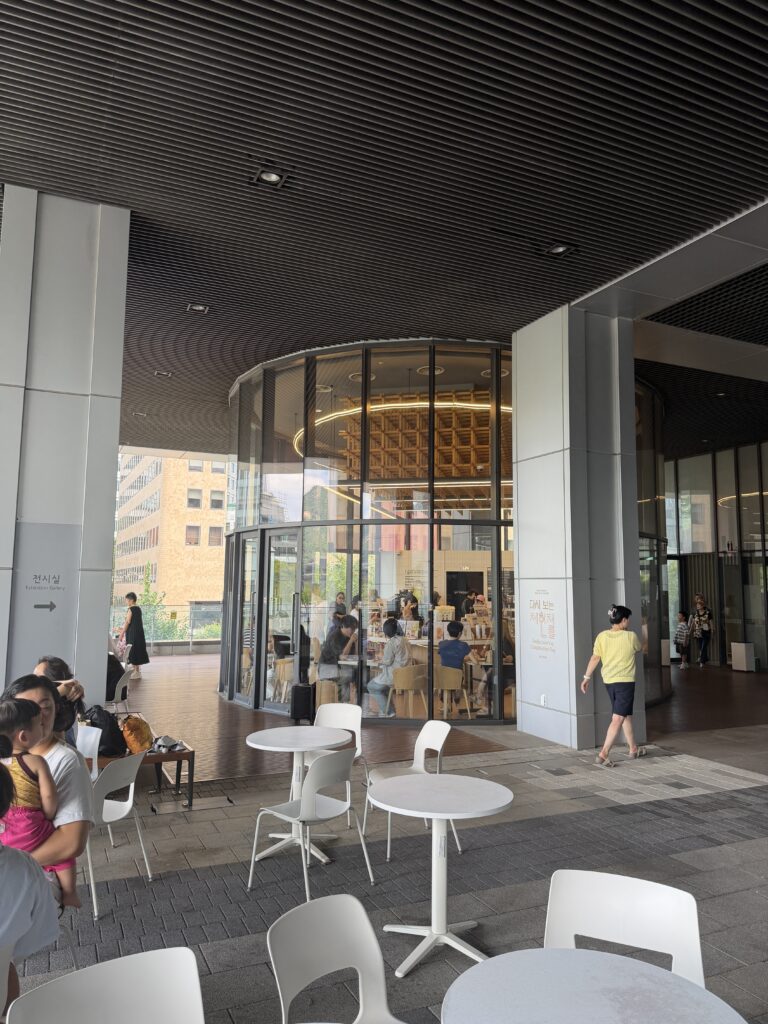
There is a café with both indoor and outdoor seating, and the outdoor tables sit under a deep overhang. In early autumn that meant shade without the glare; in December it means some shelter from the wind off the square. Useful if you need to park a tired child somewhere while the other parent finishes a floor.
How to Get There
Take Line 5 to Gwanghwamun Station and use Exit 2. The museum is on Sejong-daero, directly across from Gwanghwamun Square — a two-minute walk, entirely flat, with wide pavements the whole way.
Hours and the current special exhibition are listed on the museum’s official website (Korean, with an English version available).
If you need to check something before you go — a temporary closure, whether the night opening is running that week, what is on in the special exhibition hall — the museum’s general line is +82-2-3703-9200. The line is answered in Korean, so if you do not speak it, call the Korea Travel Hotline on 1330 instead — it runs in English, Chinese and Japanese around the clock, and the operators will phone the museum on your behalf.
My Honest Take
The National Museum of Korean Contemporary History is the most underrated stop in Gwanghwamun. It is free, it is indoors, it has a children’s floor that needs no booking and turns away nobody on age, and it has a rooftop that hands you the postcard view of Gyeongbokgung without a ticket. For a family with young kids on a cold or wet day in central Seoul, I do not know a better three hours.
If you are building a Gwanghwamun day around it, pair it with the Seoul Museum of History a few minutes west, which is also free, or walk the other way to Ssamzigil in Insadong. And if it rains, the three free museums under Gwanghwamun Square are a two-minute walk away and entirely underground.
1 thought on “National Museum of Korean Contemporary History: 3 Free Things (Seoul)”