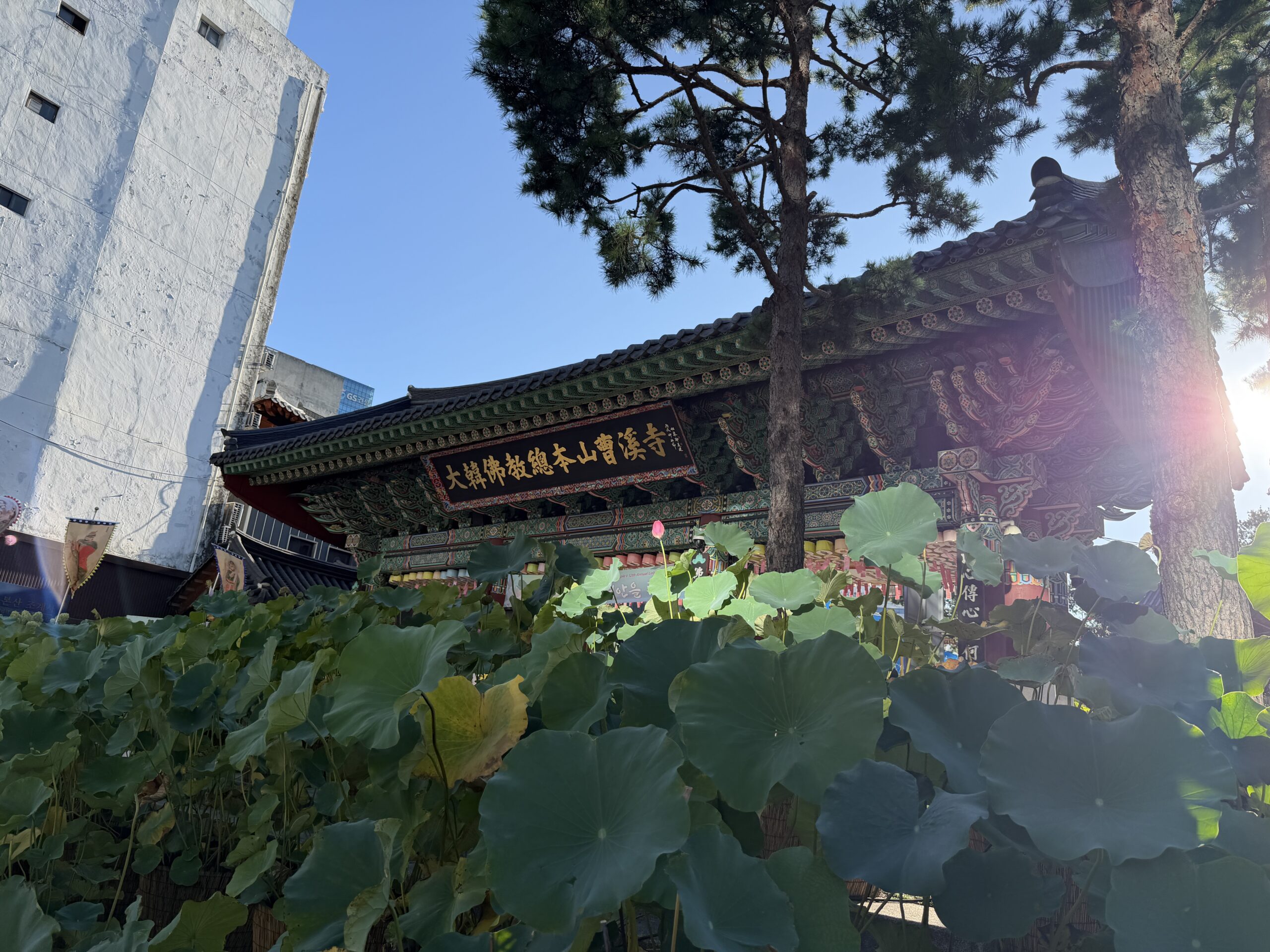
Jogyesa Temple sits in the middle of Seoul’s office district, and you can walk in off the street, without a ticket, and stand under several thousand paper lanterns. One minute away, on the same block, there is a small building where Korea’s modern postal service began and collapsed inside three weeks. Both are free. Most visitors walk past both on their way to Insadong.
We went on a weekday morning in lotus season, with a five-year-old and a 22-month-old, and stayed about ninety minutes.
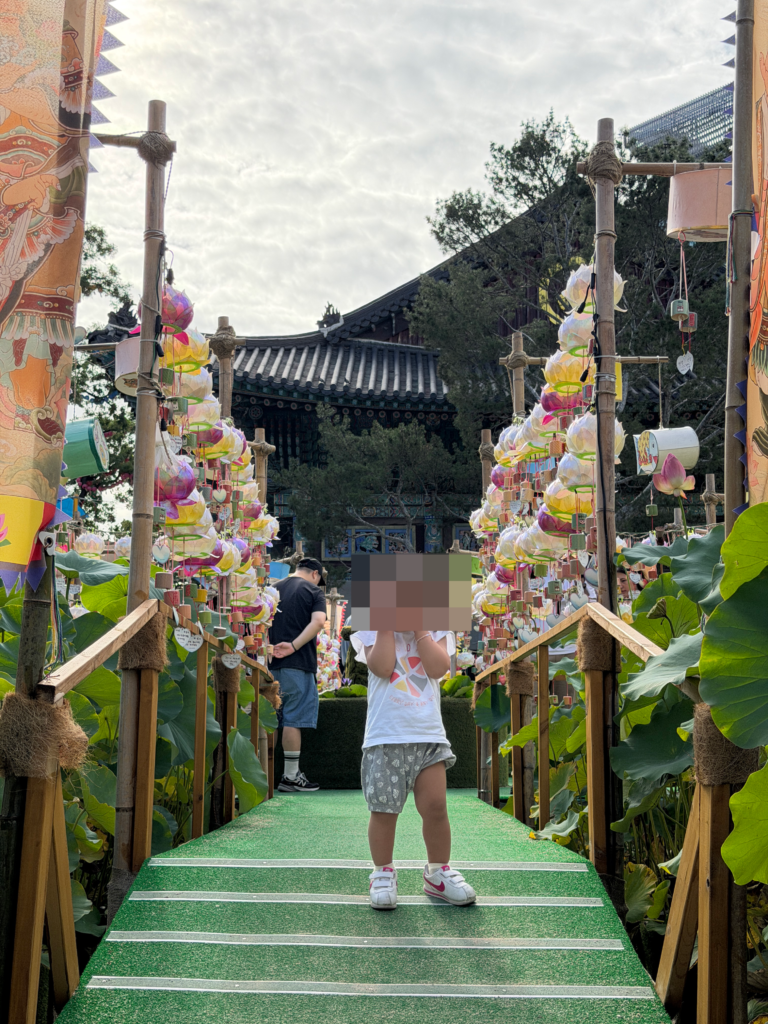
Walking into Jogyesa Temple
Jogyesa is not a museum with a temple inside it. It is the head temple of the Jogye Order, the largest Buddhist order in Korea, and people come here to pray, not to sightsee. There is no gate to buy a ticket at. You walk in from Ujeongguk-ro, past the shops selling prayer beads and monk’s robes, and you are in the courtyard.
That matters for how you behave, and I will come back to it. But it also means the place has none of the sealed-off feeling of a restored palace. Office workers cut through it at lunchtime. Someone was sweeping. A woman was bowing at the pagoda while a delivery scooter went by outside the wall.
The lotus flower festival
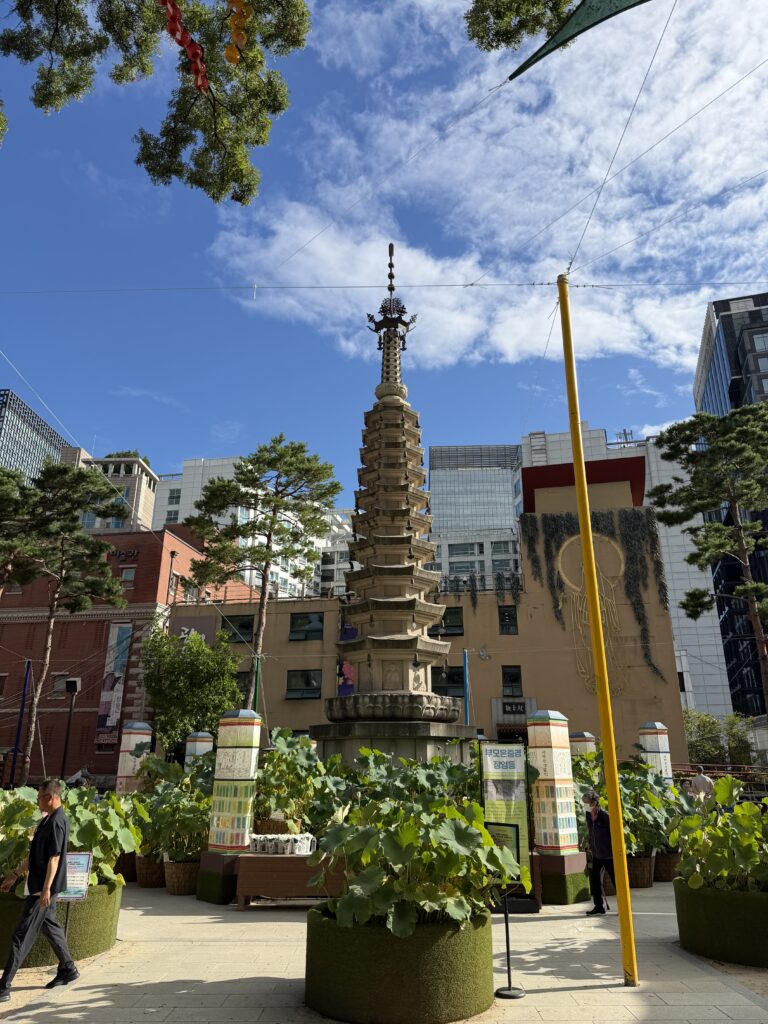
From July into September, the courtyard fills with potted lotus. Not a pond — hundreds of individual baskets and tubs, arranged in rows and terraces around the pagoda and along the walls, so you walk through them at waist height rather than looking across a pond at them.
For small children this is unusually good. The flowers are at eye level. The leaves are the size of dinner plates and hold beads of water in the middle, which is the single most interesting fact in the world if you are five.
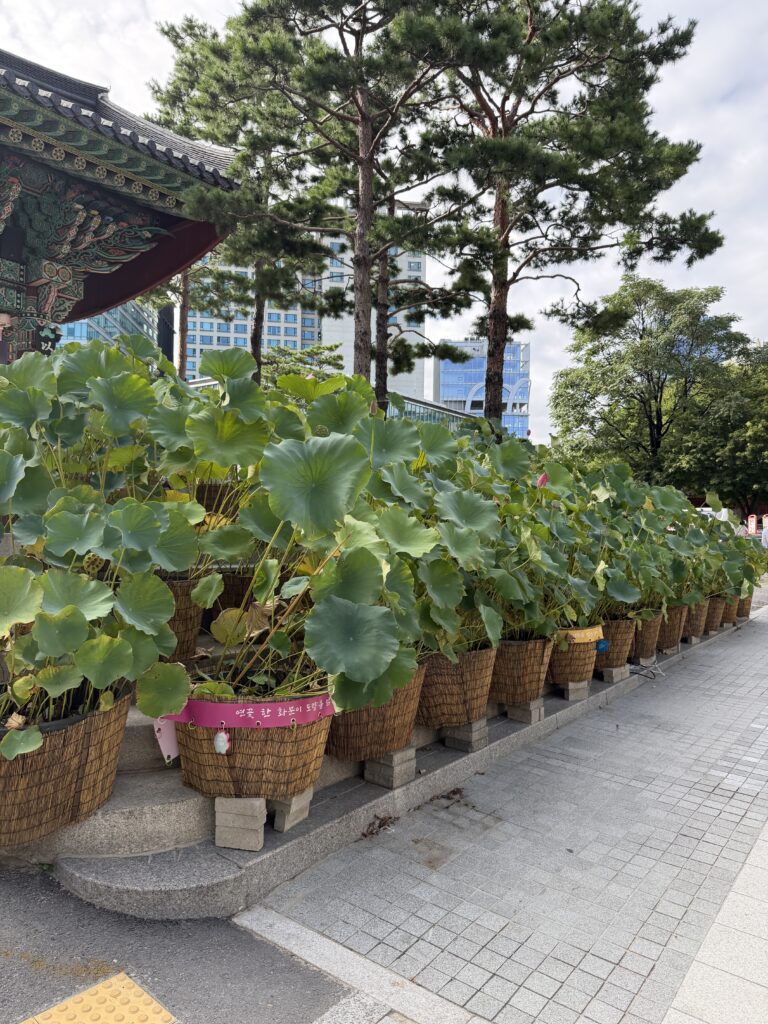
Dates for 2026: the festival ran from 10 July into mid-September. The closing date shifts with the flowering, so call before you plan a trip around it — 02-768-8600. Outside the festival the courtyard is still open and still worth an hour; you just get trees instead of flowers.
The main hall, and its ceiling
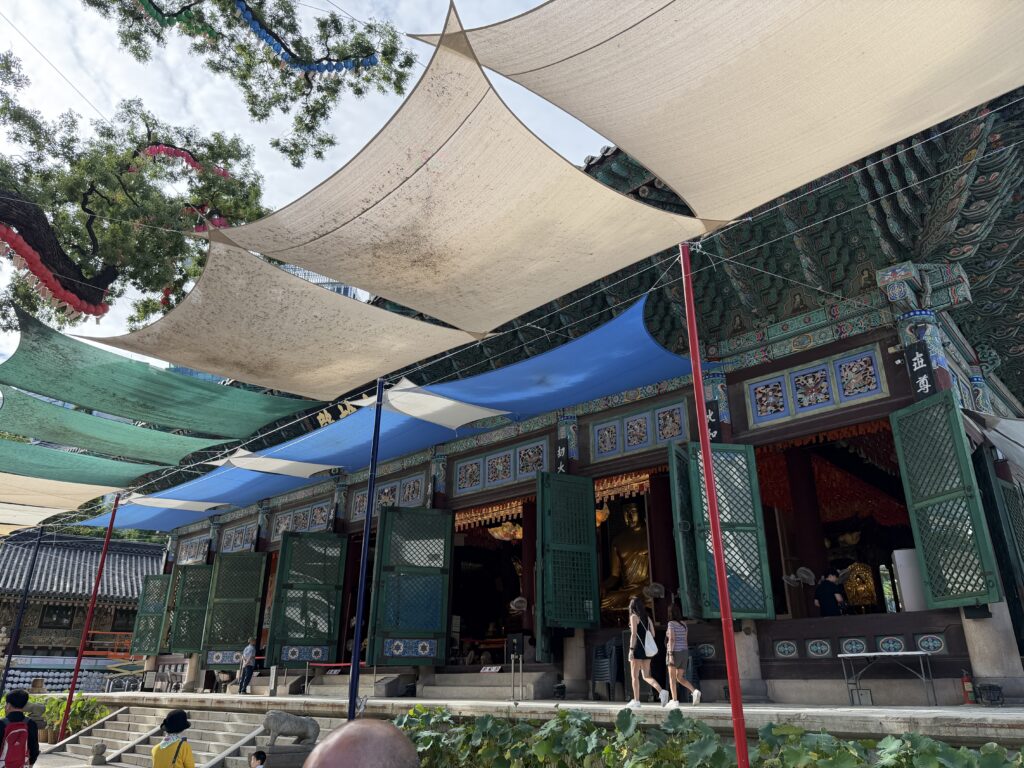
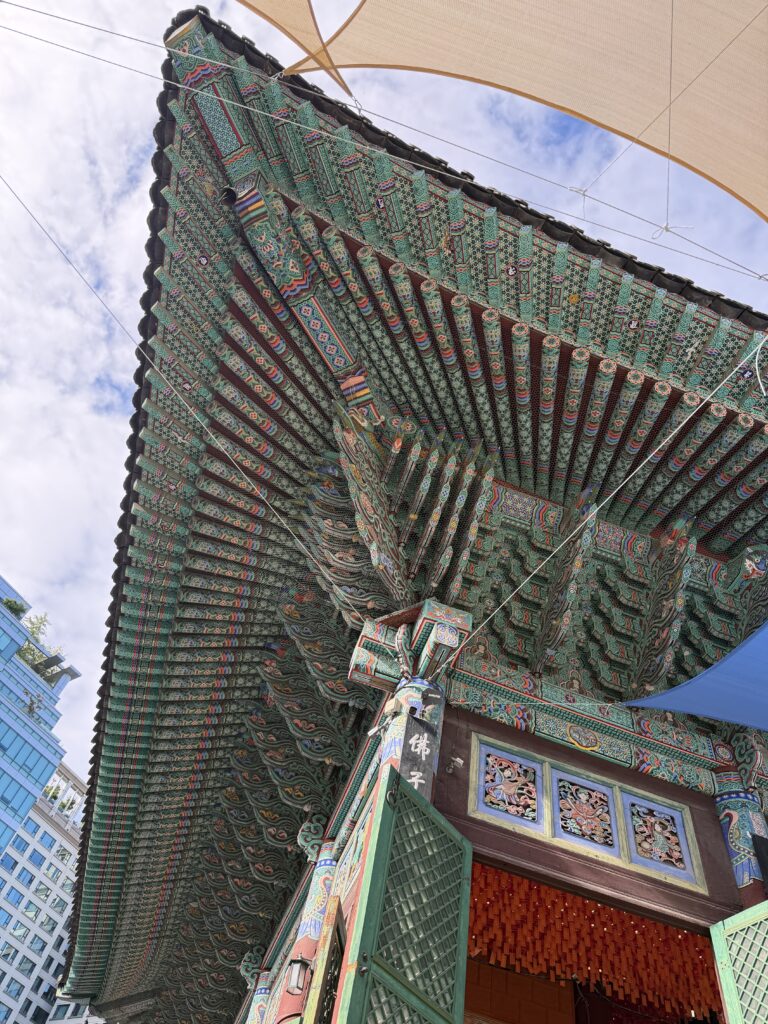
The main hall, Daeungjeon, dates from 1938 and is registered as Seoul tangible cultural heritage. From the outside it reads as a very large wooden hall with a heavy tiled roof. What you do not expect is the ceiling.
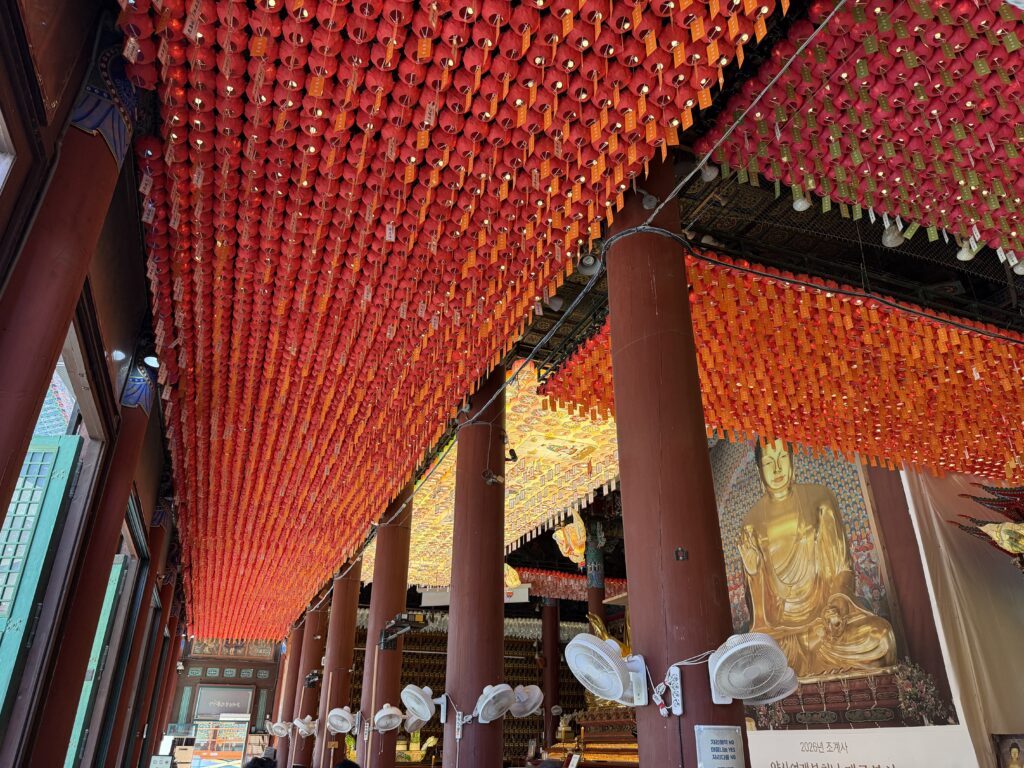
Inside and along the covered walkways, prayer lanterns hang in dense rows — thousands of them, red and orange, each one bought by someone with a name card attached. They fill the space overhead completely. The gilded Buddha figures at the far end are visible through them, which produces an effect I have not seen anywhere else in Seoul.
The best thing that happened
Under the eaves of Korean temple buildings hang small bronze bells called punggyeong, each with a thin metal fish suspended inside as the clapper. When the wind moves, the fish swings and the bell sounds — a single high note, irregular, never quite in rhythm.
Our older child stopped in the middle of the courtyard, closed both eyes, and stood still to listen. Then asked to keep listening. We stayed there for several minutes while people walked around us.
I had planned the lanterns and the flowers. The thing that actually landed was a sound I would not have thought to point out.
And the worst thing, according to the toddler
The 22-month-old had an entirely different morning. She spent the first twenty minutes crouched at the edge of the courtyard, moving a patch of sand from one place to another with great seriousness, completely uninterested in flowers.
Then we carried her into the main hall. The Buddha figures inside are tall, gilded, and lit from below in a dim room. She took one look, burst into tears, and demanded to be picked up. Once she had calmed down we tried to put her back on her feet, and she refused — arms locked, not happening.
Outside, she wanted down immediately. She went straight into the rows of lotus pots and settled in behind the leaves, with the main hall safely out of sight.
One stopped to listen. One hid in the flowers. Same courtyard, same hour.
This is a working temple
Say it plainly, because foreign visitors are often not told: people are praying here.
Photography in the courtyard, of the flowers, the pagoda and the buildings, is normal and nobody minds. Inside the main hall, be careful. If a service is running, do not photograph the people. Take your shoes off at the door if you go in, don’t step over the threshold in the middle of a bow, and keep your voice down. Nobody will stop you from entering — the courtesy is yours to manage.
There is no dress code in practice, but covered shoulders are polite.
One minute away: Korea’s first post office
Leave the temple by the main entrance, turn right, and within a minute you are standing in front of a small tile-roofed building set back from the road. This is Ujeongchoguk, the office of Korea’s first modern postal administration, now the Korea Postal Museum.
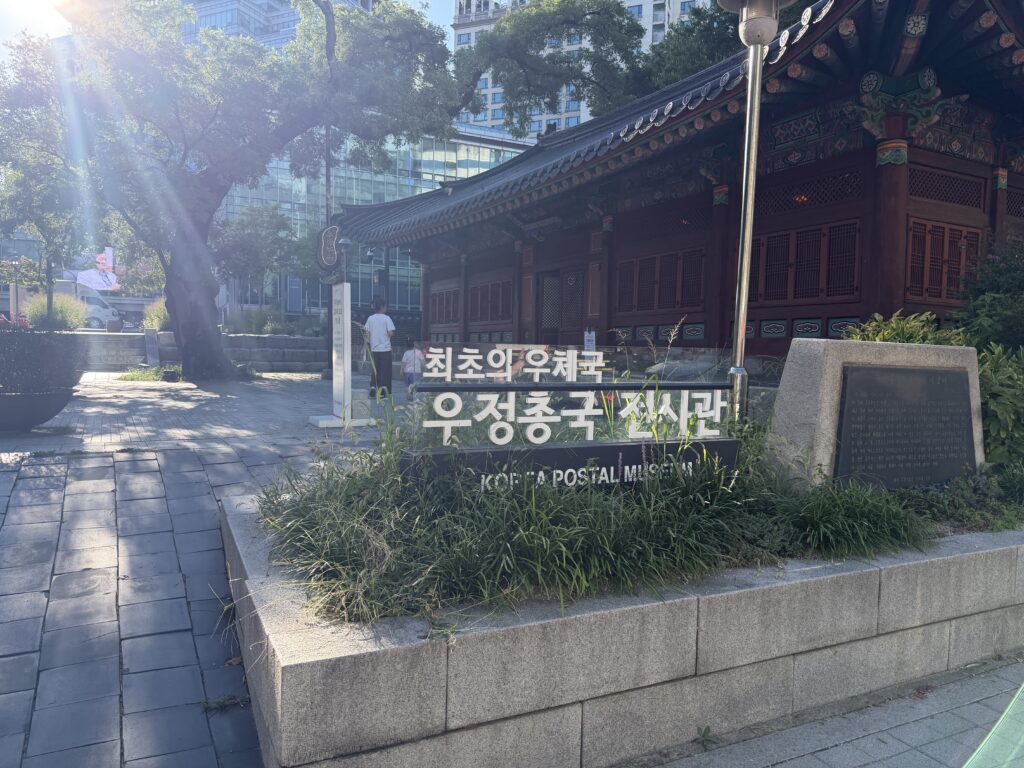
The institution was established in April 1884, during the reform push of the late Joseon period. Mail service opened on 18 November 1884.
On 4 December 1884, the building hosted a banquet to celebrate the opening. During that banquet the Gapsin Coup began. Sixteen days after Korea’s postal service started carrying mail, it was over, and the office was shut down.
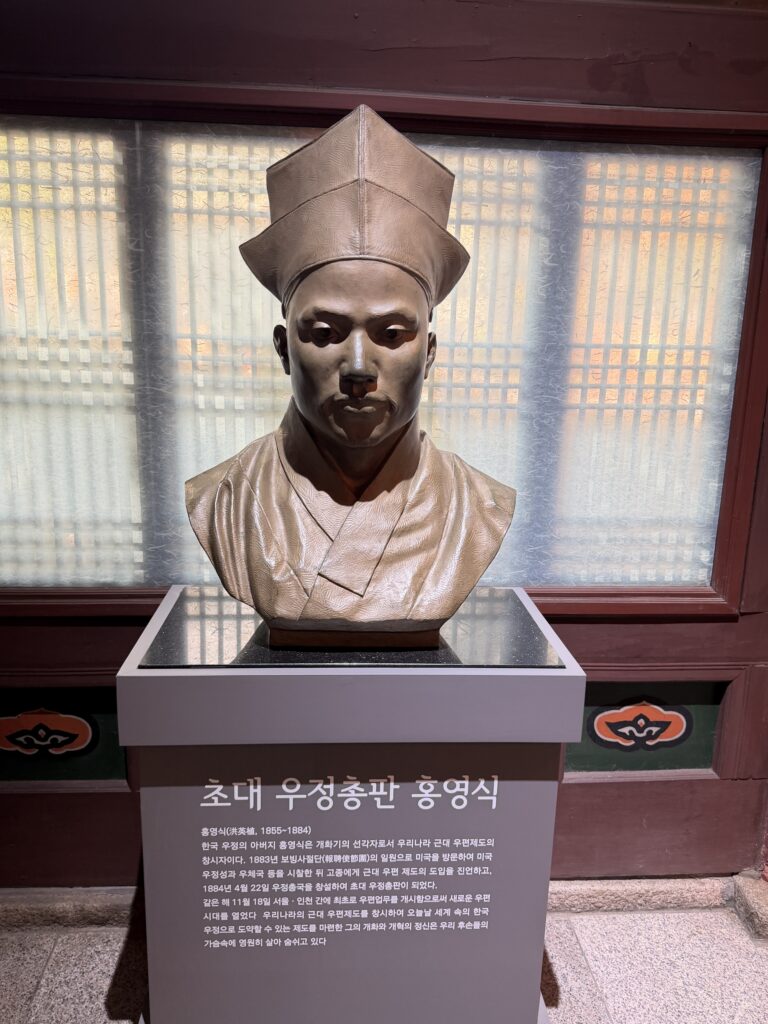
Hong Yeong-sik, the first postmaster general, was one of the reformers behind the coup. He was in his twenties when he took the post, and he did not survive the month. The bust is in the first room, and the plaque tells you the dates but not that they are only months apart.
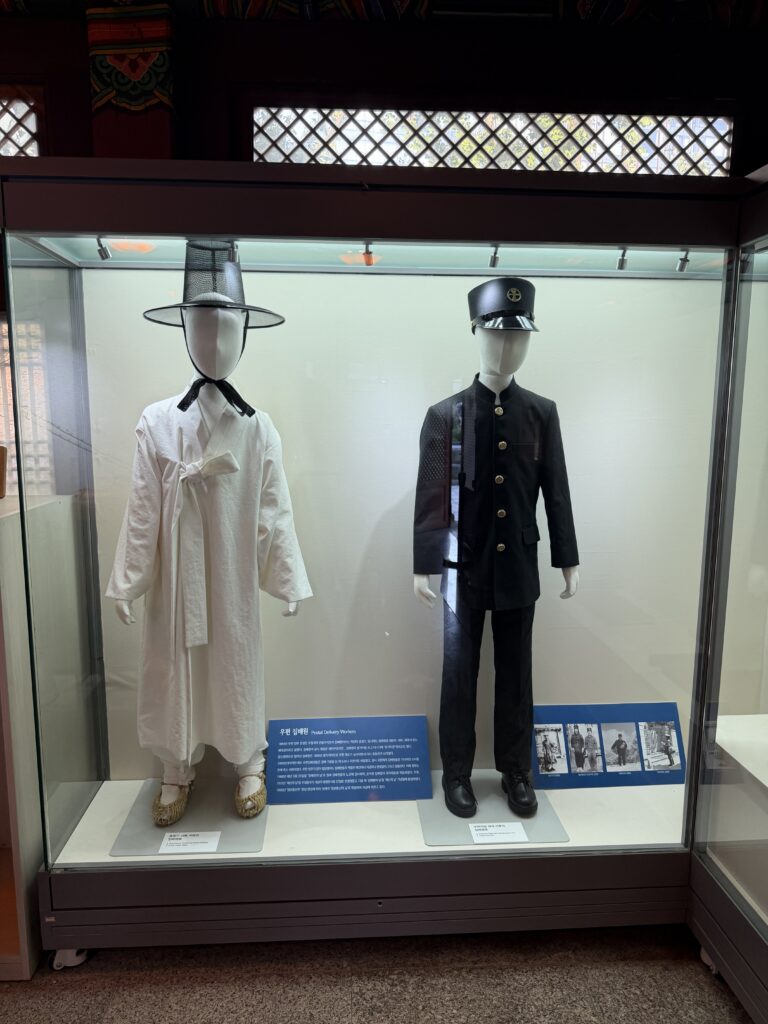
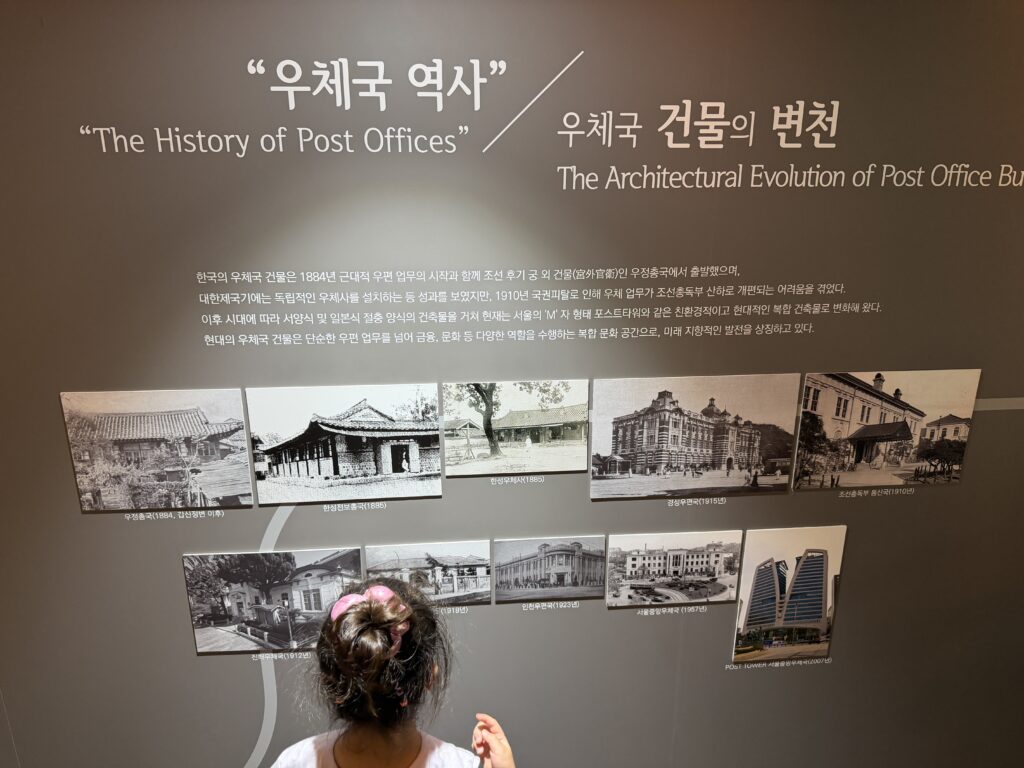
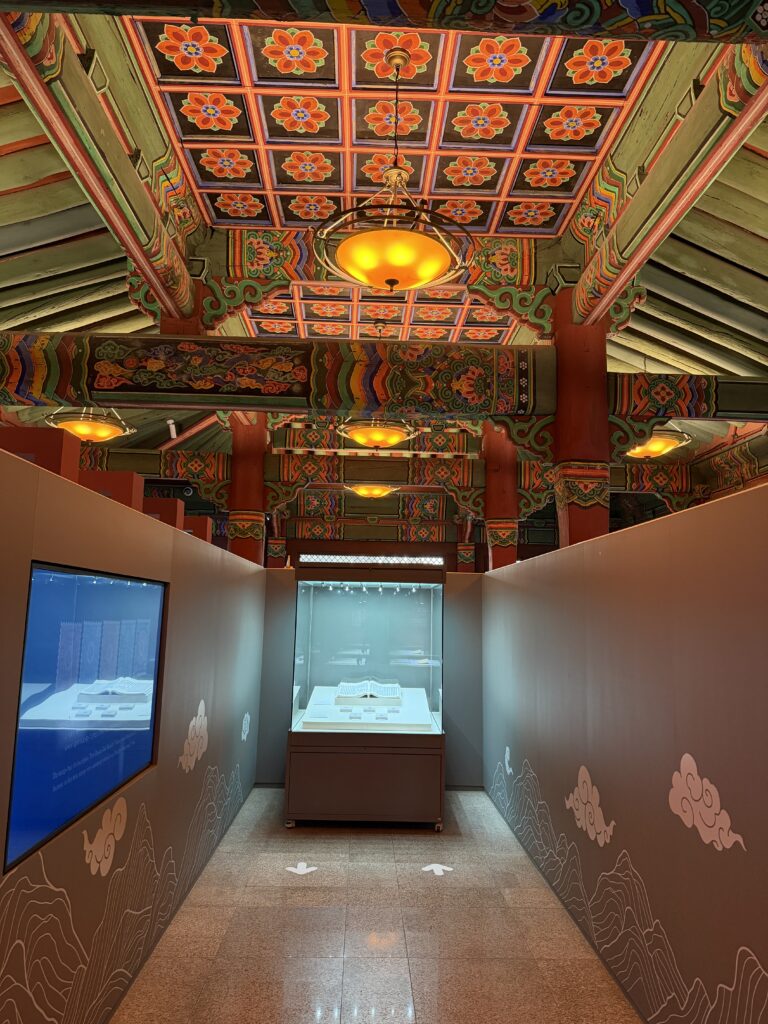
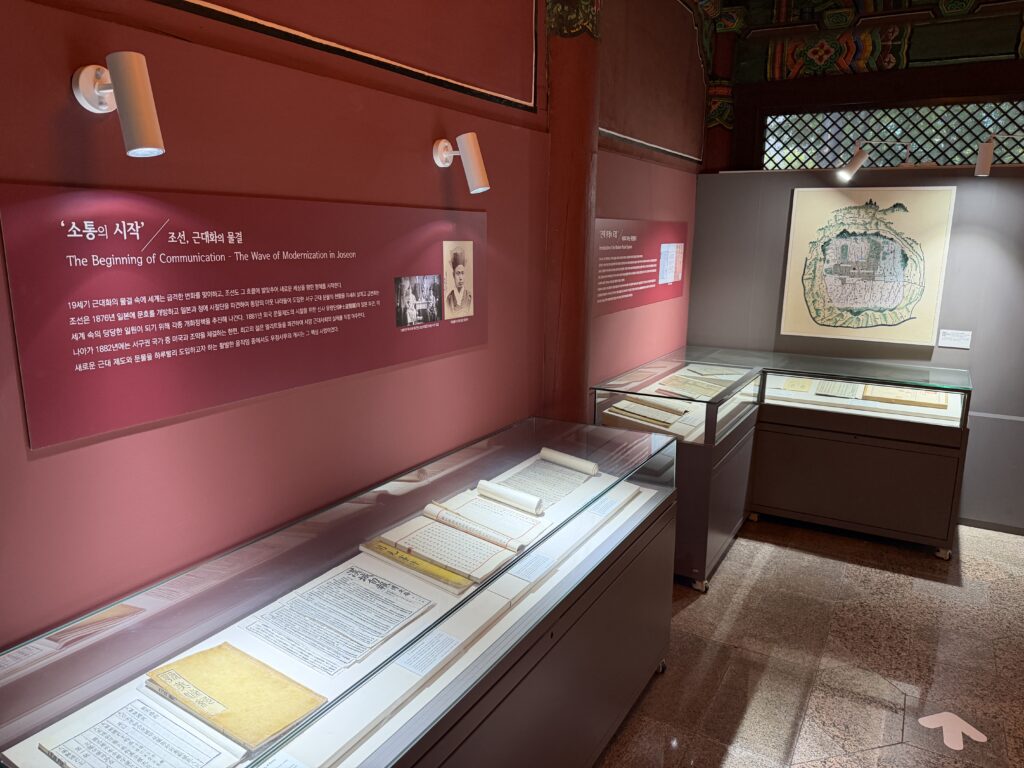
The museum takes twenty-five minutes. It is one floor, free, and quiet — there is a decent chance you will be the only visitors. For anyone who has spent a morning in crowds at Gyeongbokgung, that alone is worth the detour.
A caution on the hours: The museum opens 09:00–18:00 and closes for lunch from 11:50 to 12:50. It shuts only on 1 January and during the Lunar New Year and Chuseok holidays, so unlike most museums in Seoul it is open on Mondays. Admission is free.
Practical notes
Jogyesa Temple is at 55 Ujeongguk-ro, Jongno-gu. Free, open daily, no ticket office. Nearest stations are Anguk (Line 3, Exit 6) and Jonggak (Line 1, Exit 2), both a short flat walk. Allow about an hour at the temple, twenty-five minutes at the museum, and note that Insadong and the Ssamzigil craft mall are a further ten minutes on foot, which makes this an easy first stop rather than a destination in itself.
With a buggy: the courtyard is flat and paved and presents no problem. The raised lotus display has a step or a short ramp depending on where you enter, and the museum entrance has a step at the door. Both are manageable with one person lifting.
Toilets are in the temple complex, on the far side of the courtyard from the main hall.
Questions people ask
Do I need a ticket?
No. Both the temple and the museum are free, with no reservation.
Is the lotus festival worth timing a trip around?
If you are already in Seoul in July or August, yes — it is fifteen minutes’ walk from Gyeongbokgung and costs nothing. Outside those months, visit anyway for the lantern ceiling.
Can I go inside the main hall?
Yes, shoes off. Be quiet, and don’t photograph people who are praying. Fair warning with a toddler: it is dim inside and the gilded Buddha figures are large. Ours cried.
How long with young children?
Ninety minutes for both sites, comfortably, including time to stand still and listen to bells.
Is anything closed on Mondays?
No — this is one of the few free sights in central Seoul that is open every Monday.
Read next
Ssamzigil: The Insadong Building You Walk Up Like a Hill — Ten minutes from the temple gate. A craft mall built as one continuous ramp, so you reach the fourth floor without a single step. Workshops on every level, and a pushchair goes up the whole way.
Gyeongbokgung Palace: The Ultimate Local’s Guide — Fifteen minutes’ walk, and the obvious pairing if you are spending a day in Jongno. Tickets, hours, and the changing of the guard.
2 thoughts on “Jogyesa Temple, a Lotus Festival, and the Post Office That Lasted Sixteen Days”