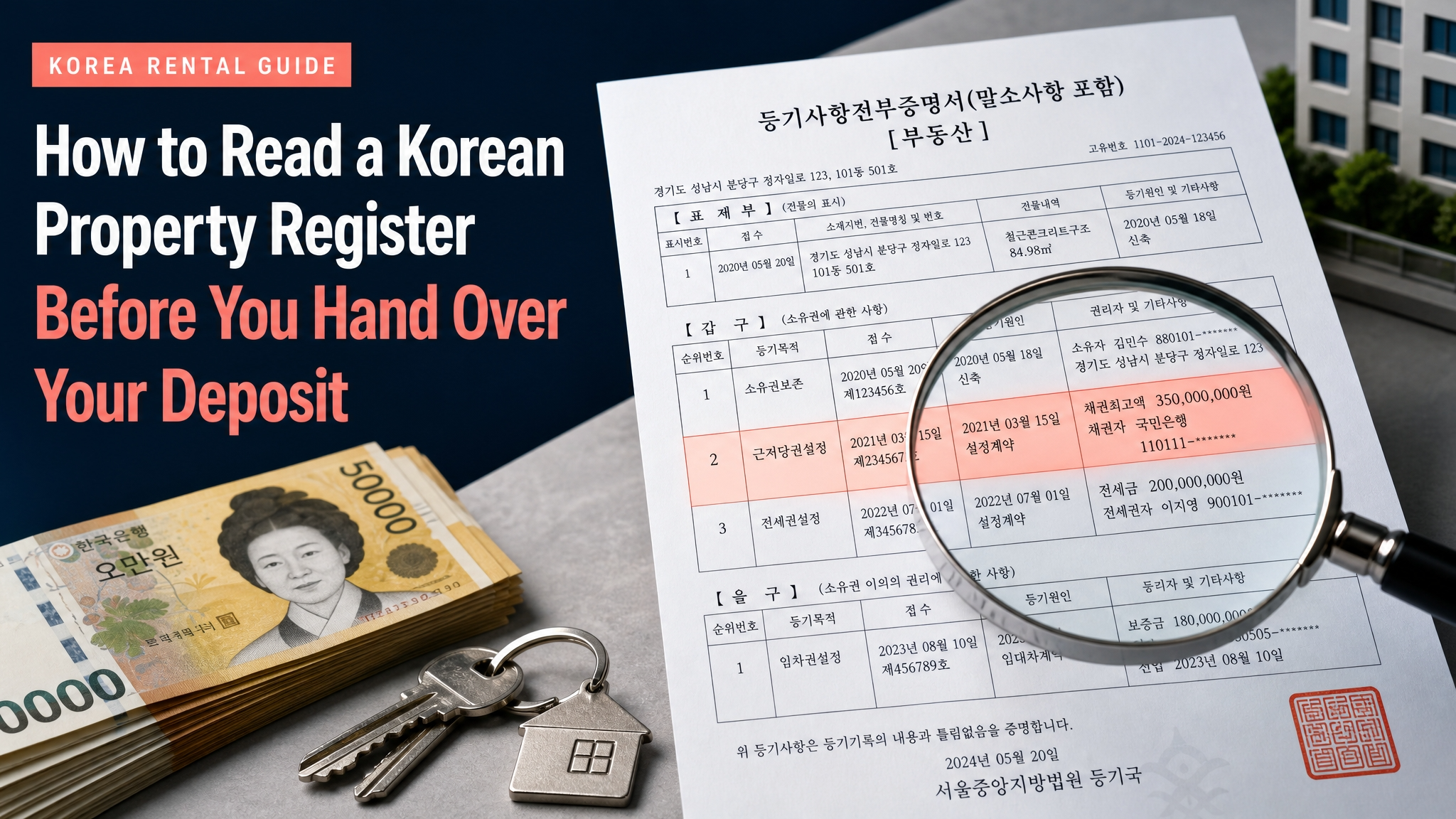
The Korean property register is a public document that costs 700 won, takes two minutes to download, and tells you more about whether you will see your deposit again than anything the landlord or the agent will say to you.
Most foreign tenants never look at it. Some are never told it exists. Others are handed a printout across a desk, nod at a page of dense Korean, and sign.
I have spent fifteen years working in property development and construction in Korea, and reading property registers is part of my job. They are less intimidating than they appear. The whole document comes down to about five figures, and in a healthy case three of them are zero.
This is a practical walkthrough: how to pull one, how to read the part that matters, and — the section most guides leave out — what the register never shows you, which is where careful foreign tenants still get hurt.
Why you, and not the agent
Korean residential leases put your money in the landlord’s hands. In jeonse you hand over a lump sum and pay no rent. In wolse you still hand over a deposit worth months of rent. If the landlord defaults and the property is auctioned, the proceeds are distributed to claimants in order of legal priority, and whoever is standing below the line where the money runs out receives nothing.
Where you sit in that queue, and what fixes your place in it, is the subject of a separate guide — how jeonse deposit protection actually works in Korea, including the two legal rights involved and the provision that makes them available to foreign nationals. Read that one for the law.
This article is about the document that tells you, before you have committed a single won, how many people are already standing in front of you.
A licensed agent is legally required to explain the property’s legal status to you, and most do it properly. But understand the incentives in that room. The agent is paid when the contract closes. The landlord wants the deposit. You are the only person present whose savings are at stake.
Pull your own copy. It costs less than a coffee.
Pulling the register
The only official source is iros.go.kr, the Supreme Court’s Internet Registry Office. Ignore third-party services that fetch it for you at a markup.
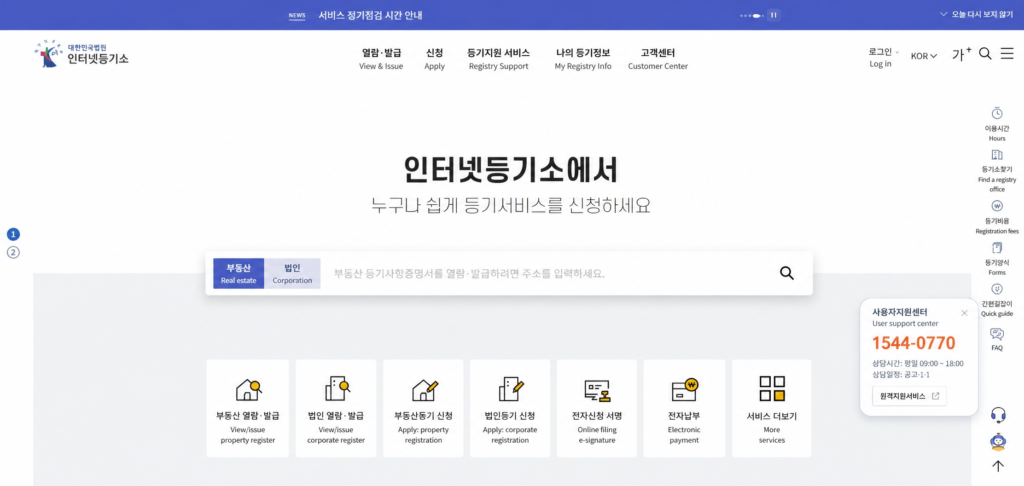
You do not need to own the property, you do not need the landlord’s permission, and you do not need to tell them you are doing it. The register is deliberately public, on the principle that anyone about to transact over a property should be able to verify its status. All you need is the address.
Two options will be offered, and the distinction matters.
Viewing (열람) costs 700 won. It shows the register on screen and lets you print it. This is what you want for checking before you sign.
Issuing (발급) costs 1,000 won and produces a certified copy with legal weight, for submitting to a bank or a government office. You do not need it for due diligence.
Search by address. You will be asked what type of property you are looking for, and this is where people first go wrong. If you are renting an apartment, an officetel, or any unit inside a building with multiple separately owned units, choose 집합건물 — collective building. Not 토지 (land), not 건물 (general building). A collective building search returns a list of individual units, and you select yours.
Check the unit number here with more care than feels necessary. Korean buildings routinely carry a registered unit number that differs from the number screwed to the door — a unit signed as 302 may be registered as 301 or as B02, usually for reasons buried in the building’s permit history. The register is what counts legally. If the number on your contract does not match the register, your contract may attach to a unit you have never set foot in. Have the discrepancy explained and the contract corrected before anything is signed.
The anatomy of a Korean property register
A collective building register has four parts, and you can read them in order.
The building title section (표제부) covers the whole structure: address, registration date, floors, construction.
The unit title section covers your unit, including its registered exclusive floor area. Glance at that figure. Korean listings quote area in several different ways, and a unit advertised as substantially larger than its registered area is worth a question.
Section A (갑구) records ownership and anything threatening ownership.
Section B (을구) records everything that is not ownership — principally borrowing secured against the property.
Section B is where your deposit lives or dies, so start there.
The number that decides it
In Section B you are looking for mortgage entries — 근저당권설정 — and within each entry, one figure: 채권최고액, the maximum claim amount.
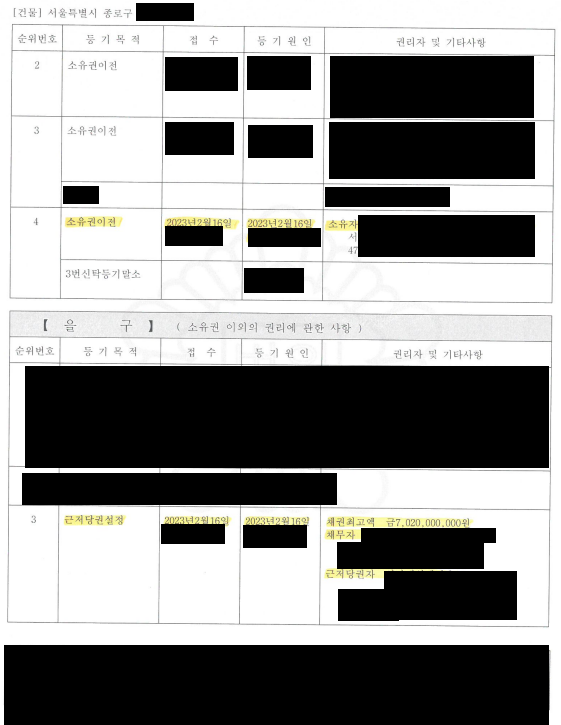
This is the most misunderstood number in Korean property, so be precise about what it is.
It is not the outstanding loan balance. It is the ceiling the lender registered against the property, conventionally set somewhere around 110 to 130 percent of the amount actually advanced, so that accrued interest and enforcement costs are covered.
The consequence: in an auction the lender can claim up to that registered ceiling ahead of you, regardless of the current balance. If a landlord tells you the mortgage is nearly repaid, that may be entirely true and it is still not the number to plan around — nothing stops them drawing down again against the same registration. Use the registered figure.
If Section B is empty, that is the clean case and this risk does not apply to you.
If there is a mortgage, do the arithmetic before you become invested in the apartment. Not after.
Add the maximum claim amount to your deposit. That total is what needs to come out of this property if everything unwinds. Compare it to what the property is actually worth.
For market value, use rt.molit.go.kr, the Ministry of Land’s real transaction price disclosure system. It publishes actual reported transaction prices building by building, rather than the asking prices on listing sites. For an apartment in a large complex this gives a reliable figure in minutes. For a smaller or unusual building it is less useful, and you should be more conservative to compensate.
The working convention among Korean tenants, and in my line of work, is that registered claims plus your deposit should sit comfortably below roughly 70 percent of market value. Below 60 percent is comfortable. Between 70 and 80 you are accepting real risk in exchange for something — a better location, a lower price — and you should at least know you are making that trade. Above 80 percent you are relying on the market not falling, which is not a plan.
That figure is a convention, not a legal standard, and it exists for a concrete reason: auction sales rarely clear full market value. Discounts of twenty percent or more are ordinary, and the shortfall falls entirely on whoever is last in the queue.
Also look for a registered lease right — 전세권설정 — held by an earlier tenant. That deposit ranks ahead of yours and belongs in the same arithmetic.
Two checks in the ownership section
Section A is quicker, but do not skip it.
First, confirm that the name in the most recent ownership entry is the name of the person signing your contract. If someone else is signing — a family member, a property manager, anyone — you need a certified power of attorney and the owner’s registered seal certificate, and you need to verify them rather than glance at them. A meaningful share of outright deposit fraud involves someone who was never the owner.
Second, scan for these terms: 압류 (seizure), 가압류 (provisional seizure), 가처분 (provisional disposition), 임의경매개시결정 (commencement of auction), 가등기 (provisional registration). Any of them means the property is already contested or already in enforcement. Do not negotiate. Walk away. There is always another apartment, and there is not always another deposit.
One more entry catches people who are otherwise careful: 신탁등기, a trust registration. If you see 신탁 anywhere on the register, the registered owner is a trust company and not the person showing you the apartment — stop and get advice before going further. I cover why this is so dangerous in the deposit protection guide.
Reading the register’s history correctly
One point of technique that saves unnecessary panic.
Entries marked 말소 have been cancelled. A discharged mortgage does not disappear — it stays visible with a cancellation note, as part of the property’s history. So a long Section B is not automatically bad news. A property bought and refinanced several times over twenty years will have a long register full of cancelled entries and may have nothing live against it at all.
Read the status of each entry, not the length of the document.
For anything you cannot parse, paste the line into a translation app. The register is formulaic — the same phrases recur in the same order — and machine translation handles it far better than most Korean legal writing.
Pull it again before you hand over the money
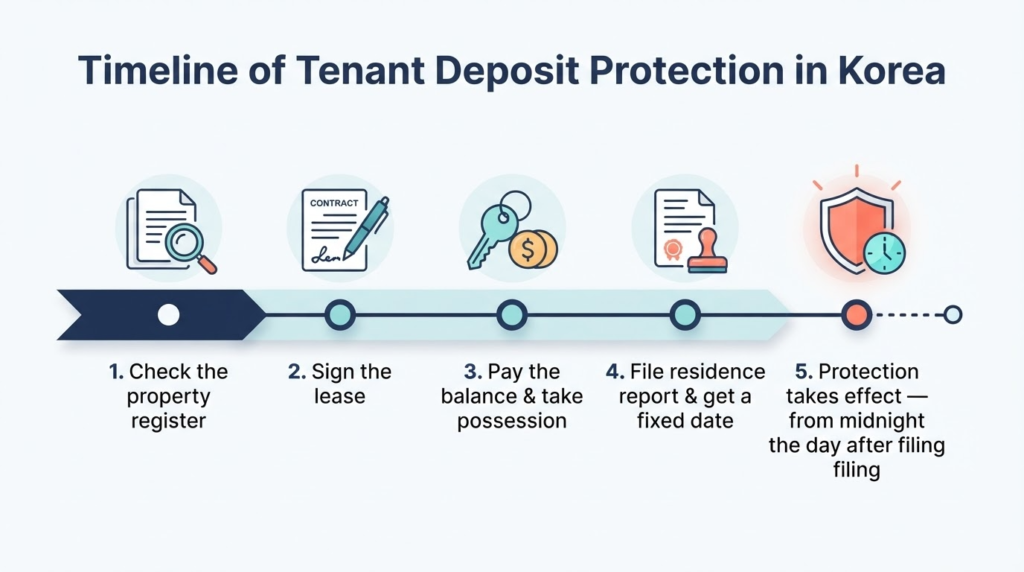
Your protection as a tenant takes effect from midnight at the start of the day after you complete your residence filing, not when you sign and not when you pay. That one-day gap is explained in full in the deposit protection guide, and it has a direct consequence for this document: a landlord who registers a new mortgage on the day you hand over the balance ranks ahead of you, and the register you pulled last week shows nothing.
So pull it three times. Once before you sign, to decide whether to sign at all. Once on the day you pay the balance and collect the keys — before you transfer the money, not after. Once the day after you file, to confirm nothing appeared overnight.
Three copies, 2,100 won. If the third shows something new, you have found out in time to act rather than eighteen months later.
Alongside this, ask for a contract clause obliging the landlord not to create any new encumbrance until your protections take effect, with the deposit repayable if they do. It appears in standard contract forms. A landlord who refuses has given you information.
What the register does not show you
A clean register is necessary but not sufficient. Several claims that can outrank you are not recorded there at all.
Tax arrears. Unpaid national and local taxes owed by the landlord can take priority over a tenant’s claim in distribution, and they appear nowhere on the property register. A property with an empty Section B can still carry a large hidden claim. Tenants now have a right to inspect a landlord’s arrears in defined circumstances — the conditions and timing are in the deposit protection guide. Know the right exists and use it.
Other tenants in a single-owner building. This is the trap I would most want a foreign tenant to understand, and it is invisible on the register by design.
Korean law distinguishes two building types that look identical from the street.
A 다세대 building (multi-household housing) is legally several separate properties. Each unit has its own entry in the property register and can be owned by a different person. When you pull the register for your unit, you are seeing that unit’s full picture.
A 다가구 building (multi-unit housing under single ownership) is legally one property with one owner, divided into units that are rented rather than sold. There is one register for the entire building. Your unit does not exist as a separate legal entity.
That difference decides whether a clean register means anything. In a 다가구 building, every tenant’s deposit ranks by its own date, and each one that predates yours stands ahead of you — yet none of them appear on the register, because tenancies are not registered interests. The register can be spotless while the building carries hundreds of millions of won in prior deposits.
How to tell which you are looking at: pull the register. If the search returns a list of individual units under 집합건물, it is 다세대. If the building appears as a single property under 건물, with one owner and no unit breakdown, it is 다가구.
If it is 다가구, there is one more document you need before you go any further. Request a 전입세대확인서 (jeonip sedae hwaginseo) — a certificate listing every household registered as resident at that address, with the name of each head of household and the date they moved in. That list is how you find out who is standing in front of you. Until a recent rule change this document was called 전입세대열람내역, and you will still see the old name online; ask for the current one.
You cannot simply walk in and request this for any address. A prospective tenant generally needs the landlord’s written consent or a signed contract to obtain it. A competent agent will produce it without being asked twice — and if you are renting in a 다가구 building and nobody has offered it, that is the single most important document missing from your file.
Building legality. The register says who owns the property and who has claims on it. It says nothing about whether the structure is legal. An illegally extended rooftop unit or an unpermitted conversion may be subject to enforcement, and will generally fail to qualify for deposit guarantee insurance. That is a different document — the building ledger, 건축물대장, available through Government24. If the unit is on a rooftop, in a basement, or simply feels improvised, it is worth ten minutes.
You cannot simply walk in and request this for any address. A prospective tenant generally needs the landlord’s written consent or a signed contract to obtain it. A competent agent will produce it without being asked twice — and if you are renting in a 다가구 building and nobody has offered it, that is the single most important document missing from your file.
If the numbers come back bad
Three responses, in order of cost to you.
Do not sign. It costs nothing and it is frequently correct. The difficulty of walking away from an apartment you have already pictured yourself living in is the main reason people sign leases they were given good reason not to sign. Do the arithmetic early, before it becomes your apartment in your head.
Require the mortgage discharged at handover. Part of your deposit goes directly to repaying the loan, the cancellation is filed at the registry the same day, and the sequence is written into the contract as a condition. Agents arrange this routinely. Verify the cancellation on the register the following morning.
Take out deposit guarantee insurance. Most foreign tenants should, regardless of what the register shows. It also has a secondary use: the insurer runs its own assessment, so a refused application has told you something the register did not. Terms and eligibility are covered in the deposit protection guide.
Where this fits
Reading the register answers one question: was this deposit ever safe to hand over.
It gives you no legal standing. That comes from taking possession and completing your residence filing, and your rank in the creditor queue comes from the fixed date on your contract — both cheap, both easy to do a week too late. Both are in the companion guide.
Do the register first, though. The other two protect your place in a queue. This one tells you whether you want to be in it.
General information drawn from published and official sources, not legal or financial advice. Fees and procedures change — verify at the source before relying on them. Free counselling on housing lease matters is available through the Korea Legal Aid Corporation.