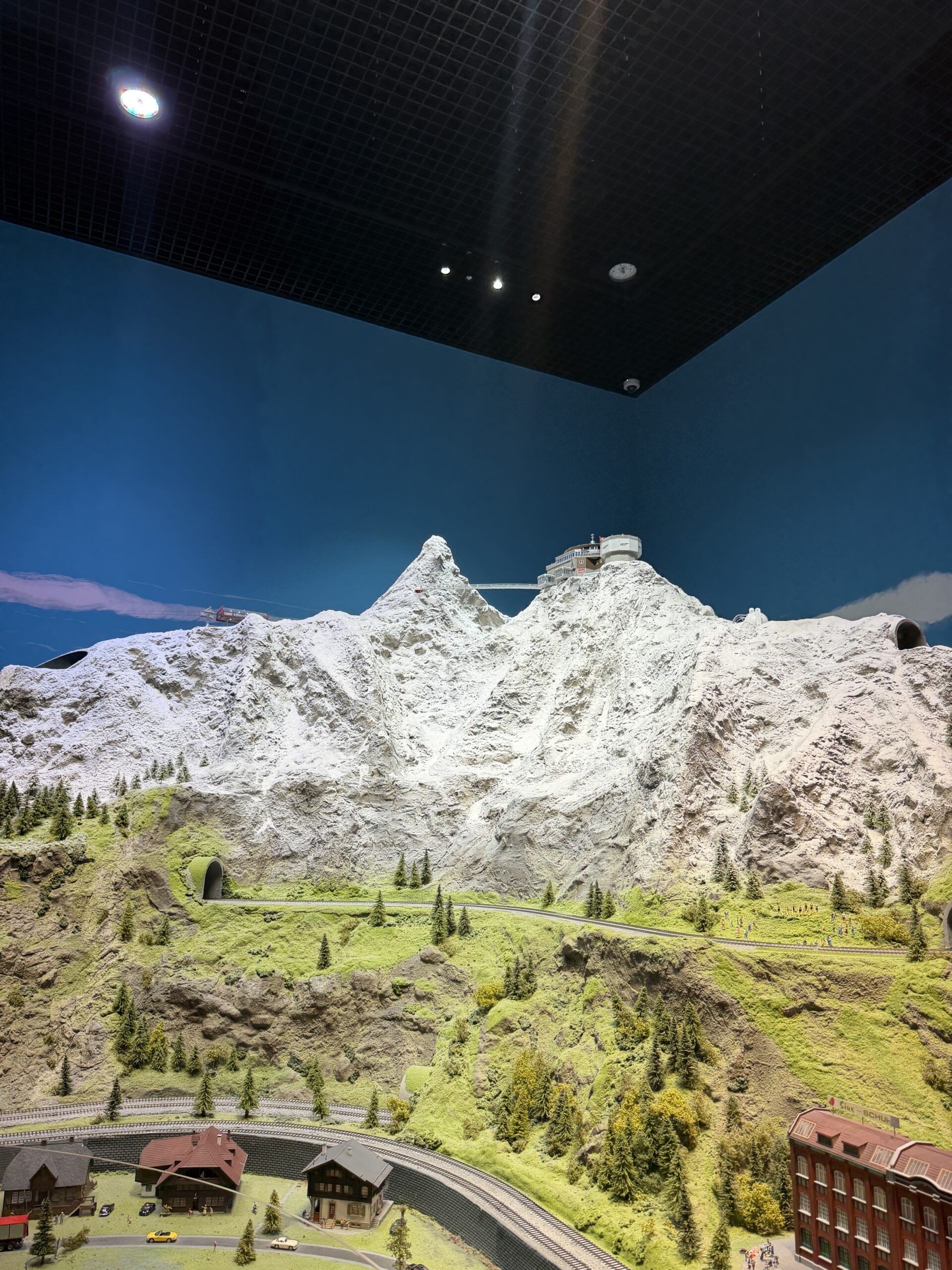
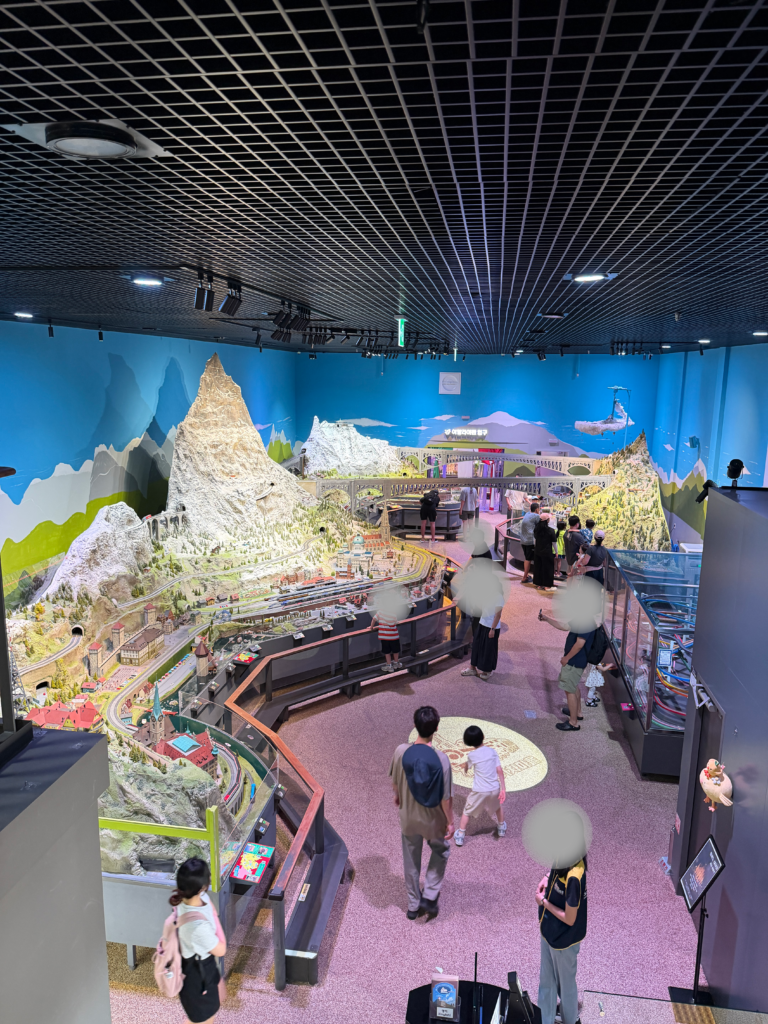
If the Italy Hall at Nowon Train Village is a place about art and architecture, then the Swiss Hall is unmistakably a place about nature and motion. The official brochure describes Switzerland as “a land of beautiful nature where Heidi sang,” and honestly, that line captures the mood of the entire room. The moment you step inside, you’re surrounded by towering alpine peaks, snow-dusted summits, quiet mountain villages, and — most importantly for a room full of children — trains that never stop winding their way through the scenery. I visited on a weekend with my two young daughters, and while I’d expected the Italy Hall to be the highlight, it was actually here in the Swiss Hall that both of them completely lost track of time. In this post I want to walk you through exactly why this hall is such a rewarding stop for families, what to look for, and how to make the most of a visit.
The Swiss Hall sits inside Hwarangdae Railroad Park, a lovely spot in northeastern Seoul built around a beautifully preserved historic station — if you haven’t read it yet, our full guide to the park covers how to get there, parking, and everything else outside the miniature halls.
Quick Info Before You Go
| Item | Details |
|---|---|
| Opening hours | Tue–Sun 10:00–19:00 (last entry 18:00) |
| Closed | Every Monday |
| Admission | Adults ₩4,000 / Youth & children ₩2,000 (half price for Nowon residents) |
| Ticket covers | Swiss Hall and Italy Hall (one ticket for both) |
| Location | Inside Hwarangdae Railroad Park |
| Parking | Free for 2 hours, then ₩150 / 5 min |
One thing worth knowing up front is that a single admission ticket covers both the Swiss Hall and the Italy Hall, so you can see both in one visit without paying twice. That makes the whole outing feel like good value, especially with children who qualify for the discounted rate. If you’re visiting with younger kids, I’d actually recommend starting with the Swiss Hall, because the interactive train buttons here grab their attention almost instantly and set a fun, energetic tone for the rest of the day. Please note that these details are accurate as of my visit — since operating hours and fees at attractions like this can change, it’s always worth double-checking the official channels before heading out.
The Star of the Show — A Matterhorn-Style Mountain and Trains Everywhere
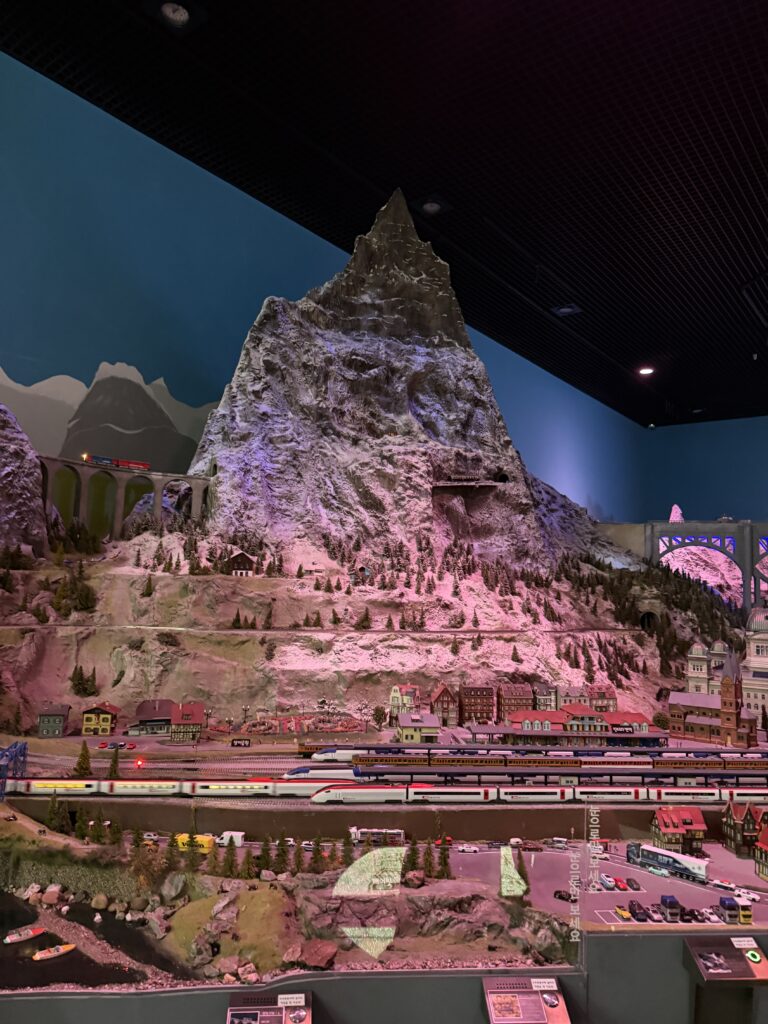
The undisputed centerpiece of the Swiss Hall is an enormous mountain that rises almost all the way to the ceiling. Its sharp, jagged peak is instantly recognizable to anyone who has ever seen a photograph of the Matterhorn — that unmistakable, slightly hooked pyramid that towers over the town of Zermatt in real life. Under the hall’s shifting pink and purple lighting, it takes on an almost fantastical, dreamlike quality. Standing at its base and looking up, you get a genuine sense of scale that flat photos can never quite convey — my kids actually tilted their heads all the way back to take it in.
But what truly makes this diorama come alive isn’t the mountain standing still; it’s the trains. Sleek, modern high-speed trains and colorful local passenger cars run continuously along the tracks that circle the mountain’s base, weaving in and out of tunnels bored straight through the rock and gliding across delicate viaducts spanning the valleys. If those curving stone viaducts look familiar, there’s a reason: they’re a nod to real Swiss engineering marvels like the Landwasser Viaduct on the Rhaetian Railway, a UNESCO World Heritage route where trains famously curve across a stone arch bridge straight into a tunnel carved into a cliff face. There’s a real rhythm to watching it — you find yourself following one train as it disappears into a tunnel and instinctively waiting for it to emerge on the far side. It’s mesmerizing in a way that’s hard to explain until you’re standing there. The designers clearly understood that a model railway isn’t really about the buildings or the scenery on their own; it’s about movement, and the constant, gentle motion of the trains is what turns a static diorama into a living little world.
Look closely and you’ll notice the astonishing level of detail packed into every corner of the scene. Tiny cars sit parked along winding mountain roads, minuscule figures wait on station platforms, and the buildings are modeled faithfully after classic European alpine architecture, right down to their steeply pitched roofs and painted shutters. It’s the kind of display where you keep spotting new little vignettes the longer you look — a fire truck here, a group of hikers there. I’d genuinely encourage you not to rush this section. Give it a few minutes, let your eyes wander, and point out the small details to your children; that slow looking is where a lot of the magic actually lives.
What Kept My Daughters Glued — The Interactive Train Buttons
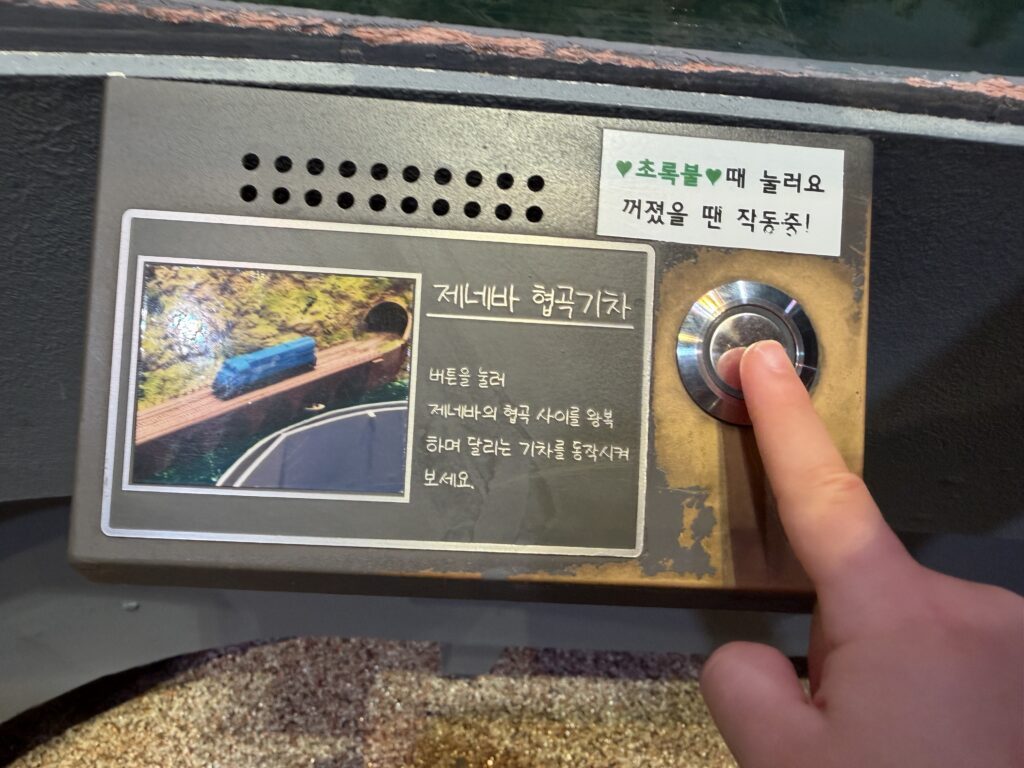
Just as the chariot race turned out to be the biggest hit in the Italy Hall, the Swiss Hall’s most beloved feature — at least in my household — was entirely hands-on. Scattered around the edges of the diorama are push-buttons, each one tied to a specific train or piece of the display. Press one and a train that was sitting idle suddenly springs to life, rattling off along its route. One button I remember clearly was labeled the “Geneva canyon train,” which sends a small blue train running back and forth across a dramatic canyon, ducking between the cliffs and over a bridge. The little sign posted beside it is wonderfully practical and even a bit charming: “Press when the light is green — it’s already running when the light is off!” It’s a simple instruction, but it does a great job of managing kids’ expectations so they don’t just hammer the button in frustration.
What I appreciated, as someone who’s read a fair bit about Swiss railways, is that these interactive trains quietly teach children something true about Switzerland: this is a country practically defined by its trains. Switzerland runs one of the densest and most punctual rail networks in the world, and its mountain lines — the cog railways that grind up impossibly steep slopes, the panoramic routes like the Glacier Express that link Zermatt and St. Moritz — are engineering achievements in their own right. When my daughters pressed a button and watched a train climb toward a peak, they were, without knowing it, reenacting exactly the kind of mountain railway that made Swiss tourism famous in the first place.
My two daughters cracked the green-light rule within about five seconds and immediately turned it into a mission, going from button to button to see how many trains they could set in motion, pointing and cheering each time a train lurched forward. There’s something genuinely engaging about being handed a small piece of control over such an elaborate display — it transforms the whole experience from passive viewing into active, gleeful play. This is the single biggest reason I’d recommend the Swiss Hall for families with young children. If you simply walk them past the diorama, you might get five minutes of mild interest before they start asking to leave. But hand them the buttons and let them work out which one does what, and you can easily lose half an hour to pure, uncomplicated fun. For a parent, watching that kind of absorbed joy is honestly worth the price of admission on its own.
Beyond the Mountains — Villages, Cities, and Quiet Night Scenes
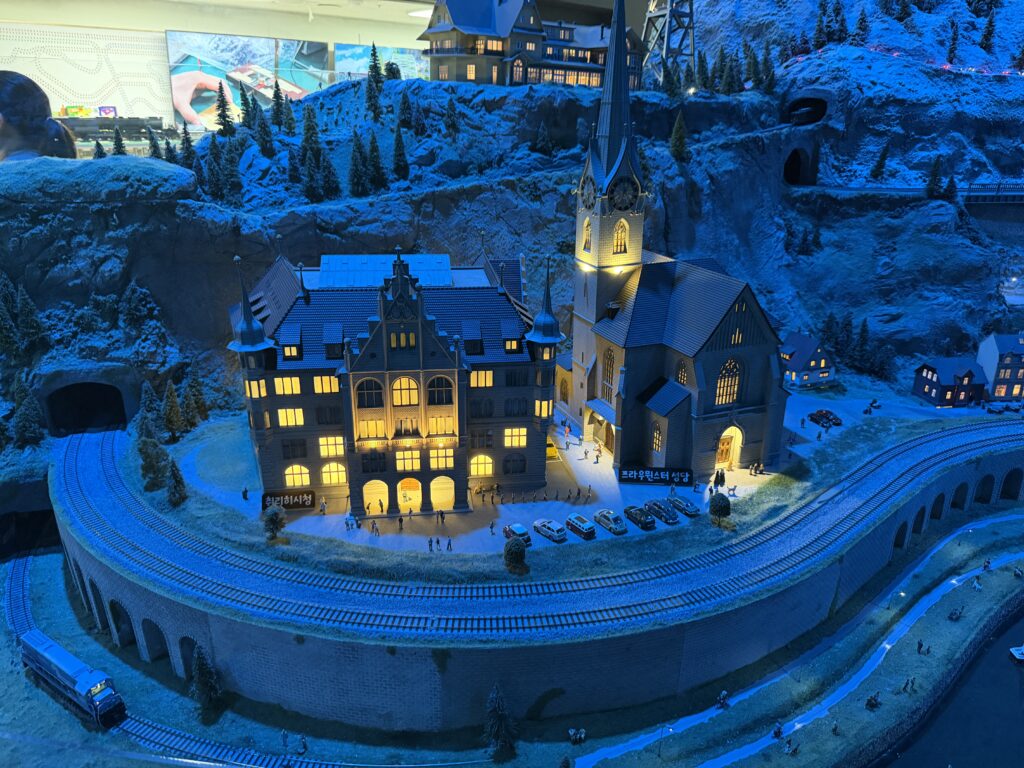
While the towering Matterhorn and the interactive trains are what most visitors remember first, the Swiss Hall has a quieter, more atmospheric side that’s easy to overlook if you’re moving too quickly. As you make your way through the space, several sections gradually shift into nighttime lighting, and this is where the exhibit reveals some of its most beautiful moments. A small Swiss village glows warmly in the simulated dark, the windows of its town hall and its church lit softly from within, while a train curves along an elevated stone track running right beside the settlement. The whole scene feels genuinely peaceful — the kind of thing you’d expect to see on a postcard of an alpine town after dusk.
The attention to architectural accuracy here is worth pausing on. Swiss towns have a very particular look — the tall, narrow clock towers on their churches, the solid stone civic buildings, the tight clusters of chalets with deep eaves built to shed heavy mountain snow — and the model makers have clearly studied it. These aren’t generic “European” buildings; they read specifically as Swiss, which is exactly the sort of detail that rewards a visitor who slows down to look. There’s a real craft to the way the lighting has been designed, too: it’s not just a matter of dimming the room, but of illuminating individual buildings from the inside so that each little house, chapel, and station feels genuinely inhabited.
These night scenes are, in my opinion, among the most photogenic parts of the entire attraction, and they’re well worth pausing for. For adults, this is where the Swiss Hall stops being simply a children’s activity and becomes something closer to an art installation. I found myself lingering here well after my daughters had already run ahead to find the next button to press, just taking in the warm, miniature glow of a village that doesn’t exist anywhere but feels somehow familiar.
Final Thoughts
The Swiss Hall at Nowon Train Village succeeds because it works on two completely different levels at the same time, and it does both of them well. For children, it’s an interactive playground where a single press of a button sends trains racing through mountains and canyons, rewarding curiosity with instant, satisfying motion. For adults — especially anyone with an interest in trains or in Switzerland itself — it’s a lovingly detailed miniature world that repays a slow, careful look, from the dramatic sweep of the Matterhorn’s peak to the viaducts that echo real Swiss railway landmarks and the gentle, glowing calm of a night-lit village tucked into the hillside. Paired with the Italy Hall on the very same ticket, it adds up to an easy, weatherproof outing that genuinely holds a whole family’s attention for a couple of hours, which is no small feat. If you’re searching for somewhere in Seoul to take young children on a weekend — somewhere that entertains them without exhausting you — the Swiss Hall is an easy one to recommend.
More Family Days Out in Seoul
Planning the rest of your visit? Don’t miss the Italy Hall at Nowon Train Village, included on the same ticket, and read our full guide to Hwarangdae Railroad Park for everything to do in the surrounding park.