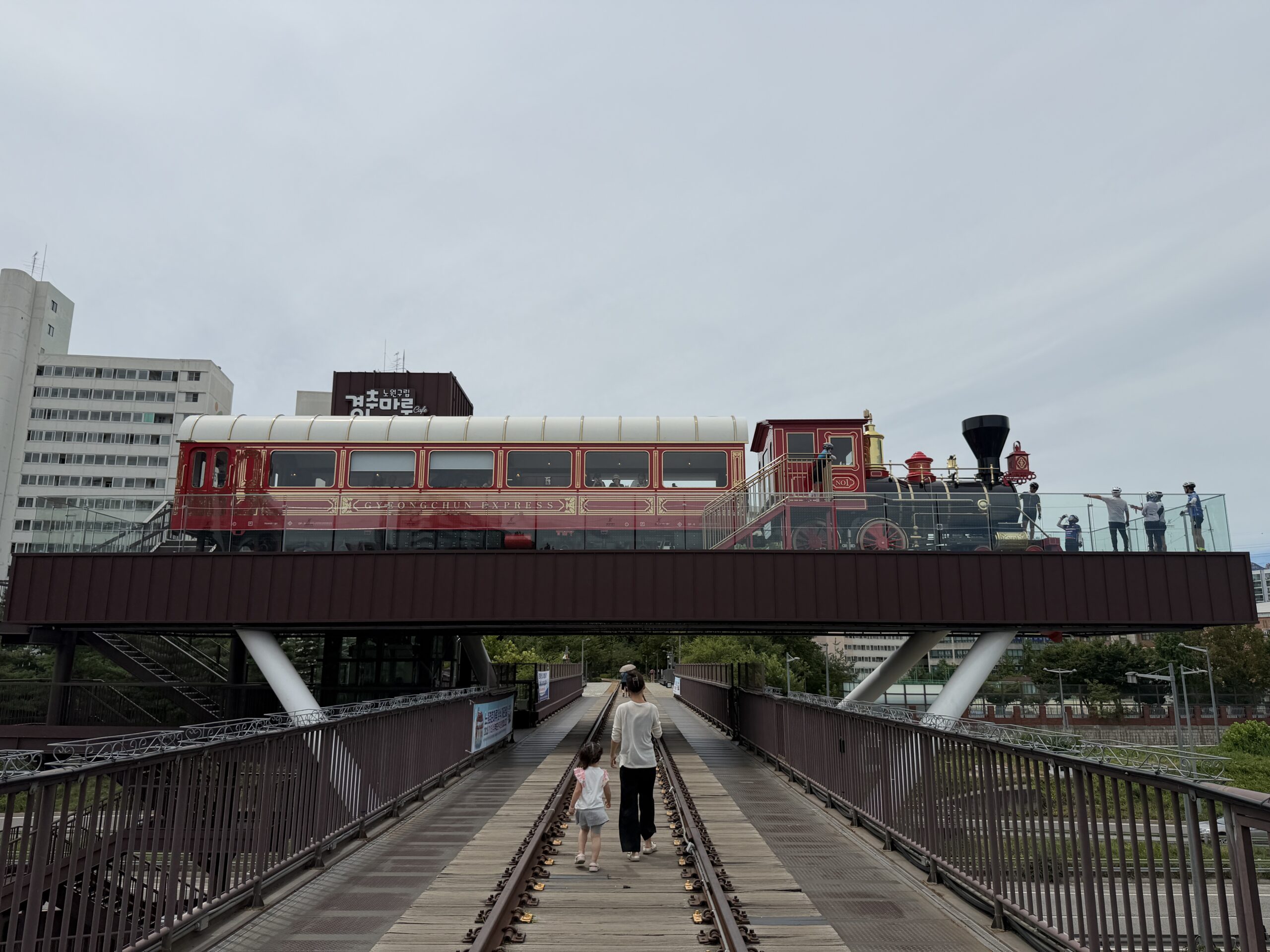
The Gyeongchun Line Forest Trail is a 6.8 kilometres in northern Seoul, built on a railway line that no longer runs. The trains once headed out of the city toward Chuncheon; when the line was rerouted, the corridor through Nowon was rebuilt as a walking trail instead of being redeveloped. The reason most people come, though, is what sits halfway along it — a café shaped like a steam locomotive, standing on the old railway bridge above Jungnang Stream.
| Item | Details |
|---|---|
| What it is | Linear park on a disused railway line |
| Admission | Free (café purchases separate) |
| Stroller | Flat and paved throughout; elevator to the bridge |
| Highlight | Gyeongchun Maru — café on the old railway bridge |
| Where | Nowon-gu, northern Seoul, along Jungnang Stream |
The Gyeongchun Line Forest Trail: an old railway that became a park
Seoul has a habit worth admiring: when infrastructure stops being useful, the city often turns it into something else rather than erasing it.
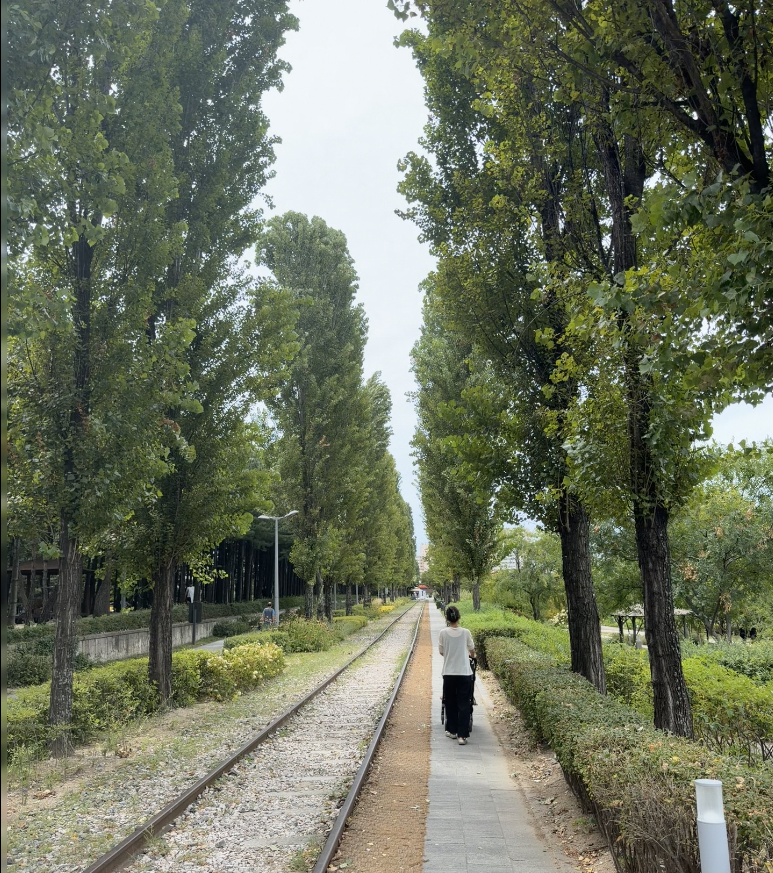
That history is why this feels different from a newly built park. Sections of preserved rail and old markers are still set into the ground, and the path runs in the long, straight, gently curving shape that only a rail bed produces. It has a form it didn’t choose. You’re walking the route the trains took.
The trail passes through ordinary residential neighbourhoods rather than a tourist district, which is part of the appeal — this is a park built for the people who live around it.
You don’t need to walk all 6.8 kilometres
The trail now runs 6.8 kilometres. It was extended in June 2026 — an extra 870 metres linking Gwangwoon University Station to the western approach of the Gyeongchun railway bridge — and the full length reopened on 29 June. It runs from there down toward the old Hwarangdae Station, but treating it as a route to complete is the wrong approach, especially with children. Pick a section, walk it slowly, turn around when someone gets tired.
The walking itself is genuinely easy, and that matters more than guidebooks admit. Because the path follows an old rail bed, it is flat the entire way. Many of Seoul’s best viewpoints come with a hill attached, and by the time you reach the top with a stroller, half the family has stopped enjoying it. There’s none of that here. The path is wide, paved, and shaded in the stretches where trees have grown in on both sides.
Signposts along the route make it hard to lose the line, so you always know you’re still following the old track.
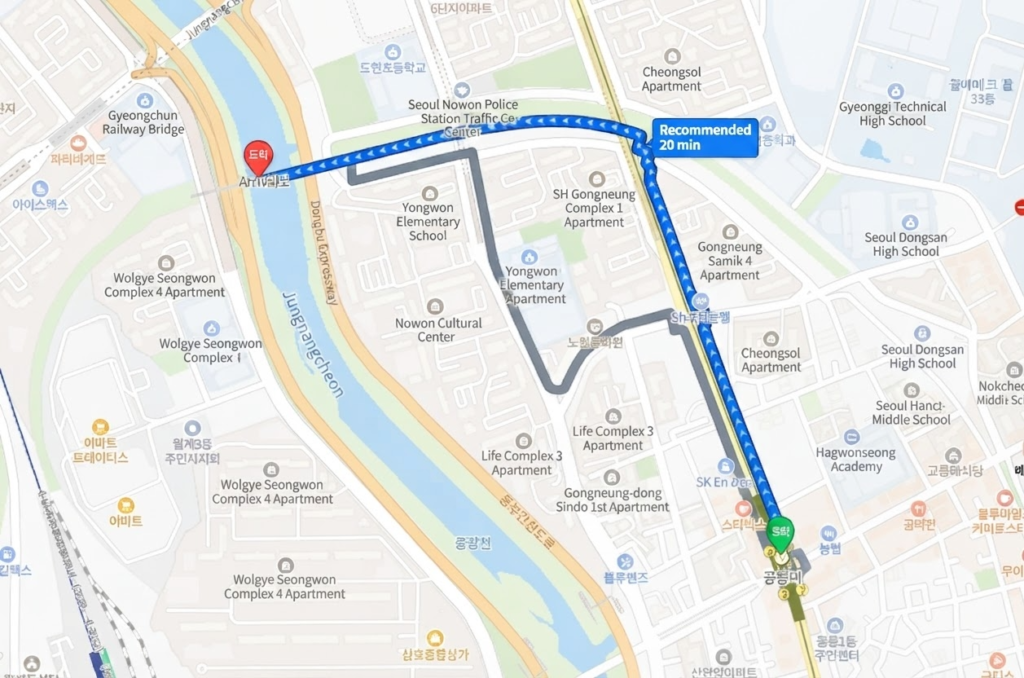
Getting There
There are two ways to reach Gyeongchun Maru, and which one you pick depends on what kind of afternoon you want.
The fastest route is Wolgye Station. Come out of Exit 2 and it’s a short, straightforward walk to the bridge — this is the one to choose if you’re short on time or just here for the café and the view.
But if you have the time, I’d actually recommend getting off at Gongneung Station instead. It takes a bit longer on foot, but it lets you walk the Gyeongchun Line trail properly on your way in, following the old rail corridor past Gyeongchun Forest Park before you reach the bridge. For us, that slower approach was the whole point — you arrive having already enjoyed the walk, rather than treating the bridge as the only stop. If you’re bringing kids or you like your outings unhurried, Gongneung is the way to go.
Gyeongchun Maru: the train café on the bridge
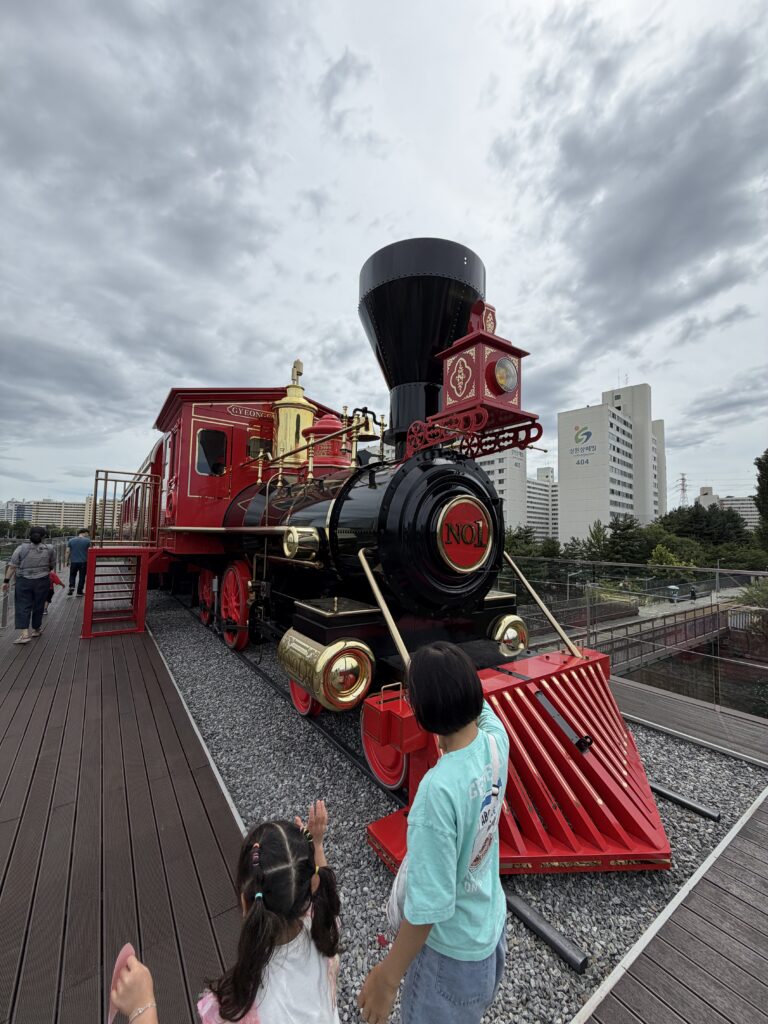
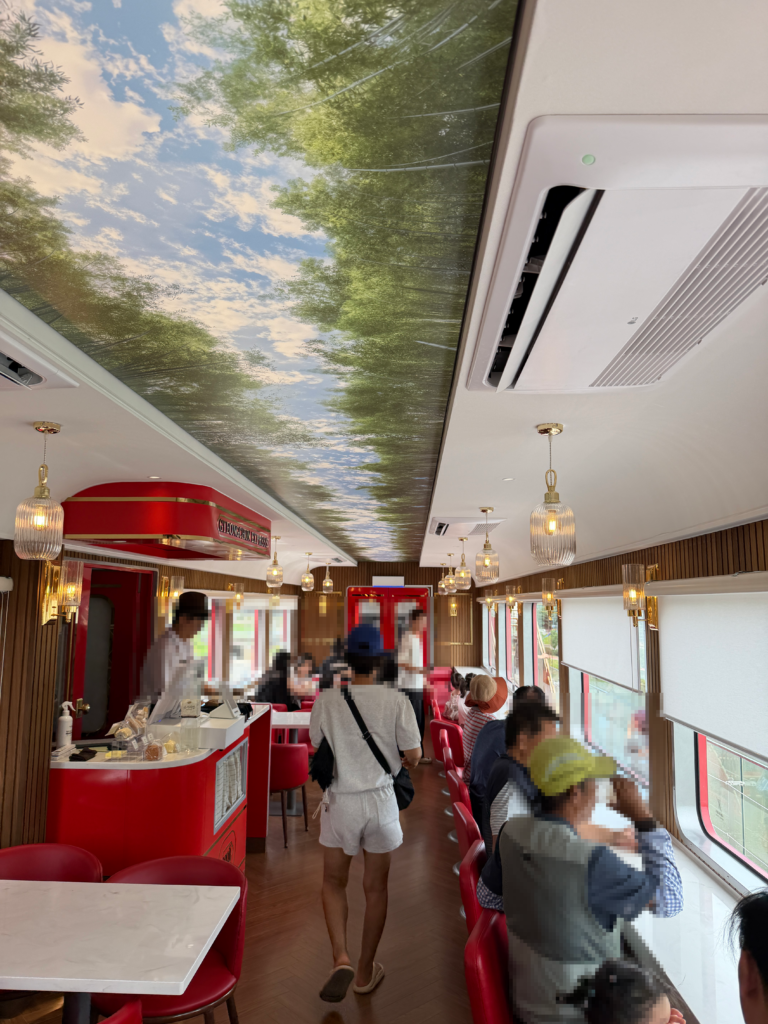
Where the old railway crossed Jungnang Stream, the structure has been reused — and a café now sits on top of it, built as a steam locomotive, dark and unmistakable against the sky above the water. You reach it by a glass elevator from trail level, which is a small thing that children find far more exciting than it has any right to be.
The transition is the appeal. One moment you’re on a tree-lined path at ground level; a minute later you’re standing on a railway bridge above a stream with the whole northern skyline open in front of you. It’s an unusually sharp change of scene for a walk that started so gently.
The café works as a natural halfway stop rather than a destination bolted onto a view. You can sit, rest, and then step back out onto the bridge deck.
The view from the old bridge deck
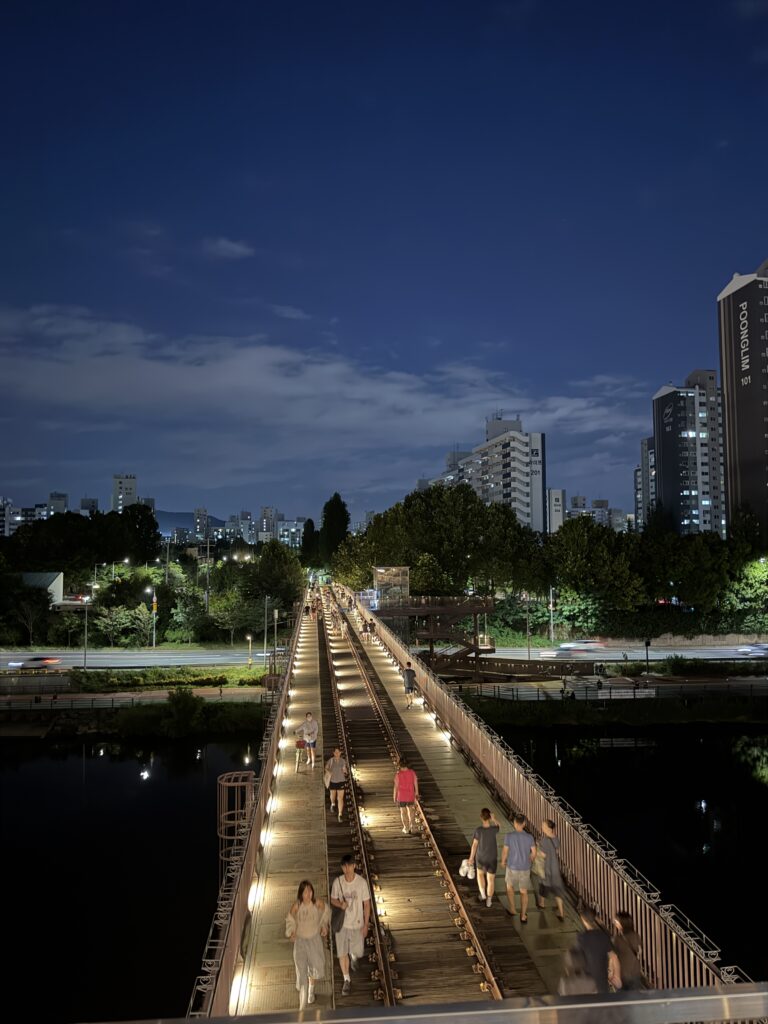
The bridge deck has been rebuilt as a wide walkway, and people don’t hurry across it. They stop, lean on the railing, and look.
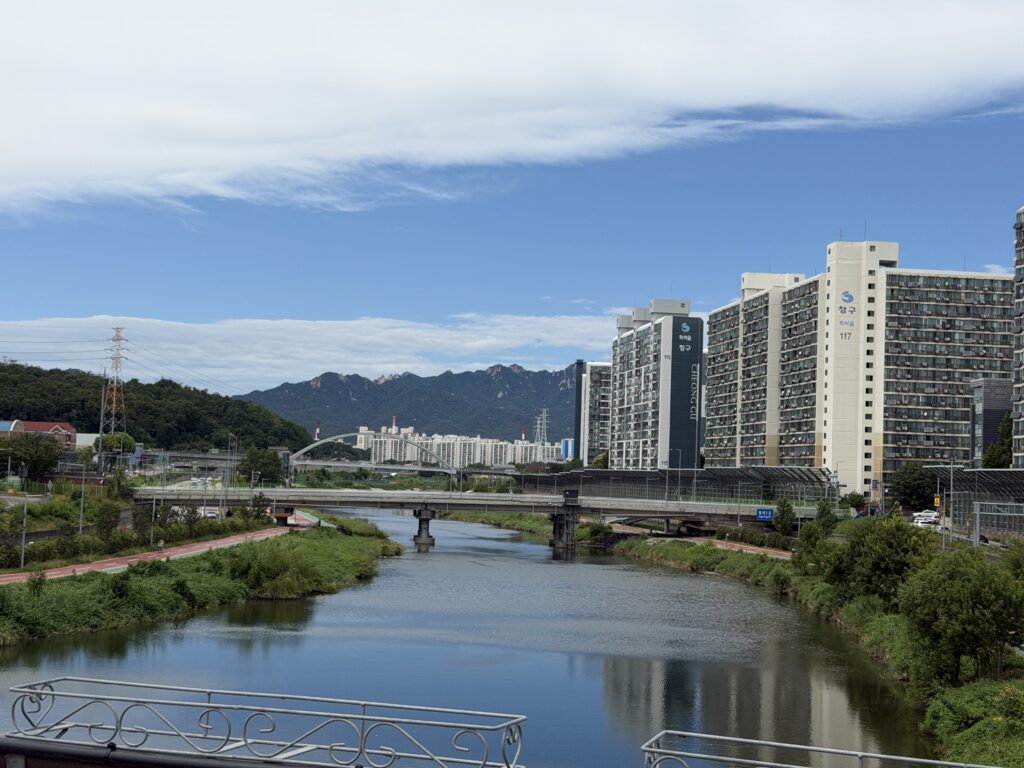
Below is Jungnang Stream. Beyond the rooftops, mountain ridges fill the horizon — this is the part of Seoul most visitors never see, where the city ends in actual mountains rather than another wall of towers. Northern Seoul has a completely different geography from the districts tourists usually stay in, and the bridge is a good place to notice it.
It’s also free, unqueued, and open. That combination is rare for a view of this kind anywhere in the city.
The music fountain we still haven’t seen
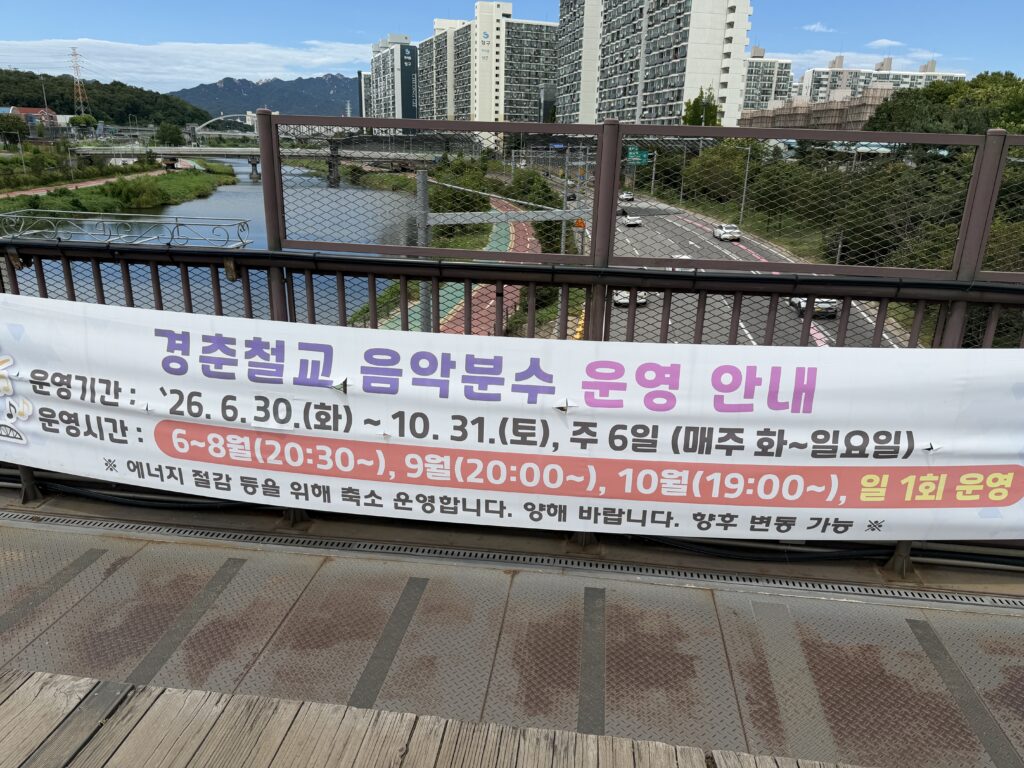
There’s a music fountain on the Gyeongchun railway bridge that runs on a seasonal evening schedule, and the details are posted on a banner right on the bridge.
We haven’t seen it. Twice. The first time was our own fault — we’d come out for an early dinner, so we walked the trail and the bridge in the afternoon and left long before the evening show. A week later we went back specifically for the fountain, timed the arrival properly, and waited on the bridge as it got dark. Nothing happened. It was out of order that night. There was no notice online and no way to know in advance; we found out by standing there.
So I still can’t tell you what it’s like firsthand. What I can pass on is the schedule, and the fact that showing up at the right time is not the same as seeing it.
The 2026 season runs from 30 June to 31 October, Tuesday through Sunday. There is one show per day, lasting about twenty minutes, and the start time moves with the sunset: around 20:30 through August, 20:00 in September, and 19:00 in October. It closes on Mondays and it does not run in the rain. That last point matters more than it sounds — a wet evening means no show at all, with no announcement.
The practical lesson from our second attempt: treat the fountain as a bonus, not the reason for the trip. If it runs, you’ve had a good evening. If it doesn’t, you’re still standing on a lit railway bridge over a stream with the mountains behind the city — which is what we ended up with, twice, and it was worth the walk both times.
Practical notes
Admission to the trail is free, which makes it easy to add to any afternoon in northern Seoul. The path is flat and paved, so strollers are genuinely fine, and the elevator means the bridge is accessible too.
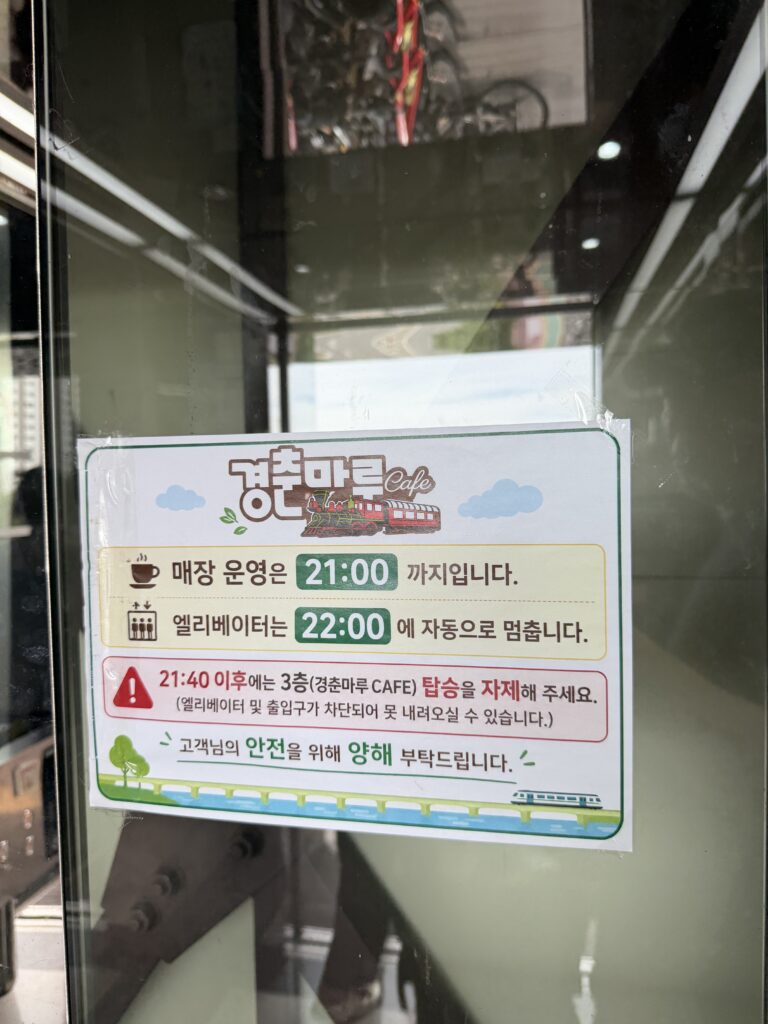
The café on the bridge, Nowon Gyeongchun Maru, opens 09:00 to 21:00 from March through November, and 10:00 to 19:00 in December, January and February. It closes every Tuesday, plus May Day and the main holidays. Note the mismatch that catches people out: the café is closed on Tuesdays, but the music fountain below is closed on Mondays. There is no single day when both are guaranteed, so pick which one matters more to you. There’s also a detail in the posted notice worth knowing: the glass elevator shuts down automatically at 22:00, and after 21:40 you’re asked not to go up to the third-floor café, because the elevator and exits can be closed off and you may not be able to get back down. Don’t cut it too fine in the evening.
There are benches at intervals along the trail. Because the corridor runs alongside Jungnang Stream, you can drop down to the water for a longer walk if everyone still has energy.
There are public toilets roughly midway, on the stretch between Gyeongchun Forest Park and Gyeongchun Maru — worth knowing before you set off with children, because the sections either side of it have none. Convenience stores sit just outside the corridor at the road crossings rather than on the trail itself, so buy water before you enter. In the hottest weeks the district runs two “healing fridges” handing out free bottled water at rest stops along the trail, one at the former Singongdeok Station site and one at the Gyeongchun Falls shelter, alongside its shaded rest areas and cooling shelters. We were given a bottle each on our first visit, in the afternoon. When we came back in the evening a week later, nobody was handing out water — so treat it as a bonus rather than a substitute for bringing your own.
Hours and schedules change seasonally. For current opening hours, closures and the fountain schedule, the Seoul city guide to the Gyeongchun Line Forest Trail lists all three in one place.
Make it a railway afternoon
This spot works best combined with two others nearby. Hwarangdae Railroad Park and Nowon Train Village are close enough to visit the same day, and together they make an easy old-railway theme for a half-day in the north of the city.
For children who are into trains, following them from one site to the next gives the afternoon a thread — which, in my experience, is the difference between a walk they tolerate and one they remember.
Frequently asked questions
Is the Gyeongchun Line Forest Trail free?
Yes. The trail and the bridge walkway are free to enter. Only café purchases cost anything.
Can you take a stroller?
Yes. The path follows an old rail bed, so it’s flat and paved, and a glass elevator reaches the bridge level.
How long does it take?
The full trail is 6.8 kilometres, but almost nobody walks all of it. From Wolgye Station it is roughly a 10-minute walk to Gyeongchun Maru; from Gongneung Station it is about 20 minutes, following the old rail corridor the whole way. We took the longer approach from Gongneung and it was the better half of the afternoon. Allow around two hours in total for the walk, the bridge and a stop at the café.
Is the café actually on the bridge?
Yes — it sits on the old railway bridge over Jungnang Stream, reached by elevator from the trail.
Does the music fountain always run?
No. The 2026 season is 30 June to 31 October, Tuesday to Sunday, one twenty-minute show a day. It closes on Mondays and in the rain, and we turned up at the right time on a clear evening only to find it out of order with no advance notice. Plan the evening around the bridge itself and treat the fountain as a bonus.